YOUR CLEP STUDY COMPANION
CLEP U.S. History I 106: Reconstruction Amendments
Lesson 19.4 of Chapter 19 of the U.S. History to 1877 study guide on Effortless Math covers CLEP U.S. History I 106: Reconstruction Amendments: the key terms, the core ideas, and worked examples showing how this topic is tested on the exam.
Lesson 19.4 of Chapter 19 of the U.S. History to 1877 study guide on Effortless Math covers CLEP U.S. History I 106: Reconstruction Amendments: the key terms, the core ideas, and worked examples showing how this topic is tested on the exam.
U.S. History to 1877 | Chapter 19 | Lesson 19.4
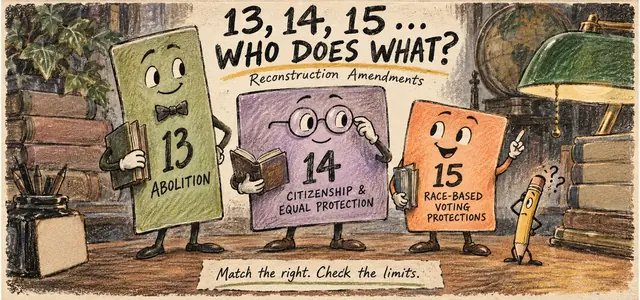
The Thirteenth Amendment abolished slavery and involuntary servitude except as punishment after conviction and granted Congress enforcement power. The Fourteenth established birthright national citizenship, prohibited states from abridging privileges or immunities of U.S. citizens, and required due process and equal protection. The Fifteenth prohibited federal and state denial of voting rights on account of race, color, or previous condition of servitude.
Each amendment had limits. The Thirteenth’s punishment exception became entangled with convict labor. The Fourteenth’s broad language required enforcement and interpretation. The Fifteenth did not prohibit poll taxes, literacy tests, sex discrimination, or every apparently race-neutral device. Enforcement clauses mattered because rights written on paper needed legislation and institutions.
The amendments also allocate responsibility differently. The Fourteenth begins “No State shall,” making state action central to its first section. The Fifteenth prohibits denial by either the United States or any state on the named racial grounds. Each gives Congress enforcement power. A strong answer therefore identifies both the protected right and the actor or mechanism the text reaches instead of treating all three amendments as interchangeable statements of equality.
See the history take shape
Use this lesson from APUSH Simplified to review the period and its central historical problem. Pause when the video reaches the turning point named above.
Video: Reconstruction Amendments Explained, APUSH Simplified.
Check your understanding
- Birthright citizenship appears in the
- Thirteenth Amendment’s abolition clause.
- Fifteenth Amendment’s voting-rights clause.
- Twelfth Amendment’s electoral procedure.
- Tenth Amendment’s reserved-powers provision.
- Fourteenth Amendment’s citizenship clause.
- Which amendment prohibited race-based voting denial?
- Thirteenth.
- Fourteenth alone.
- Fifteenth.
- First.
- Fifth.
- Select all Fourteenth Amendment guarantees:
- citizenship,
- due process,
- equal protection,
- privileges or immunities,
- women’s suffrage.
- Identify one limit of the Fifteenth Amendment’s text.
Write a brief response using a named fact from the lesson.
Open the answers and reasoning
Independent preparation. CLEP is a registered trademark of the College Board, which does not endorse this lesson.

Related to This Article
More math articles
- Free Grade 6 English Worksheets for New Jersey Students
- Overview of the CLEP College Mathematics Test
- Response bias
- The Ultimate 7th Grade WVGSA Math Course (+FREE Worksheets)
- 10 Most Common 7th Grade SBAC Math Questions
- Free Grade 6 English Worksheets for Washington, D.C. Students
- Reproductive rights
- 10 Most Common 5th Grade ACT Aspire Math Questions
- How to Find Domain and Range of a Function?
- How to Find the Perimeter of Right-Angled Triangle?













What people say about "The Reconstruction Amendments Explained"?
No one replied yet.