YOUR CLEP STUDY COMPANION
CLEP U.S. History I 107: Reconstruction Governments and Black Political Participation
Lesson 19.5 of Chapter 19 of the U.S. History to 1877 study guide on Effortless Math covers CLEP U.S. History I 107: Reconstruction Governments and Black Political Participation: the key terms, the core ideas, and worked examples showing how this topic is…
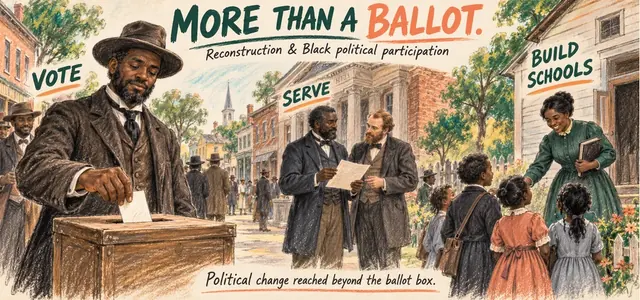
Lesson 19.5 of Chapter 19 of the U.S. History to 1877 study guide on Effortless Math covers CLEP U.S. History I 107: Reconstruction Governments and Black Political Participation: the key terms, the core ideas, and worked examples showing how this topic is tested on the exam.
U.S. History to 1877 | Chapter 19 | Lesson 19.5
With Black male suffrage and new state constitutions, southern politics changed. Black voters formed a major Republican constituency, served in conventions, legislatures, local offices, Congress, and the U.S. Senate. Hiram Revels and Blanche K. Bruce represented Mississippi in the Senate. Officeholders supported public schools, civil-rights measures, infrastructure, and state services.
Reconstruction coalitions included freedpeople, northern migrants labeled carpetbaggers, and white southern Republicans labeled scalawags. Those hostile labels can conceal varied motives. Governments faced corruption, but corruption was not unique to Reconstruction, and the claim that Black rule caused governmental failure was central to white supremacist propaganda. Most officeholders were white, even where Black voters were essential.
Participation operated at several levels. Voters selected delegates and officials. Conventions rewrote state constitutions. Legislators built statewide school systems and public institutions. Local officeholders administered courts and counties. Members of Congress claimed national authority. Measuring only the number of Black senators understates political change, while describing every government as “Black rule” overstates Black control and repeats an opposition slogan.
Watch, then test the claim
Black History in Two Minutes or so offers a visual route through this topic. As you watch, compare its explanation with the source limits in the written lesson.
Video: Reconstruction: The Vote | Black History in Two Minutes (or so), Black History in Two Minutes or so.
Check your understanding
- Reconstruction governments most expanded
- state support for private planter schools only.
- public education and political participation.
- voting restricted to prewar electorates.
- local government controlled exclusively by federal officers.
- officeholding reserved for northern migrants.
- Hiram Revels and Blanche K. Bruce served as
- Black members of the U.S. House from South Carolina.
- Reconstruction governors of Mississippi.
- Freedmen’s Bureau commissioners for the Deep South.
- U.S. senators from Mississippi.
- delegates who never held national office.
- Select all parts of Republican coalitions:
- freedpeople,
- white southern Republicans,
- northern migrants,
- Black officeholders,
- every former Confederate leader.
- Explain why hostile political cartoons are evidence of opposition rather than direct proof of government performance.
Write a brief response using a named fact from the lesson.
Open the answers and reasoning
Independent preparation. CLEP is a registered trademark of the College Board, which does not endorse this lesson.

Related to This Article
More math articles
- Work, Pay, and Occupational Segregation
- The Best Grade 4 ELA Practice Tests for Maryland Students
- The Ultimate 6th Grade SBAC Math Course (+FREE Worksheets)
- The Best Grade 7 Math Book for New Mexico Students
- 5th Grade ILEARN Math Worksheets: FREE & Printable
- Unlocking the Potential of Algebra 1: A Comprehensive Guide for Teachers
- How to Pass the Praxis Core Math Test (2026 Guide)
- How Is the SHSAT Test Scored?
- STAAR Math 2026: A Texas Parent’s Complete Survival Guide (Grades 3–8)
- How to Simplify Ratios? (+FREE Worksheet!)






What people say about "Reconstruction Governments and Black Politics"?
No one replied yet.