Grade 6 Math: Subtracting Fractions with Unlike Denominators
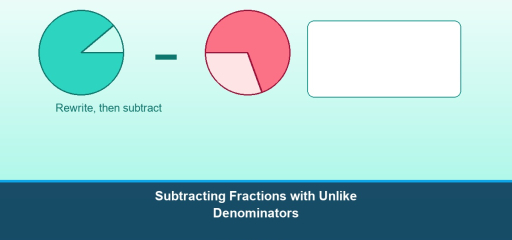
TL;DR: Subtraction works just like addition once the denominators match. If they don’t, find the least common denominator, rewrite both fractions to use it, then subtract the numerators and keep the bottom the same. Simplify the result if you can. The whole game is making the pieces the same size before you take anything away, once they match, you are just counting how many of those equal pieces are left. Same toolkit as addition, with a minus sign.
Key takeaways:
- Different denominators mean different-size pieces – you can’t subtract until they match.
- Find the least common denominator (LCD), then rewrite both fractions.
- Subtract the numerators; keep the common denominator.
- Simplify the result by dividing top and bottom by any common factor.
- Example: \(\dfrac{5}{6} – \dfrac{1}{4} = \dfrac{10}{12} – \dfrac{3}{12} = \dfrac{7}{12}\).
Grade 6 focus: Subtracting fractions with unlike denominators uses the same rewriting process as addition: find a common denominator (preferably the LCD), rewrite each fraction, then subtract the numerators.
Video lesson: Watch this Khan Academy tutorial for a clear walk-through.
Method
- Find the LCD of the denominators.
- Rewrite each fraction as an equivalent fraction with that denominator.
- Subtract the numerators; keep the denominator.
- Simplify the result if needed.
Pre-Algebra for Beginners 2026 The Ultimate Step by Step Guide to Preparing for the Pre-Algebra Test
Worked example
Compute \(\frac{7}{10} – \frac{1}{4}\).
\(\mathrm{LCM}(10,4)=20\). Then \(\frac{7}{10} = \frac{14}{20}\) and \(\frac{1}{4} = \frac{5}{20}\). Difference: \(\frac{14}{20} – \frac{5}{20} = \frac{9}{20}\).
Borrowing from the whole
When the first numerator is too small (in mixed-number form), you may need to regroup, borrow \(1\) whole from the integer part and rewrite it as a fraction with the same denominator. That skill pairs directly with this lesson.
Common mistakes
- Subtracting numerators before making denominators match.
- Using an incorrect equivalent fraction when scaling.
- Leaving a negative intermediate step unaddressed when working with mixed numbers.
Fluency check
Try \(\frac{5}{6} – \frac{3}{8}\). LCD \(= 24\): \(\frac{20}{24} – \frac{9}{24} = \frac{11}{24}\).
Recommended EffortlessMath Books
For a workbook that pairs with this page, Mastering Grade 6 Math walks your sixth grader through every grade-6 topic with worked examples and plenty of practice. For more story-problem reps, Mastering Grade 6 Math Word Problems is the matching word-problem book.
Frequently Asked Questions
Why do I need a common denominator to subtract fractions?
Because the denominator tells you the size of each piece. \(\dfrac{1}{4}\) and \(\dfrac{1}{6}\) are different-size pieces – you can’t subtract them until you cut both into the same size. Rewriting both with the LCD gives equal-size pieces you can count up and down.
What’s the LCD?
The least common denominator – the smallest number both denominators divide into evenly. For \(\dfrac{1}{3}\) and \(\dfrac{1}{5}\), the LCD is 15 because \(15 \div 3 = 5\) and \(15 \div 5 = 3\). When denominators share no common factor, the LCD is just their product.
How do I subtract a smaller fraction from a bigger one?
Find the LCD, rewrite both, subtract the numerators, keep the denominator. \(\dfrac{3}{4} – \dfrac{1}{6}\): LCD is 12, so \(\dfrac{9}{12} – \dfrac{2}{12} = \dfrac{7}{12}\). The answer is the difference of the new numerators over the common denominator.
What if I try to subtract a bigger fraction from a smaller one?
You’ll get a negative answer. \(\dfrac{1}{6} – \dfrac{3}{4} = \dfrac{2}{12} – \dfrac{9}{12} = -\dfrac{7}{12}\). Grade 6 introduces negative numbers, so negative fraction answers are valid. If the question wants a positive answer, double-check that you subtracted in the right order.
Can I subtract mixed numbers the same way?
Two paths. (1) Subtract whole parts and fraction parts separately – sometimes you need to borrow from the whole part. (2) Convert to improper fractions first: \(3\dfrac{1}{4} – 1\dfrac{1}{6} = \dfrac{13}{4} – \dfrac{7}{6} = \dfrac{39}{12} – \dfrac{14}{12} = \dfrac{25}{12} = 2\dfrac{1}{12}\). The improper-fraction method avoids borrowing.
Walk me through an example.
Subtract \(\dfrac{7}{10} – \dfrac{2}{5}\). The denominators are 10 and 5. The LCD is 10 (since \(10 \div 5 = 2\) and \(10 \div 10 = 1\)). Rewrite: \(\dfrac{7}{10}\) stays the same; \(\dfrac{2}{5} = \dfrac{4}{10}\). Subtract: \(\dfrac{7}{10} – \dfrac{4}{10} = \dfrac{3}{10}\). Already in lowest terms.
What if one denominator divides the other?
The LCD is just the larger one. \(\dfrac{5}{8} – \dfrac{1}{2}\): the LCD is 8. Rewrite \(\dfrac{1}{2} = \dfrac{4}{8}\). Subtract: \(\dfrac{5}{8} – \dfrac{4}{8} = \dfrac{1}{8}\). Easiest case – no big multiplication needed.
How do I check my subtraction?
Add the answer back to the smaller fraction and you should get the bigger one. \(\dfrac{7}{12} + \dfrac{3}{12} = \dfrac{10}{12}\) ✓ (which matches your rewritten version of \(\dfrac{5}{6}\)). Or convert everything to decimals as a sanity check.
Where does this skill show up later?
Pre-algebra and algebra both lean on fraction subtraction – solving equations like \(\dfrac{x}{3} – \dfrac{x}{4} = 2\) needs it. So do geometry word problems (“a stick is \(\dfrac{3}{4}\) foot long; you cut off \(\dfrac{1}{6}\) foot. How much is left?”). SAT, ACT, and most state tests include this skill on every grade-7+ exam.
What’s the most common mistake?
Subtracting the denominators instead of keeping them. \(\dfrac{5}{6} – \dfrac{1}{4}\) is NOT \(\dfrac{4}{2} = 2\). Once both fractions have the same denominator, you only subtract the tops. Keep the bottom unchanged. If your answer for two close positive fractions is huge, you probably made this mistake.
Related EffortlessMath Lessons
If a topic on this page feels rusty, these short lessons go deeper:

Related to This Article
More math articles
- Area and Perimeter of Any Shape: Complete Formula Guide
- Hoover, the RFC, and the Bonus Army
- Proportional Predictions: How to Use Proportions to Estimate Population Size
- Top 10 Tips to Overcome HiSET Math Anxiety
- Volume Practice — Prisms & Cubes (Free Drills)
- Republican Governance, Tax Policy, and Normalcy
- 10 Most Common 8th Grade ACT Aspire Math Questions
- Biodiversity Made Simple: Richness and Evenness
- Wisconsin FORWARD Grade 8 Math Free Worksheets: Free Printable PDFs Covering Every Grade 8 Skill
- Distance & Midpoint Calculator (Free, with Graph)
What people say about "Grade 6 Math: Subtracting Fractions with Unlike Denominators"?
No one replied yet.