How to Find GCF and LCM: Methods, Examples, and Word Problems for 2026
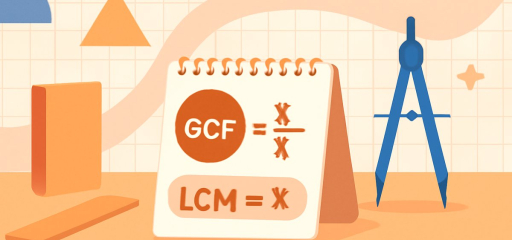
GCF and LCM look small on the standards list, but they show up everywhere: simplifying fractions, adding fractions, factoring, scheduling problems, and even unit conversion. Most students learn one method, use it for everything, and then trip when the numbers get larger. The fix is having three reliable methods and knowing when each shines.
This guide explains every method, walks through real examples, gives you a side-by-side cheat sheet, and ends with word problems you can use to drill until both ideas are automatic.
What GCF and LCM Actually Mean
- GCF (Greatest Common Factor) is the biggest number that divides into two or more numbers cleanly. GCF of 12 and 18 is 6.
- LCM (Least Common Multiple) is the smallest number that two or more numbers both divide into. LCM of 4 and 6 is 12.
Memory trick: GCF is bigger than the numbers’ shared building blocks; LCM is the smallest place all the numbers meet.
Three Reliable Methods
You should know all three. Each one is fastest in a different situation.

Method 1: Listing Factors and Multiples
Best for small numbers (each under 30).
To find GCF of 18 and 24: – Factors of 18: 1, 2, 3, 6, 9, 18. – Factors of 24: 1, 2, 3, 4, 6, 8, 12, 24. – Largest common factor: 6.
To find LCM of 4 and 6: – Multiples of 4: 4, 8, 12, 16, 20, 24, … – Multiples of 6: 6, 12, 18, 24, … – Smallest common multiple: 12.
Easy and visual, but slow once numbers get bigger.
Method 2: Prime Factorization
Best for medium and large numbers.
Find GCF and LCM of 60 and 84.
Prime factor each: – 60 = 2² × 3 × 5 – 84 = 2² × 3 × 7
GCF: take the lowest power of every shared prime. – Shared: 2² and 3. – GCF = 2² × 3 = 12.
LCM: take the highest power of every prime that appears in either number. – Primes: 2², 3, 5, 7. – LCM = 2² × 3 × 5 × 7 = 420.
Two slogans: – GCF uses the lowest powers of shared primes. – LCM uses the highest powers of all primes that appear.
Method 3: The Ladder (Upside-Down Division)
Best for finding GCF and LCM at the same time.
Find GCF and LCM of 36 and 48 with the ladder.
2 | 36 48 2 | 18 24 3 | 9 12 | 3 4
Divide both numbers by a common prime until they share no more. The numbers stacked on the left are the GCF. Multiply the GCF by the leftovers at the bottom to get the LCM.
- GCF = 2 × 2 × 3 = 12.
- LCM = 12 × 3 × 4 = 144.
The ladder is faster than prime factorization once you have practiced it, especially for three numbers at once.
GCF and LCM for Three or More Numbers
The methods scale, but watch the order.
Find GCF and LCM of 12, 18, and 30.
Prime factorize: – 12 = 2² × 3 – 18 = 2 × 3² – 30 = 2 × 3 × 5
GCF (lowest power of shared primes): 2 and 3 are shared. Lowest power of 2 is 2¹; lowest power of 3 is 3¹. – GCF = 2 × 3 = 6.
LCM (highest power of every prime that appears): 2², 3², 5. – LCM = 4 × 9 × 5 = 180.
The ladder works too. Divide all three by a common prime until no prime divides all three.
The Useful Identity: GCF × LCM = Product
For any two positive integers a and b:
GCF(a, b) × LCM(a, b) = a × b.
Example: a = 12, b = 18. – GCF × LCM = 6 × 36 = 216. – a × b = 216. Check.
This identity is gold on quick problems. If you know GCF, multiply by a × b and divide to get LCM. Note: it only works for exactly two numbers.
GCF in Fractions
GCF is the tool you use to simplify fractions.
Simplify 36/48. – GCF of 36 and 48 is 12. – 36 ÷ 12 = 3; 48 ÷ 12 = 4. – 36/48 = 3/4.
If you ever cannot simplify a fraction in one step, you used a common factor that was not the greatest. Use the GCF, not just any factor.
LCM in Fractions
LCM is the tool you use to add or subtract fractions with unlike denominators.

Add 1/6 + 5/8. – LCM of 6 and 8: 24. – 1/6 = 4/24; 5/8 = 15/24. – Sum: 19/24.
The LCM is the least common denominator.
GCF and LCM Word Problems
Word problems are where GCF and LCM go from concept to grade-getter.
Type 1: GCF Problems
A teacher has 24 pencils and 36 erasers. She wants to make identical bags with no leftovers. What is the largest number of bags she can make?
Use GCF. – GCF of 24 and 36 = 12. – Answer: 12 bags. Each bag has 2 pencils and 3 erasers.
Signal words for GCF: identical, equal groups, largest, no leftovers, split.
Type 2: LCM Problems
Two buses leave the same station. Bus A returns every 12 minutes. Bus B returns every 18 minutes. After how many minutes will both buses be back at the station at the same time?
Use LCM. – LCM of 12 and 18 = 36. – Answer: 36 minutes.
Signal words for LCM: again at the same time, repeating event, next time, smallest, soonest.
Type 3: Mixed Problems
Three lighthouses flash every 6, 8, and 10 seconds. They flash together at midnight. When will they next flash together?
LCM of 6, 8, 10. – 6 = 2 × 3; 8 = 2³; 10 = 2 × 5. – LCM = 2³ × 3 × 5 = 120 seconds = 2 minutes.
Answer: 2 minutes after midnight.
Common GCF/LCM Mistakes
Five mistakes that show up most often.
- Confusing GCF and LCM signals in word problems. Write G or L next to the problem before computing.
- Picking a common factor instead of the greatest. 12/18: 2 is a common factor, but the GCF is 6. Use it.
- Skipping a prime in the LCM. A prime that appears in only one number still counts toward the LCM.
- Multiplying instead of factoring with big numbers. For 84 and 360, factor first; do not list multiples.
- Using the identity for three numbers. GCF × LCM = product only works for two numbers.
A Cheat Sheet You Can Memorize
| Task | Method that fits best |
|---|---|
| Two small numbers (< 30) | Listing |
| Two medium numbers | Prime factorization or ladder |
| Two large numbers | Prime factorization |
| Need both GCF and LCM | Ladder |
| Three or more numbers | Prime factorization or ladder |
| Word problem mentions equal groups, identical, largest | GCF |
| Word problem mentions next time, repeating, soonest | LCM |
Frequently Asked Questions
How do you find GCF and LCM using prime factorization? Write each number as a product of primes. The GCF uses the lowest power of each prime the numbers share; the LCM uses the highest power of every prime that appears. For 36 = 2² × 3² and 48 = 2⁴ × 3, the GCF is 2² × 3 = 12 and the LCM is 2⁴ × 3² = 144.
How do you find GCF and LCM of 3 numbers? Prime factorization works best. For 12, 18 and 30, write 12 = 2² × 3, 18 = 2 × 3² and 30 = 2 × 3 × 5. The primes shared by all three are 2 and 3, so the GCF is 6. For the LCM, take the highest power of each prime: 2² × 3² × 5 = 180. Note that GCF × LCM = product only works for two numbers.
How do you find GCF and LCM with the cake method? Write the numbers side by side and keep dividing them by a prime that goes into all of them, writing the quotients underneath, until no common prime is left. For 24 and 40: divide by 2 to get 12 and 20, by 2 again to get 6 and 10, and by 2 again to get 3 and 5. The GCF is the product of the side divisors, 2 × 2 × 2 = 8. The LCM is 8 × 3 × 5 = 120.
How do you find GCF and LCM fast? For two numbers, find the GCF first and use GCF × LCM = the product of the numbers. For 15 and 20, the GCF is 5 and 15 × 20 = 300, so the LCM is 300 ÷ 5 = 60. Another quick check: if one number divides the other, the smaller one is the GCF and the larger one is the LCM, as with 7 and 21.
How do you find GCF and LCM in word problems? Decide whether the problem is splitting things into equal groups or finding when things line up again. Splitting into the largest equal groups is a GCF problem: 24 pencils and 36 erasers make at most 12 identical kits. Events repeating until they match is an LCM problem: buses every 8 and 12 minutes leave together again after 24 minutes.
How do you find GCF and LCM with exponents? Compare the exponents of each base. The GCF takes the smaller exponent of each shared base, and the LCM takes the larger exponent of every base. For x³y² and x²y⁵, the GCF is x²y² and the LCM is x³y⁵. The same rule works with numbers in exponent form, such as 2³ × 5 and 2 × 5², whose GCF is 2 × 5 = 10.
Closing Thought
GCF and LCM are small ideas with big use. Pick the right method for the size of the numbers, watch the signal words in word problems, and use the identity to check your work. Drill ten of each type for a week and these problems become free points the rest of your math career.
For more practice, browse our pre-algebra worksheets and our full Math Topics library. When you are ready for a structured workbook, our pre-algebra collection covers GCF, LCM, and every related topic above.

Related to This Article
More math articles
- Acronyms, IFUs, Standards, and Records
- South Carolina SC READY Grade 3 Math Worksheets — 49 Free Printable Single-Skill PDFs
- How to Work with the Intermediate Value Theorem?
- The Best Grade 7 ELA Practice Tests for Washington Students
- District of Columbia Algebra 1 Free Worksheets: 64 Free Printable Algebra 1 Practice PDFs
- Top 10 4th Grade MCAS Math Practice Questions
- Full-Length 6th Grade MCAS Math Practice Test-Answers and Explanations
- Rational-choice voting
- Barriers to Entry: Why One Seller Can Persist
- 7th Grade FSA Math Worksheets: FREE & Printable











What people say about "How to Find GCF and LCM"?
No one replied yet.