6th Grade Math: The Complete Parent’s Guide for 2026

Sixth grade is the year math becomes middle school math. Your child meets ratios and proportions for the first time. Negative numbers show up. Variables sneak into expressions. The whole tone shifts from “compute this” to “represent this.” If 5th grade is the bridge, 6th grade is the first step onto the bigger map.
Here is what parents need to know.
What 6th Graders Learn in Math
Across most US states (Common Core, TEKS, B.E.S.T., NJSLS), 6th grade math is organized around five big strands.
1. Ratios and proportional relationships
- Understanding what a ratio is: $3:4$ means “for every 3 of one, there are 4 of another.”
- Equivalent ratios using tables and tape diagrams.
- Unit rates: $\$3 \text{ for 5 apples}$ → $\$0.60$ per apple.
- Percent as a special ratio: \(35\% = \dfrac{35}{100}\).
2. The number system: integers and rational numbers
- Negative numbers and the number line.
- Absolute value.
- Adding, subtracting, multiplying, dividing positive and negative fractions and decimals.
- Coordinate plane in all four quadrants.
3. Expressions and equations
- Translating words into algebraic expressions.
- Evaluating expressions for given values: if \(x = 4\), then \(3x + 2 = 14\).
- Solving one-step equations: \(x + 7 = 12\).
- Recognizing equivalent expressions through the distributive property.
4. Geometry
- Area of triangles, quadrilaterals, and polygons.
- Volume of rectangular prisms with fractional edges.
- Surface area using nets.
5. Statistics
- Mean, median, mode, and range.
- Mean absolute deviation (a conceptual introduction).
- Dot plots, histograms, and box plots.
Where 6th Graders Struggle
Integers and “the rules” with negatives
\(-3 – 5 = -8\) but \(-3 – (-5) = 2\)? Many 6th graders get rules-and-rules-confused. The fix: use the number line until it clicks. Negative is “left.” Subtracting a negative is “going right twice.”

Ratios and proportional reasoning
“$3:4$” vs. “\(\dfrac{3}{4}\)” vs. “75%”, your child needs to see these as the same idea in three forms. Many struggle to translate between them. Tape diagrams and double number lines are the most effective visual tools.
Variables as numbers
“Why is \(x\) a letter? Letters aren’t numbers!” This is one of the biggest cognitive leaps in middle school. Use simple examples: “If I have \(x\) apples and I get 3 more, I have \(x + 3\) apples.” Start concrete; abstract follows.
Equations and the “balance” idea
\(x + 7 = 12\) is solved by subtracting 7 from both sides. Many 6th graders just guess at the answer (“8? 5? Got it!”) instead of learning the inverse-operation approach. Teach the method, not the answer.
Word problems with percents
“A shirt is on sale for 30% off. The original price was \$40. What is the sale price?”. This trips up half the class. Practice the two approaches: subtract 30%, or find 70% directly. Both work; have your child master one.
A Weekly Practice Routine
25 to 30 minutes a day, 5 days a week.
- Monday, Ratios and percents. Equivalent ratios, unit rates, percent of a number.
- Tuesday, Integer operations. Adding, subtracting, multiplying, dividing with negatives.
- Wednesday, Expressions and equations. Evaluating, simplifying, solving one-step equations.
- Thursday, Geometry or statistics. Area, volume, or box plots and histograms.
- Friday, Mixed review. A short page with everything from the week.
Weekend math, keep it real:
– Calculate tip and tax at a restaurant, that’s a percent problem.
– Compare unit prices at the grocery store. That’s a ratio problem.
– Watch a basketball game and compute shooting percentages, statistics.
– Plan a family trip and figure miles per hour, rates.
Recommended Practice Resources
Warning Signs to Watch For
By December of 6th grade, your child should comfortably:
– Add and subtract integers using a number line.
– Find a unit rate.
– Convert between fractions, decimals, and percents.
– Evaluate $3x + 2$ when \(x = 5\).
– Solve \(x + 7 = 12\) by inverse operations.
If they can’t, here is what to do:
- Daily 15-minute drill on the weakest topic.
- Visual tools, number lines for integers, tape diagrams for ratios.
- Free worksheets keyed to the topic.
- A talk with the teacher. Ask exactly which skills need reinforcement.
- Patience. 6th grade is the year math gets abstract. Some kids need a few extra weeks to catch up, and they almost always do, with steady support.
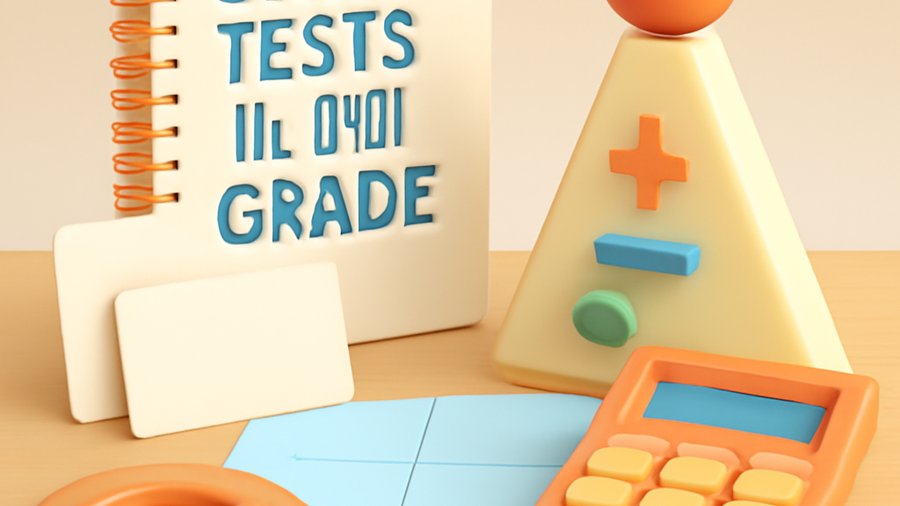
State Tests in 6th Grade
By March of 6th grade, your child should be ready for state-test questions like:
– “If 3 pencils cost \$0.45, how much do 7 pencils cost?”
– “What is $-4 + 9 – 6$?”
– “Simplify $3(x + 4) – x$.”
– “Find the area of a triangle with base 8 cm and height 5 cm.”
– “Given the data set \(\{2, 4, 4, 5, 6, 8, 9\}\), find the median.”
Free Resources
Effortless Math has a complete free 6th grade math system:
- 6th Grade Math Worksheets, every 6th grade topic, printable, with answer keys.
- 6th Grade Math eBooks, workbooks and state-test prep books.
- Math Topics Library, every topic explained.
Frequently Asked Questions
How long should 6th grade math homework take?
30 to 45 minutes a night, with occasional longer projects.
Is it normal for a 6th grader to suddenly “hate math”?
Yes, 6th grade is the year math gets abstract, and many kids resist. The fix is steady, low-pressure practice and showing them they can do it.
Should my 6th grader use a calculator?
For complex multi-step word problems and statistics, sometimes yes. For the core skills (integers, fractions, simple equations), no, mental math builds the foundation.
Is pre-algebra the same as 6th grade math?
Some districts call accelerated 6th grade “pre-algebra.” Standard 6th grade is pre-pre-algebra. Both eventually lead to Algebra 1 in 8th or 9th grade.
How important are 6th grade math grades?
Important. Middle school math performance is one of the strongest predictors of high school math success. A solid 6th grade builds momentum.
My child still struggles with fractions, should we fix that first?
Yes, absolutely. Fraction fluency is the gateway to ratios, expressions, and equations. Spend 2 to 3 weeks rebuilding fractions before tackling 6th grade topics in isolation.
You Are Still the Most Important Help
Middle school math feels like a wall to many parents. But your child does not need you to know everything. They need you to sit next to them, ask questions, and keep the practice steady. The math gets harder, but the recipe doesn’t change.
Keep Practicing With the Right Resources

Related to This Article
More math articles
- How to Remove Discontinuity from a Function
- 6th Grade ILEARN Math Worksheets: FREE & Printable
- Enhanced ACT Math 2026: The New 45-Question Section, Explained
- SHSAT Math Worksheets: FREE & Printable
- Free Grade 6 English Worksheets for New Jersey Students
- TExES Core Subjects Math- Test Day Tips
- 49 Free MTYA Grade 5 Math Worksheets for Maine Students (Aligned, One Skill Per Page)
- Differential Association and Social Learning
- Homeostasis, Skeleton, and Muscles
- Standard Deviation Explained: A Step-by-Step Guide for 2026







What people say about "6th Grade Math: The Complete Parent's Guide"?
No one replied yet.