Complementary and Supplementary Angles: Definitions and Examples for 2026

Complementary and supplementary angles are usually the first angle-pair topic students meet in geometry. They are also one of the most reliable sources of easy test points, until students mix up which is which. A 90 vs. 180 confusion can turn ten quick problems into ten wrong answers.
This guide gives you bulletproof definitions, a memory trick that has worked for generations of students, the full set of related angle pairs you will see on the same tests, and a complete worked example for every problem type.
The Definitions
- Complementary angles: two angles whose measures add to 90°.
- Supplementary angles: two angles whose measures add to 180°.
That’s the whole topic. The challenge is keeping them straight.
The Memory Trick
Alphabetical order helps:
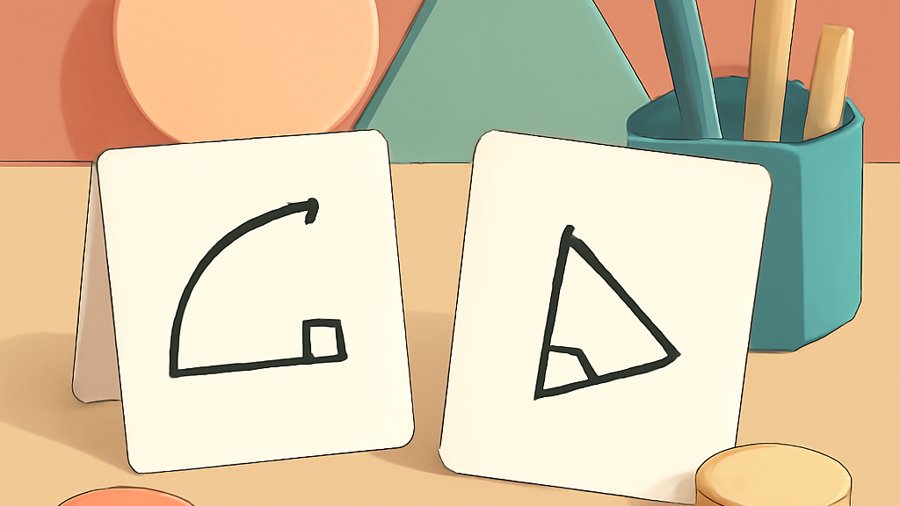
- C before S in the alphabet → Complementary uses the smaller number (90).
- S comes later → Supplementary uses the larger number (180).
A second trick: “C is for corner.” A right-angle corner is 90°, and complementary angles add to a corner.
A third trick: “S is for straight.” A straight line is 180°, and supplementary angles form a straight line when placed adjacent.
Pick the one that sticks for you and use it on every quiz.
Visual Recognition
- Two angles that together fit into a right angle (a corner) are complementary.
- Two angles that together form a straight line are supplementary.
- Adjacent supplementary angles are called a linear pair.
- Complementary and supplementary angles do not have to be adjacent. They can be in different parts of the figure as long as their measures add to 90 or 180.
Finding the Missing Angle
If angle A is complementary to angle B, and angle A = 35°, find angle B.
Sum is 90°. So B = 90 − 35 = 55°.
If angle X is supplementary to angle Y, and angle X = 110°, find angle Y.
Sum is 180°. So Y = 180 − 110 = 70°.
That is the entire computation. Almost every problem reduces to a subtraction.
Algebraic Problems
Tests like to dress up the same idea with variables.
Two complementary angles measure (2x + 10)° and (3x − 5)°. Find x.
(2x + 10) + (3x − 5) = 90.
5x + 5 = 90.
5x = 85.
X = 17.
Then the angles are 2(17) + 10 = 44° and 3(17) − 5 = 46°. Check: 44 + 46 = 90. ✓
Two supplementary angles are in the ratio 4: 5. Find both angles.
Let the angles be 4k and 5k. They add to 180:
4k + 5k = 180 → 9k = 180 → k = 20.
Angles: 80° and 100°.
A Quick Reference
| Property | Complementary | Supplementary |
|---|---|---|
| Sum | 90° | 180° |
| Each angle is | Acute (under 90°) | One can be acute, one obtuse; both 90° is possible |
| Adjacent name | “Forms a right angle” | “Linear pair” if adjacent |
| Symbol | None standard | None standard |
Related Angle Pairs You’ll See on the Same Test
Tests rarely cover only complementary and supplementary angles in isolation. Three close cousins appear constantly:

- Vertical angles (across the X of two intersecting lines) are equal.
- Adjacent angles share a vertex and a side. They are not always equal.
- Linear pair is two adjacent angles whose non-shared sides form a straight line. A linear pair is always supplementary.
Use the diagram below to recognize each pair on sight.
\ ∠1 / \ / ∠2 \ / ∠4 / \ / \ / ∠3 \
In two intersecting lines:
– ∠1 and ∠3 are vertical angles → equal.
– ∠2 and ∠4 are vertical angles → equal.
– ∠1 and ∠2 are a linear pair → supplementary.
– ∠3 and ∠4 are a linear pair → supplementary.
Word Problems
The complement of an angle is 30° less than the angle itself. Find the angle.
Let the angle be x. Its complement is 90 − x. The complement is 30° less than the angle: 90 − x = x − 30.
90 + 30 = 2x → 2x = 120 → x = 60°.
Check: complement is 30°, which is indeed 30° less than 60°. ✓
Two supplementary angles differ by 40°. Find both.
Let the smaller be x. The other is x + 40. Sum is 180:
x + (x + 40) = 180.
2x + 40 = 180.
2x = 140.
X = 70°.
Angles: 70° and 110°.
Common Mistakes
- Swapping 90 and 180. The single most common error. Use the alphabet trick every time.
- Assuming pairs must be adjacent. They do not have to be. Two angles in different figures can still be complementary or supplementary.
- Calling vertical angles supplementary. Vertical angles are equal, not supplementary (unless they are right angles).
- Forgetting that one supplementary angle can be obtuse. Two acute angles cannot be supplementary; their sum would be under 180°.
Quick Practice (Do These Mentally)
- Complement of 25°. → 65°
- Supplement of 130°. → 50°
- An angle equals its complement. What is it? → 45°
- An angle equals its supplement. What is it? → 90°
- Twice an angle is its supplement. → angle is 60°
- The supplement of an angle is three times its complement. Find the angle. (Solve: 180 − x = 3(90 − x) → 180 − x = 270 − 3x → 2x = 90 → x = 45°.)
If you can do 1 through 5 in under 15 seconds each, you are ready for any quiz on this topic.
Frequently Asked Questions
Can two right angles be complementary?
No. A right angle is 90°, and 90 + 90 = 180. Two right angles are supplementary, not complementary.
Can two acute angles be supplementary?
No. Two acute angles each measure under 90°, so their sum is under 180°.
Are complementary angles always adjacent?
No. The two 45° angles inside the same triangle are complementary regardless of whether they share a side.
Are all linear pairs supplementary?
Yes. A linear pair is two adjacent angles whose non-shared sides form a straight line, so they always sum to 180°.
Does either definition work in three dimensions?
Both definitions apply to any pair of angles whose measures add to the given total, regardless of where the angles live.
Closing Thought
Complementary angles add to 90°. Supplementary angles add to 180°. Use the alphabet trick to keep them straight, recognize the related pairs (vertical, adjacent, linear pair), and the topic becomes a stream of one-step subtractions.
For more practice, browse our Geometry worksheets (resource currently unavailable) and our full Math Topics library. When you are ready for a structured workbook, our Geometry collection covers every angle-pair relationship in depth.

Related to This Article
More math articles
- Best Graphing Calculators for Math Teachers
- Use of Technology in Math Class that Works
- Reproduction and Variation
- How to Self-Study Algebra: The Complete Step-by-Step Path
- A Scored Model Essay
- Triangles
- Best Coronavirus Resources for Students
- How to Unlock the Essentials: A Comprehensive Guide to Factors, GCD, Factorization, and LCM
- Overview of the CHSPE Mathematics Test
- 6th Grade FSA Math Worksheets: FREE & Printable












What people say about "Complementary and Supplementary Angles"?
No one replied yet.