SOHCAHTOA Made Simple: A Complete Right-Triangle Trig Guide for 2026
SOHCAHTOA is the most useful mnemonic in high school math. It opens up every right-triangle trig problem in geometry, every angle-of-elevation question on the SAT, and the whole foundation of pre-calc. Yet most students remember the letters without ever connecting them to confident problem solving.
This guide rebuilds SOHCAHTOA from the ground up with sharp definitions, a step-by-step recipe, every problem type you will see, and the inverse-trig tools for the second half of the unit.
The Mnemonic, Decoded
SOH-CAH-TOA stands for:
Sine = Opposite / Hypotenuse.
Cosine = Adjacent / Hypotenuse.
Tangent = Opposite / Adjacent.
These ratios apply to right triangles only. The “opposite” and “adjacent” are with respect to a chosen non-right angle, not the right angle itself.
Labeling the Sides
Pick any acute angle in the right triangle and call it θ.
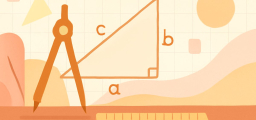
The hypotenuse is the longest side, opposite the right angle.
The opposite side is across from θ.
The adjacent side is next to θ (the leg that is not the hypotenuse).
Practice: in a 3-4-5 right triangle, choose the angle across from the side of length 4.
Opposite = 4.
Adjacent = 3.
Hypotenuse = 5.
Then:
– sin θ = 4/5 = 0.8.
– cos θ = 3/5 = 0.6.
– tan θ = 4/3 ≈ 1.33.
The Recipe for Finding a Missing Side
Mark the right angle.
Mark the given acute angle as θ.
Label the three sides: opposite, adjacent, hypotenuse.
Identify which two sides are involved (one given, one unknown).
Choose the trig ratio that uses exactly those two:
– Opposite and hypotenuse → sine.
– Adjacent and hypotenuse → cosine.
– Opposite and adjacent → tangent.
Set up the equation, then solve.
Example 1: Find a Side
A right triangle has a 35° angle. The hypotenuse is 20. Find the side opposite the 35°.
Step 5: opposite and hypotenuse → sine.
sin 35° = opposite / 20.
opposite = 20 · sin 35° ≈ 20 · 0.5736 ≈ 11.47.
Example 2: Find a Side Using Tangent
A right triangle has a 40° angle. The adjacent side is 12. Find the opposite side.
tan 40° = opposite / 12.
opposite = 12 · tan 40° ≈ 12 · 0.8391 ≈ 10.07.
Example 3: Find a Side Using Cosine
A right triangle has a 60° angle. The hypotenuse is 14. Find the adjacent side.
cos 60° = adjacent / 14.
adjacent = 14 · 0.5 = 7.
The Recipe for Finding a Missing Angle
When you know two sides and want the angle, use the inverse trig functions (sin⁻¹, cos⁻¹, tan⁻¹).
If sin θ = 0.6, then θ = sin⁻¹(0.6).
The inverse trig functions go from a ratio back to the angle.
Example 4: Find an Angle
A right triangle has legs 5 (opposite) and 12 (adjacent). Find the angle.
Use tangent because we have opposite and adjacent.
tan θ = 5/12 ≈ 0.4167.
θ = tan⁻¹(0.4167) ≈ 22.6°.
Example 5: Find an Angle Using Sine
A right triangle has hypotenuse 25 and opposite side 7.
sin θ = 7/25 = 0.28.
θ = sin⁻¹(0.28) ≈ 16.3°.
Example 6: Angle of Elevation
The angle of elevation is the angle from horizontal up to a viewed point.
A 50-foot ladder leans against a wall and forms a 75° angle with the ground. How high up the wall does it reach?
sin 75° = height / 50.
height = 50 · sin 75° ≈ 50 · 0.966 ≈ 48.3 ft.
A flagpole casts a 30-foot shadow. The angle of elevation of the sun is 50°. How tall is the flagpole?
tan 50° = height / 30.
height = 30 · tan 50° ≈ 30 · 1.1918 ≈ 35.75 ft.
Example 7: Angle of Depression
The angle of depression is the angle from horizontal down to a viewed point. It equals the angle of elevation from the lower point (alternate interior angles on parallel horizontals).
A lifeguard stands 20 ft above the water and spots a swimmer at an angle of depression of 35°. How far is the swimmer (horizontally) from the base of the lifeguard tower?
tan 35° = 20 / horizontal distance.
horizontal distance = 20 / tan 35° ≈ 20 / 0.7002 ≈ 28.6 ft.
Special Angles to Memorize
Memorizing these saves time on the SAT and on most quizzes:
θ
sin θ
cos θ
tan θ
0°
0
1
0
30°
1/2
√3/2
√3/3
45°
√2/2
√2/2
1
60°
√3/2
1/2
√3
90°
1
0
undefined
Pattern trick for sine of 0°, 30°, 45°, 60°, 90°: √0/2, √1/2, √2/2, √3/2, √4/2.
Cosine is the reverse.
The Pythagorean Identity
A bonus shortcut: sin²θ + cos²θ = 1, always, for any angle in a right triangle.
If sin θ = 3/5, then cos²θ = 1 − 9/25 = 16/25, so cos θ = 4/5.
This avoids the calculator entirely when you already know one of the two main ratios.
Common Mistakes
Choosing the wrong ratio. Label the sides first, then pick the ratio that uses your two sides.
Forgetting the calculator must be in DEGREE mode. Radian mode gives garbage for these problems. Check the corner of the screen.
Confusing opposite and adjacent. Opposite is across from θ. Adjacent is next to θ, but it is the leg, not the hypotenuse.
Using a regular trig function when you need an inverse. If you know a ratio and want an angle, hit sin⁻¹, cos⁻¹, or tan⁻¹.
Forgetting to take the inverse at the end. If you write “tan θ = 5/12” and stop, you have not solved for θ. Apply tan⁻¹.
A Quick Decision Tree
You know two sides and want a side? → Use a trig ratio with the angle and solve.
You know two sides and want an angle? → Use an inverse trig ratio.
The two sides are the legs? → Tangent.
One side is the hypotenuse? → Sine or cosine, depending on whether the other is opposite or adjacent.
Frequently Asked Questions
Is SOHCAHTOA on the SAT?
Yes. The Digital SAT covers it directly with side-finding and angle-of-elevation problems.
Do these ratios work for non-right triangles?
No. For non-right triangles, use the Law of Sines or Law of Cosines.
Why are sine and cosine never greater than 1?
Because they are ratios of a leg to the hypotenuse, and the hypotenuse is always the longest side.
What is the unit of an angle in SOHCAHTOA problems?
Most high school courses use degrees. Some pre-calc and physics classes use radians. Match your calculator to the problem.
What if my answer for a side is negative?
Re-check your setup. In right triangles, every side is positive. A negative answer means you set up the ratio upside-down.
Closing Thought
SOHCAHTOA is three ratios and one labeling step. Label the three sides relative to θ, pick the ratio that involves your two sides, and solve. Use inverse trig when the unknown is the angle. Memorize the special-angle table and you save several minutes per test.
For more practice, browse our Trigonometry worksheets (resource currently unavailable) and our full Math Topics library. When you are ready for a structured workbook, our Algebra 2 collection covers all of right-triangle and unit-circle trig.
by: Effortless Math Team about
(category: Articles)










What people say about "SOHCAHTOA: A Right-Triangle Trig Guide"?
No one replied yet.