Area and Perimeter of Any Shape: Complete Formula Guide

Area and perimeter come up everywhere, from 3rd-grade worksheets to the SAT to laying flooring in your living room. The math is not complicated, but the formulas are easy to mix up, and the units trip students up constantly. This guide gives you every formula, when to use it, and how to handle the tricky shapes.
The Two Big Ideas
Perimeter is the distance around a shape. It is measured in linear units: inches, cm, feet, meters.
Area is the space inside a shape. It is measured in square units: in², cm², ft², m².
If you ever confuse them, picture a fence (perimeter) vs. The grass inside (area).
Squares and Rectangles
Square (all sides equal, length \(s\))
- Perimeter: \(P = 4s\)
- Area: \(A = s^2\)
Rectangle (length \(l\), width \(w\))
- Perimeter: \(P = 2l + 2w\)
- Area: \(A = l \cdot w\)
Example: A rectangle 8 cm by 5 cm.
\(P = 2(8) + 2(5) = 26\) cm.
\(A = 8 \times 5 = 40\) cm².

Triangles
General triangle (base \(b\), height \(h\))
- Area: \(A = \dfrac{1}{2} b h\)
The height must be perpendicular to the base, not just any side.
Perimeter of any triangle
Add the three sides.
Special triangles
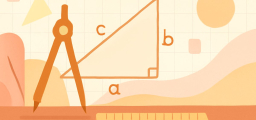
Right triangle: Use the legs \(a\) and \(b\) as base and height. \(A = \dfrac{1}{2} ab\). The hypotenuse \(c\) satisfies \(a^2 + b^2 = c^2\).
Equilateral triangle (all sides equal length \(s\)):
– \(P = 3s\)
– \(A = \dfrac{\sqrt{3}}{4} s^2\)
Heron’s formula (when you know all three sides \(a, b, c\) but not the height):
\(s = \dfrac{a + b + c}{2}\)
\(A = \sqrt{s(s-a)(s-b)(s-c)}\)
Recommended Practice Resources

Circles
For a circle with radius \(r\) (or diameter \(d = 2r\)):
- Circumference (perimeter): \(C = 2\pi r = \pi d\)
- Area: \(A = \pi r^2\)
Use \(\pi \approx 3.14\) or \(\pi \approx \dfrac{22}{7}\), or leave the answer in terms of \(\pi\) when the problem allows.
Example: A circle with radius 7 cm.
\(C = 2\pi(7) = 14\pi \approx 43.98\) cm.
\(A = \pi(7)^2 = 49\pi \approx 153.94\) cm².
Parallelograms and Trapezoids
Parallelogram (base \(b\), perpendicular height \(h\))
- Area: \(A = b \cdot h\)
- Perimeter: \(P = 2(\text{base} + \text{slant side})\)
Trapezoid (parallel sides \(a\) and \(b\), height \(h\))
- Area: \(A = \dfrac{1}{2}(a + b) h\)
- Perimeter: add all four sides.
Rhombus (all sides equal length \(s\), diagonals \(d_1, d_2\))
- Perimeter: \(P = 4s\)
- Area: \(A = \dfrac{1}{2} d_1 d_2\)
Regular Polygons (5+ Sides)
For a regular polygon with \(n\) sides of length \(s\) and apothem (perpendicular distance from center to a side) \(a\):
- Perimeter: \(P = ns\)
- Area: \(A = \dfrac{1}{2} \cdot P \cdot a = \dfrac{1}{2} \cdot ns \cdot a\)
The apothem can be found using trigonometry: \(a = \dfrac{s}{2 \tan(180° / n)}\).
Composite Shapes (the SAT/ACT Favorite)
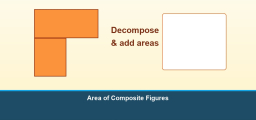
Many test questions give you an L-shape, a shape with a circle cut out, or a triangle plus a rectangle.

Strategy: Break the shape into pieces you already know, find the area of each piece, then add or subtract.
Example: A rectangle 10 cm by 8 cm with a circle of radius 3 cm cut out of it.
Rectangle area = $80$ cm².
Circle area = \(\pi(3)^2 = 9\pi \approx 28.27\) cm².
Remaining area = \(80 – 28.27 \approx 51.73\) cm².
3D Versions (Surface Area)
If a test asks for surface area, it is the sum of the areas of all the faces. You still use the 2D formulas above; you just add them up.
For example, a rectangular prism with length \(l\), width \(w\), height \(h\):
\[\text{Surface Area} = 2(lw + lh + wh)\]
Common Mistakes
Forgetting to square the units
Area is in square units. Writing “40 cm” for area is wrong. Write “40 cm².”
Using the wrong height
Triangles and parallelograms need the perpendicular height, not the slant side.
Confusing radius and diameter
\(d = 2r\). If a problem gives you a diameter of 14 cm, the radius is 7 cm.
Forgetting \(\pi\)
Some students compute area as \(r^2\) without the \(\pi\).
Mixing units
A rectangle with sides “12 inches and 1 foot” needs to be converted: both in inches gives \(12 \times 12 = 144\) in², or both in feet gives \(1 \times 1 = 1\) ft².
Mis-reading composite figures
Always re-draw composite shapes and label every measurement before computing.
Practical Examples
Painting a wall
A wall is 14 ft long and 9 ft tall. There is a window 4 ft by 3 ft. How much wall needs painting?
Wall area: \(14 \times 9 = 126\) ft².
Window area: \(4 \times 3 = 12\) ft².
Paintable area: \(126 – 12 = 114\) ft².
If a gallon of paint covers 350 ft², you need less than a gallon. Buy one.
Building a fence
You want to fence in a yard that is 60 ft by 40 ft. How much fencing?
Perimeter: \(2(60) + 2(40) = 120 + 80 = 200\) ft.
Pizza math
A 16-inch pizza vs. Two 10-inch pizzas, which gives more pizza?
16-inch: radius 8, area \(= 64\pi \approx 201\) in².
Two 10-inch: each radius 5, area \(= 25\pi \approx 78.5\) in² each → 157 in² total.
The 16-inch pizza is the better deal.
Free Resources
Effortless Math has a full free geometry library:
- Geometry Worksheets (resource currently unavailable), area, perimeter, and more.
- Math Topics Library, every geometry topic explained.
- Geometry eBooks, full geometry workbooks.
Frequently Asked Questions
What is the difference between area and perimeter?
Perimeter is the distance around. Area is the space inside.
Can a shape have the same number for area and perimeter?
Yes, for example, a square with side length 4 has perimeter 16 and area 16. The units are different (16 cm vs 16 cm²), but the numbers are equal.
How do I find area when only the diagonal is given?
For a square, side = diagonal / \(\sqrt{2}\), then square it. For a rectangle, you usually need another piece of information.
What if the shape is irregular?
Break it into pieces you recognize (rectangles, triangles, circles), compute each piece, and add.
Do I always need \(\pi\) for circles?
Yes, circles are always defined by \(\pi\). You can leave answers in terms of \(\pi\) when the problem allows.
What units should my final answer use?
Whatever units the problem gives, squared for area, linear for perimeter. Always include units in the final answer.
Master the Formulas. Master the Test.
Area and perimeter problems are point-for-point gifts on any standardized test, if you know your formulas cold. Print a formula sheet. Drill 10 problems a day for a week. By next Sunday, you will solve any area or perimeter problem in 60 seconds or less.
Keep Practicing With the Right Resources

Related to This Article
More math articles
- Impeachment and removal
- Secularization, Religious Change, and Civil Religion
- Why do AAA or SSA Not Prove Congruence?
- Research Ethics and Participant Protection
- The Best Grade 7 ELA Practice Tests for Idaho Students
- Natural and Artificial Selection
- The Best Grade 8 ELA Practice Tests for Nevada Students
- Studying Inequality Responsibly
- When do the ACT Scores Come out?
- The 5 Best Computers For College Students






What people say about "Area and Perimeter Formula Guide"?
No one replied yet.