Grade 6 Math: Volume with Fractional Edge Lengths
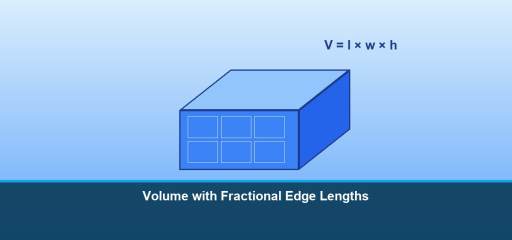
TL;DR: Volume of a rectangular prism is the same multiplication you have always done, length times width times height, even when the edges are fractions. Multiply the numerators across the top, multiply the denominators across the bottom, simplify if you can, and remember the answer comes out in cubic units. Fractional edges don’t change the rule. They just mean you are stacking smaller-than-unit boxes inside the prism. Same formula, slightly daintier dimensions.
Key takeaways:
- Volume formula: \(V = l \times w \times h\), same as for whole-number edges.
- Multiply fractions: top \(\times\) top, bottom \(\times\) bottom.
- Convert mixed numbers to improper fractions before multiplying.
- Volume is in cubic units (cubic feet, cubic cm, etc.).
- Example: \(\dfrac{1}{2} \times \dfrac{2}{3} \times \dfrac{3}{4} = \dfrac{6}{24} = \dfrac{1}{4}\) cubic unit.
Grade 6 focus: The volume of a right rectangular prism measures space inside the box. \(V = \ell \times w \times h\), where the three dimensions are length, width, and height (all perpendicular).
Video lesson: Watch this Khan Academy video on volume when edge lengths are fractions (Grade 6 geometry).
Fractional edge lengths
When an edge is a fraction, multiply all three dimensions, fractions multiply like any numbers. Units are cubic (cubic inches, cubic feet, etc.).
Unit cubes interpretation
Think: “How many \(\frac{1}{2}\)-inch cubes fit along each edge?” Multiply those counts to get the number of \(\frac{1}{2}\)-inch cubes in the prism, consistent with \(V = \ell wh\).
Worked example
Prism with dimensions \(2\) cm, \(3\) cm, and \(\frac{1}{2}\) cm: \(V = 2 \times 3 \times \frac{1}{2} = 3\) cubic centimeters.
Common mistakes
- Adding edges instead of multiplying.
- Using square units instead of cubic units.
- Forgetting to simplify fractional volumes.
Fluency check
Compute \(V\) for \(\frac{3}{4}\) in., \(\frac{2}{3}\) in., \(6\) in. Multiply carefully and simplify.
Volume with Fractional Dimensions
Volume = length × width × height. When dimensions are fractions, multiply them as fractions: numerators together, denominators together. For mixed numbers, convert to improper fractions first. 1 1/2 = 3/2.
Example
Dimensions 1/2 × 3 × 4 inches: Volume = 1/2 × 3 × 4 = (1/2 × 3) × 4 = 3/2 × 4 = 6 cubic inches.
Another Example
Dimensions 1 1/2 × 2 × 3 1/2 feet: Convert to 3/2 × 2 × 7/2. Calculate: 3/2 × 2 = 3, then 3 × 7/2 = 21/2 = 10 1/2 cubic feet.
Key Reminders
- Convert mixed numbers before multiplying
- Simplify before multiplying to keep numbers small
- Answer is always in cubic units
- Show all steps
Related Topics
Review Simplifying Fractions for fraction skills.
Recommended EffortlessMath Books
For a workbook that pairs with this page, Mastering Grade 6 Math walks your sixth grader through every grade-6 topic with worked examples and plenty of practice. For more story-problem reps, Mastering Grade 6 Math Word Problems is the matching word-problem book.
Frequently Asked Questions
What’s the formula for the volume of a rectangular prism?
\(V = l \times w \times h\), where \(l\) is length, \(w\) is width, and \(h\) is height. The same formula works whether the edges are whole numbers or fractions. For a box with edges 2, 3, and 4 units: \(V = 2 \times 3 \times 4 = 24\) cubic units.
How do I multiply three fractions?
Multiply all numerators together for the new numerator; multiply all denominators together for the new denominator. \(\dfrac{1}{2} \times \dfrac{1}{3} \times \dfrac{2}{5} = \dfrac{1 \times 1 \times 2}{2 \times 3 \times 5} = \dfrac{2}{30} = \dfrac{1}{15}\). Then simplify.
Why is volume in cubic units?
Volume measures how much 3D space a shape takes up. We measure it in unit cubes (a 1-by-1-by-1 cube is one cubic unit). A 2-by-3-by-4 box can hold 24 unit cubes, so its volume is 24 cubic units. The “cubic” reminds you that volume is three-dimensional.
How do I handle mixed-number edge lengths?
Convert each mixed number to an improper fraction first. \(1\dfrac{1}{2} \times 2\dfrac{1}{3} \times \dfrac{3}{4} = \dfrac{3}{2} \times \dfrac{7}{3} \times \dfrac{3}{4} = \dfrac{63}{24} = \dfrac{21}{8} = 2\dfrac{5}{8}\) cubic units. Skipping the conversion leads to wrong answers – mixed numbers don’t multiply directly.
Can volume be less than 1?
Yes – if at least one edge is less than 1, the volume can be a fraction. For edges \(\dfrac{1}{2}\), \(\dfrac{1}{2}\), \(\dfrac{1}{2}\): \(V = \dfrac{1}{2} \times \dfrac{1}{2} \times \dfrac{1}{2} = \dfrac{1}{8}\) cubic unit. Smaller box, smaller volume.
Walk me through a word problem.
“A box is \(\dfrac{3}{4}\) foot long, \(\dfrac{1}{2}\) foot wide, and \(\dfrac{2}{3}\) foot tall. What’s its volume?” \(V = \dfrac{3}{4} \times \dfrac{1}{2} \times \dfrac{2}{3} = \dfrac{6}{24} = \dfrac{1}{4}\) cubic foot. You can also cancel before multiplying: the 3s cancel, leaving \(\dfrac{1}{4} \times \dfrac{1}{2} \times \dfrac{2}{1} = \dfrac{2}{8} = \dfrac{1}{4}\).
How does packing unit cubes show this?
If your unit is a \(\dfrac{1}{2}\)-foot cube (volume \(\dfrac{1}{8}\) cubic foot), you’d need 2 cubes per foot in each direction. For the \(\dfrac{3}{4} \times \dfrac{1}{2} \times \dfrac{2}{3}\)-foot box, that’s hard to picture directly – which is why the multiplication formula is faster. But the formula and the unit-cube count always match.
What units should I use?
Whatever the problem uses. If edges are in feet, volume is in cubic feet. If edges are in cm, volume is in cubic cm. If the problem mixes units (one edge in feet, another in inches), convert all edges to the same unit BEFORE multiplying.
How do I check my answer?
Estimate. Round each fraction to a friendly number and re-multiply. \(\dfrac{3}{4} \approx 0.75\), \(\dfrac{1}{2} = 0.5\), \(\dfrac{2}{3} \approx 0.67\). \(0.75 \times 0.5 \times 0.67 \approx 0.25\), which matches \(\dfrac{1}{4}\). If your exact answer doesn’t roughly match the estimate, recheck.
Where does this skill show up later?
Grade 7 and 8 extend it to surface area of prisms, volume of cylinders and cones, and volumes with decimal edges. Geometry class uses it for any 3D shape made of rectangular pieces. SAT and ACT include volume problems on most tests. Master fractional volume now, and the rest is just new formulas.
Related EffortlessMath Lessons
If a topic on this page feels rusty, these short lessons go deeper:

Related to This Article
More math articles
- Unlock the Answers: “GED Math for Beginners” Solution Manual
- The Cardiovascular System
- The Best Grade 8 Math Book for Virginia Students
- The Ultimate ISASP Algebra 1 Course (+FREE Worksheets)
- Properties of the Horizontal Line
- Multiplying Mixed Numbers for 5th Grade: Convert and Multiply
- 10 Most Common 7th Grade IAR Math Questions
- Best Graphing Calculators for High School Students
- Free Exercise Clause
- How to Use Models to Decompose Fractions into Unit Fractions?
What people say about "Grade 6 Math: Volume with Fractional Edge Lengths"?
No one replied yet.