Triangle Theorems Every Student Should Know in 2026

Triangles carry roughly forty percent of a geometry course. Almost every proof, every coordinate problem, every trig identity, and every measurement question goes back to a small set of theorems about triangles. Memorize them properly and most of geometry becomes recognition: which theorem applies here?
This guide is the complete cheat sheet, organized so you can find any theorem in under five seconds. Use it during homework and review it the night before each unit test.
1. Triangle Angle Sum Theorem
The three interior angles of any triangle sum to 180°.
If a triangle has angles 50° and 70°, the third is 180 − 50 − 70 = 60°.
This is the single most-used theorem in geometry. Memorize it cold.
2. Exterior Angle Theorem
An exterior angle of a triangle equals the sum of the two non-adjacent interior angles.

If two interior angles are 40° and 65°, the exterior angle at the third vertex is 105°.
Why it works: the exterior angle and its adjacent interior angle form a linear pair (180°). And the three interior angles sum to 180°. Subtracting the adjacent interior angle gives the sum of the other two.
3. Triangle Inequality Theorem
The sum of any two sides of a triangle is greater than the third side.
Sides 4, 5, and 10 cannot form a triangle because 4 + 5 = 9 < 10.
A useful corollary: the third side of a triangle is between |a − b| and a + b.
Two sides are 6 and 9. The third side must be greater than 3 and less than 15.
This shows up on the SAT every year.
4. Isosceles Triangle Theorem and Converse
In an isosceles triangle, the angles opposite the equal sides are equal. Conversely, if two angles of a triangle are equal, the sides opposite them are equal.
A triangle with two 50° angles has two equal sides (the ones opposite those angles).
5. Triangle Congruence Theorems
Two triangles are congruent if they have the same size and shape. The five shortcuts to prove congruence:
| Name | Pattern |
|---|---|
| SSS | All three pairs of sides equal |
| SAS | Two sides and the included angle equal |
| ASA | Two angles and the included side equal |
| AAS | Two angles and a non-included side equal |
| HL | Hypotenuse and a leg equal (right triangles only) |
Two patterns that are not valid: AAA (only proves similarity) and SSA (called the “ambiguous case”, can yield 0, 1, or 2 triangles).
6. Triangle Similarity Theorems
Two triangles are similar if they have the same shape (same angles) but possibly different size. The three shortcuts:
| Name | Pattern |
|---|---|
| AA | Two pairs of angles equal |
| SAS Similarity | Two pairs of sides proportional, included angles equal |
| SSS Similarity | All three pairs of sides proportional |
AA is the most useful by far. If you can find two pairs of equal angles, the triangles are similar, and corresponding sides are proportional.
7. The Pythagorean Theorem
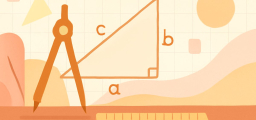
In a right triangle with legs a and b and hypotenuse c:
\[a^2 + b^2 = c^2\]
Legs 6 and 8 give hypotenuse 10.
Legs 5 and 12 give hypotenuse 13.
Common Pythagorean triples worth memorizing: (3,4,5), (5,12,13), (8,15,17), (7,24,25), (20,21,29).
8. Converse of the Pythagorean Theorem
If a² + b² = c², then the triangle is a right triangle. Use this to test whether three side lengths form a right triangle.
Sides 9, 40, 41: check 81 + 1,600 = 1,681 = 41². Right triangle. ✓
9. Special Right Triangles
45-45-90 triangle: legs are equal, hypotenuse is leg × √2.
Legs 5 → hypotenuse 5√2.
30-60-90 triangle: shortest leg opposite 30° is x; longer leg opposite 60° is x√3; hypotenuse opposite 90° is 2x.
Shortest leg 4 → longer leg 4√3, hypotenuse 8.
These two come up on every standardized test.
10. Midsegment Theorem
A segment joining the midpoints of two sides of a triangle is parallel to the third side and half its length.

Triangle ABC has midsegment connecting midpoints of AB and AC. The midsegment is parallel to BC and half as long as BC.
11. Triangle Median Theorem (Centroid)
The three medians of a triangle (segments from each vertex to the midpoint of the opposite side) meet at the centroid. The centroid divides each median in a 2:1 ratio (long part from vertex).
The centroid is the triangle’s balance point.
12. Triangle Inequality of Sides and Angles
Within a triangle, the largest angle is opposite the longest side, and the smallest angle is opposite the shortest side.
A triangle has sides 5, 7, 9. The largest angle is opposite the side of length 9.
This lets you rank angles by side length and vice versa, even without computing measures.
13. The Angle Bisector Theorem
An angle bisector of a triangle divides the opposite side in the ratio of the adjacent sides.
In a triangle with sides AB = 6, AC = 9, and the bisector from A hits BC at point D: BD/DC = AB/AC = 6/9 = 2/3.
14. Areas
| Triangle type | Area formula |
|---|---|
| Any triangle | (1/2) × base × height |
| Two sides and included angle | (1/2) ab sin C |
| Three sides (Heron) | √[s(s−a)(s−b)(s−c)], where s = (a+b+c)/2 |
| Equilateral with side s | (s²√3)/4 |
A Worked-Example Roundup
Example 1. Find x: angles in a triangle are 40°, (2x), and (3x + 10°).
40 + 2x + 3x + 10 = 180 → 5x + 50 = 180 → x = 26°.
Example 2. Sides 6 and 10. Third side is between 4 and 16.
Example 3. A 30-60-90 has shortest leg 7. Hypotenuse is 14, longer leg is 7√3.
Example 4. A right triangle has legs 9 and 12. Hypotenuse is 15 (3-4-5 scaled by 3).
Example 5. Two triangles share an angle and have proportional sides around it. They are similar by SAS Similarity.
Common Mistakes
- Using SSA to prove congruence. SSA is not a valid congruence shortcut.
- Confusing AAS with ASA. Both work, but the angle pattern is different. ASA: angle-side-angle (the side is between the two angles). AAS: angle-angle-side (the side is not between).
- Using AA for congruence. AA only proves similarity, not congruence.
- Treating side-length sums as inequalities. The triangle inequality requires strict inequality (no equal sign).
- Forgetting the 2:1 ratio of the centroid. The vertex side is the longer part.
Frequently Asked Questions
Which theorem is most asked on the SAT?
Triangle angle sum and the Pythagorean theorem are by far the most common.
Do I need to prove the theorems on the test?
Most state tests ask you to apply them; some honors and AP tests ask you to prove a few. Memorize statements first, proofs second.
Is AAA a congruence shortcut?
No. AAA only guarantees similarity. The two triangles could be different sizes.
Why is SSA called the ambiguous case?
Because two sides and a non-included angle can correspond to zero, one, or two triangles depending on the configuration.
Is the Pythagorean theorem the same as the distance formula?
Yes, essentially. The distance between (x₁, y₁) and (x₂, y₂) is √[(x₂−x₁)² + (y₂−y₁)²], which is the Pythagorean theorem on a right triangle whose legs are the horizontal and vertical differences.
Closing Thought
Geometry is recognition. The hard part is not the math; it is spotting which of these fourteen theorems applies. Drill the list and the worked examples until each theorem fires the moment you see its setup.
For more practice, browse our Geometry worksheets (resource currently unavailable) and our full Math Topics library. When you are ready for a structured workbook, our Geometry collection covers every theorem above in detail.

Related to This Article
More math articles
- Riemann Sums Made Easy: Step-by-Step Tutorial
- 5th Grade SBAC Math FREE Sample Practice Questions
- Homophones and Frequently Misspelled Words
- Long Division using 1 Number
- FTCE Math Flashcards (Free Online: Formulas, Terms & Concepts)
- Free Grade 4 English Worksheets for Oregon Students
- The Best Grade 4 ELA Practice Tests for North Dakota Students
- Marginal revenue product combines productivity and output value
- The Best Grade 7 Math Book for Indiana Students
- Praxis Core Math Worksheets: FREE & Printable







What people say about "Triangle Theorems Every Student Should Know"?
No one replied yet.