Grade 6 Math: Area of Polygons on the Coordinate Plane
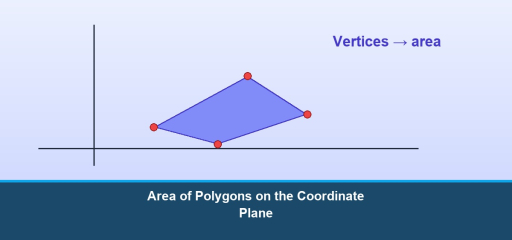
TL;DR: When a polygon sits on a coordinate plane, the gridlines do half the measuring for you. Plot the vertices, look at what shape you have, and reach for the formula you already know. For oddly-shaped polygons, slice them into rectangles and triangles, find each area, and add them up. Count side lengths straight off the gridlines, no ruler needed. Once you can read coordinates as measurements, polygons on the plane stop being mysterious and start being routine.
Key takeaways:
- Plot each vertex carefully – the ordered pair tells you the column (x) and row (y).
- Identify the shape: rectangle, triangle, trapezoid, or composite (a mix).
- Use the right formula: rectangle \(=l \times w\); triangle \(=\dfrac{1}{2} \times b \times h\); trapezoid \(=\dfrac{1}{2}(b_1+b_2)h\).
- For composite shapes, split into pieces, find each area, then add them up.
- Count whole units along the gridlines; don’t eyeball.
Grade 6 focus: On the coordinate plane, you can find the area of polygons whose vertices are given as ordered pairs \((x,y)\). Common approaches: surround with a rectangle and subtract triangles, decompose into rectangles and right triangles, or use the shoelace formula when appropriate (often introduced later).
Video lesson: Watch this Anywhere Math lesson on polygons in the coordinate plane.
Rectangle method
- Plot the vertices in order.
- Draw a bounding rectangle whose sides align with the grid.
- Subtract areas of right triangles or rectangles outside the polygon but inside the bounding box.
Decomposition method
Split the polygon into shapes with known area formulas (rectangles, right triangles). Add the areas.
Why coordinates help
Side lengths can be found from differences in \(x\) and \(y\) values when sides are horizontal or vertical.
Worked idea
For a rectangle with vertical/horizontal sides on the grid, width = difference in \(x\), height = difference in \(y\); area = width \(\times\) height.
Common mistakes
- Plotting points in the wrong order, crossing segments.
- Confusing \(x\) and \(y\) when finding side lengths.
- Using non-perpendicular “slanted” sides as if they were base/height without a proper height segment.
Practice tip
Use graph paper or a grid: sketch lightly, label every length you use in your calculations.
Recommended EffortlessMath Books
For a workbook that pairs with this page, Mastering Grade 6 Math walks your sixth grader through every grade-6 topic with worked examples and plenty of practice. For more story-problem reps, Mastering Grade 6 Math Word Problems is the matching word-problem book.
Frequently Asked Questions
How do I plot a point like \((3, 5)\)?
Start at the origin \((0, 0)\). Move 3 units right along the x-axis. From there, move 5 units up along the y-axis. That’s the point \((3, 5)\). The first number is always the horizontal move; the second is always the vertical. If a coordinate is negative, you move left or down instead.
What’s the area of a rectangle on the coordinate plane?
Length times width. Find length by counting (or subtracting) along one side, and width along an adjacent side. Vertices \((2,1)\), \((7,1)\), \((7,5)\), \((2,5)\) make a rectangle 5 wide and 4 tall, with area \(5 \times 4 = 20\) square units.
How do I find the base and height of a triangle?
The base is any side; the height is the perpendicular distance from that side to the opposite vertex. If the triangle has a horizontal or vertical side, use that as the base – then the height is easy to count. For a triangle with vertices \((0,0)\), \((6,0)\), \((4,5)\), the bottom side is the base (6 units), and the height (from that side up to \((4,5)\)) is 5 units.
What if the triangle has no horizontal side?
You can still find the area, but break it into pieces or use the box method: enclose the triangle in a rectangle, find the rectangle’s area, then subtract the right triangles that aren’t part of your original triangle. This always works on grade-6 problems.
How do I find the area of a trapezoid?
\(A = \dfrac{1}{2}(b_1 + b_2)h\), where \(b_1\) and \(b_2\) are the parallel sides and \(h\) is the perpendicular distance between them. For a trapezoid with parallel sides 4 and 8 units long and height 3 units: \(A = \dfrac{1}{2}(4+8)(3) = \dfrac{1}{2}(12)(3) = 18\) square units.
Walk me through a composite shape example.
An L-shaped polygon has vertices \((0,0)\), \((4,0)\), \((4,2)\), \((2,2)\), \((2,5)\), \((0,5)\). Split it: one rectangle on the bottom (4 wide, 2 tall = 8) and one rectangle on top of the left part (2 wide, 3 tall = 6). Total area: \(8 + 6 = 14\) square units.
Can I use the distance formula at grade 6?
You don’t need to – and it’s not part of the grade-6 standards. For sides that are horizontal or vertical, just count units or subtract coordinates. Slanted sides are usually broken into pieces or handled by the box method. The distance formula \(d = \sqrt{(x_2-x_1)^2 + (y_2-y_1)^2}\) comes in grade 8.
What units do I use for area?
Square units. If the grid uses centimeters, area is in square centimeters. If it just uses “units” (no specific length), area is in “square units.” Always include the units in your answer – leaving them off is a common point loss on tests.
What if vertices have negative coordinates?
The math is identical. Find side lengths by subtracting coordinates and taking the absolute value. For a rectangle with vertices \((-3, -1)\), \((2, -1)\), \((2, 3)\), \((-3, 3)\): width is \(|2-(-3)| = 5\), height is \(|3-(-1)| = 4\), area \(= 20\) square units.
Where does this skill show up later?
Coordinate geometry runs through grades 7-12: finding distances, slopes, midpoints, areas, and equations of figures. Grade 6 is where you build the foundation – plotting points, finding side lengths, and computing simple areas. On state tests at grade 6, expect one or two coordinate-plane area questions.
Related EffortlessMath Lessons
If a topic on this page feels rusty, these short lessons go deeper:
- How to graph points on the coordinate plane
- How to identify polygons
- How to find the area of rectangles
- How to find the area of shapes (resource currently unavailable)
- How to find perimeter and area

Related to This Article
More math articles
- ASVAB Math: Complete Guide and Study Tips
- No-Commission Baccarat and the Dragon-7 Trade-off
- How to Balance the Scales: Inequalities in Decimal Addition and Subtraction
- Remainder Riddles: How to Decipher Division with One-digit Divisors
- Best Calculators for Linear Algebra and Calculus
- Matter and Materials
- Dividing Fractions for 5th Grade: Keep, Change, Flip
- Mendelian Genetics
- Free Colorado Grade 2 Math Worksheets
- Equation of Each Ellipse and Finding the Foci, Vertices, and Co– Vertices of Ellipses
What people say about "Grade 6 Math: Area of Polygons on the Coordinate Plane"?
No one replied yet.