Surface Area and Volume Formulas: Complete Reference for 2026
The solids unit in geometry is mostly formulas. Memorize them and you reliably score in the 80s and 90s. Skip them and the unit collapses. The good news is that there are only about ten formulas worth learning, and most of them follow a small set of patterns once you see how they are built.
This guide is a complete reference: every prism, every pyramid, every roundish solid, plus the way to handle composite figures and the units mistakes that cost points.
The Two Big Patterns
Almost every volume formula is one of these:
Prism / cylinder pattern: volume = base area × height.
Pyramid / cone pattern: volume = (1/3) × base area × height.
Almost every surface-area formula is the sum of:
1. Base area (one or two bases).
2. Lateral area (sides, usually perimeter or circumference × height, or a slant-height variation).
Hold those two patterns in your head and the table below stops feeling like memorization.
Prisms
A prism has two parallel, congruent bases connected by rectangles.
Solid
Volume
Surface Area
Rectangular prism
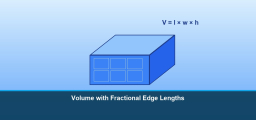
V = lwh
SA = 2(lw + lh + wh)
Cube (side s)
V = s³
SA = 6s²
Triangular prism
V = (base area) × h
SA = 2(base area) + (perimeter of base) × h
Any prism
V = (base area) × h
SA = 2(base area) + (perimeter of base) × h
Notice the surface-area pattern: two bases plus perimeter-times-height (the lateral area).
Cylinders
A cylinder is a prism with a circular base.
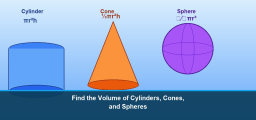
V = π r² h.
SA = 2π r² + 2π r h.
The 2π r² is the two circular bases. The 2π r h is the lateral area (circumference × height, imagine unrolling the side into a rectangle).
A can has r = 3 cm and h = 10 cm.
V = π · 9 · 10 = 90π ≈ 282.7 cm³.
SA = 2π · 9 + 2π · 3 · 10 = 18π + 60π = 78π ≈ 245 cm².
Pyramids
A pyramid has a polygon base and triangular faces meeting at an apex.
Solid
Volume
Surface Area
Square pyramid (base s, slant ℓ)
V = (1/3) s² h
SA = s² + 2sℓ
Triangular pyramid (tetrahedron)
V = (1/3)(base area) h
SA = sum of four triangle areas
Any pyramid
V = (1/3)(base area) h
SA = base area + (1/2)(perimeter)(slant height)
The (1/3) factor comes from calculus and shows up in every pointed solid.
Cones
A cone is a pyramid with a circular base.
V = (1/3) π r² h.
SA = π r² + π r ℓ, where ℓ is the slant height.
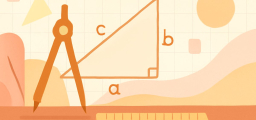
Slant height relates to height by Pythagoras: ℓ² = r² + h².
A cone has r = 4 and h = 3. Slant ℓ = √(16 + 9) = 5.
V = (1/3) · π · 16 · 3 = 16π ≈ 50.3.
SA = π · 16 + π · 4 · 5 = 16π + 20π = 36π ≈ 113.1.
Spheres
The only round solid with no lateral / base distinction.
V = (4/3) π r³.
SA = 4π r².
A sphere of radius 6.
V = (4/3) π · 216 = 288π ≈ 904.8.
SA = 4π · 36 = 144π ≈ 452.4.
A useful pattern: the surface area of a sphere equals the surface area of the cylinder it fits inside (without its top and bottom).
Hemispheres
Half a sphere with a circular base.
V = (2/3) π r³.
SA (closed) = 2π r² + π r². The 2π r² is the half-sphere; the π r² is the circular base.
Composite Figures: A Three-Step Recipe
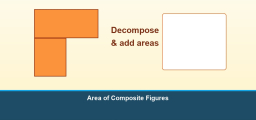
Decompose the figure into named solids (a cylinder plus a hemisphere, for example).
Compute the volume or surface area of each piece.
Combine: add volumes; for surface area, add only the exposed surfaces.
An ice-cream cone is topped by a hemisphere. The cone has r = 3 and h = 8. The hemisphere has r = 3.
For surface area, drop the cone’s circular top and the hemisphere’s flat circle, because they are joined and hidden. Surface area = lateral cone + hemisphere shell = π · 3 · ℓ + 2π · 9. Slant ℓ = √(9 + 64) = √73. SA = 3π√73 + 18π.
Units Mistakes That Cost Points
Volume uses cubic units (cm³, in³, ft³). Surface area uses square units (cm², in², ft²). Mixing them or forgetting the exponent on the unit costs full credit on most state tests.
Conversion catch: 1 m = 100 cm, but 1 m³ = 1,000,000 cm³ (because (100)³). Forgetting this is the most common conversion error.
The Slant Height vs. Height Trap
For pyramids and cones, height (h) is the perpendicular distance from base to apex. Slant height (ℓ) is along the lateral face from base edge to apex.
Volume always uses h.
Lateral surface area always uses ℓ.
If a problem gives you h and asks for surface area, compute ℓ first. If it gives ℓ and asks for volume, compute h first.
Use Pythagoras on the appropriate right triangle inside the solid.
A Quick Cheat Sheet
Solid
Volume
Surface Area
Cube
s³
6s²
Rectangular prism
lwh
2(lw + lh + wh)
Cylinder
π r² h
2π r² + 2π r h
Cone
(1/3) π r² h
π r² + π r ℓ
Sphere
(4/3) π r³
4π r²
Hemisphere
(2/3) π r³
3π r² (closed)
Square pyramid
(1/3) s² h
s² + 2sℓ
Triangular prism
(base area) h
2(base area) + (perimeter) h
Tape this inside your geometry binder.
Common Mistakes
Using diameter instead of radius. Half the diameter first.
Mixing units of volume and surface area. Cubic for volume, square for surface area.
Treating slant height as height for volume. Volume uses perpendicular height only.
Forgetting the (1/3) in pyramids and cones. Cone volume is one-third of the same-base-and-height cylinder.
Double-counting hidden surfaces in composite figures. Joined faces are not counted in surface area.
Frequently Asked Questions
Are these formulas on the SAT?
The SAT provides most of them in the reference box, but you save time by knowing them cold.
What’s the most-tested formula?
Cylinder volume on the SAT and ACT; rectangular prism in middle school; sphere volume in AP Calculus.
Do I need to prove these formulas?
Not in standard geometry. AP Calculus derives the sphere and cone formulas with integration.
Why is the cone formula one-third of the cylinder?
Because of the way solids built from triangular cross-sections behave under integration. The 1/3 appears for any pointed solid.
What if the problem uses π = 3 or π = 22/7?
Use whatever the problem tells you. Default to the exact answer (in terms of π) unless asked for a decimal.
Closing Thought
Solid geometry is a memorization unit, but the two patterns (base × height for prisms / cylinders, one-third of that for pyramids / cones) cut the workload in half. Drill the cheat sheet, label units, and never confuse slant height with height. Composite figures look hard but decompose into the same nine solids every time.
For more practice, browse our Geometry worksheets (resource currently unavailable) and our full Math Topics library. When you are ready for a structured workbook, our Geometry collection covers surface area and volume in depth.
by: Effortless Math Team about
(category: Articles)










What people say about "Surface Area and Volume Formulas Reference"?
No one replied yet.