Grade 6 Math: Area of Composite Figures
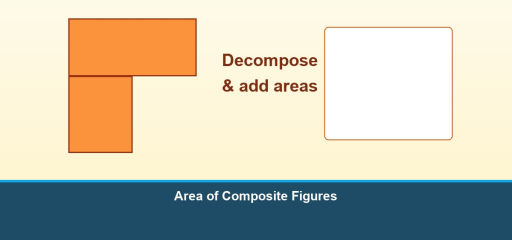
TL;DR: Composite figures are just simple shapes glued together, a rectangle joined to a triangle, an L-shape made of two rectangles, that kind of thing. To find the area, break the figure into pieces you recognize, calculate each piece’s area on its own, and add them up. If part of the figure is cut out, subtract that piece instead. You already know how to find the area of rectangles and triangles. This is just stitching those skills together.
Key takeaways:
- Composite figures are built from basic shapes: rectangles, triangles, trapezoids, circles, semicircles.
- Strategy 1: split the figure into shapes, find each area, then add.
- Strategy 2: surround the figure with a rectangle and subtract the missing pieces.
- Label each sub-shape’s dimensions clearly before doing arithmetic.
- Always include units squared (\(\text{cm}^2\), \(\text{in}^2\), etc.) in your final answer.
Grade 6 focus: A composite figure (or compound shape) is made from simpler figures, often rectangles and triangles. You find total area by adding areas of non-overlapping parts, or by subtracting a “cut-out” from a larger rectangle.
Video lesson: Watch this Math with Mr. J example of area for composite figures made from rectangles.
Strategy: Decompose
- Draw dashed lines to split the shape into rectangles/triangles you recognize.
- Label unknown lengths using properties of rectangles (opposite sides equal).
- Compute each area, then add (or subtract for holes).
Example (add regions)
An L-shape can split into two rectangles. Add their areas.
Example (subtract)
A rectangle with a rectangular hole: area = big rectangle − hole.
Explain your reasoning
Grade-level tasks often ask you to justify decompositions. Sketch, label, and show each area calculation.
Common mistakes
- Double-counting overlapping regions.
- Missing a hidden segment length needed for a sub-figure.
- Using perimeter where area is required.
Composite Figures: Complete Decomposition Guide
Master the systematic approach: identify basic shapes within the composite figure, separate them visually with dividing lines, calculate each area using standard formulas, and combine results. This method works for any complexity level. Examples include rectangle plus triangle (house shape), L-shapes created by subtracting one rectangle from another, and more complex multi-part figures.
Worked Examples with Full Reasoning
Rectangle plus triangle: 8×5=40 plus (1/2)x8x3=12 equals 52 cm². L-shaped figure: 12×10=120 minus 4×3=12 equals 108 cm². Trapezoid plus rectangle: 6×4=24 plus (1/2)(6+4)x3=15 equals 39 cm². Each example shows identifying shapes, calculating areas, and combining.
Review triangles, trapezoids, and compound figures for additional practice and related concepts.
Mastering Composite Figures: Decomposition Strategy
Composite figures are shapes constructed by combining two or more basic geometric forms like rectangles, triangles, circles, and trapezoids. Rather than seeking an obscure formula for an unusual shape, you employ decomposition: identify the basic shapes, calculate the area of each, and combine the results. This systematic approach works for any complexity level and teaches fundamental geometric reasoning.
The Decomposition Process
Begin by examining the composite figure carefully. Identify which basic geometric shapes comprise the overall figure. Visualize dividing lines that separate the composite figure into component shapes. Assign dimensions to each component based on the given measurements. Calculate the area of each basic shape using standard formulas. Add all areas together if combining shapes. Subtract removed areas if a piece has been cut out from a larger shape. Finally, verify that your units are correct (square centimeters, square inches, etc.) and that the final answer is reasonable given the figure’s approximate size.
Worked Example: Rectangle and Triangle Composition
A house-shaped figure consists of a rectangular base and a triangular roof. The rectangle measures 8 cm wide by 5 cm tall. The triangle sits on the rectangle’s top edge, with a base of 8 cm and height of 3 cm. Calculate the rectangle area: length times width equals 8 times 5 equals 40 cm². Calculate the triangle area: one-half times base times height equals one-half times 8 times 3 equals 12 cm². Add the areas: 40 + 12 equals 52 cm² total. This is the area of the entire house-shaped composite figure.
Worked Example: L-Shaped Figure Using Subtraction
An L-shaped courtyard can be calculated as a large rectangle with a smaller rectangular section removed from one corner. The outer dimensions are 12 meters by 10 meters, giving a large area of 120 m². The removed rectangular section measures 4 meters by 3 meters, with area 12 m². The L-shaped area equals 120 minus 12 equals 108 m². This method is often simpler than trying to separate the L into two rectangles when one section’s dimensions aren’t explicitly given.
Worked Example: Trapezoid and Rectangle Combination
A composite figure consists of a rectangle (6 cm by 4 cm) with a trapezoid attached to its top. The trapezoid has parallel sides of 6 cm (bottom, touching the rectangle) and 4 cm (top), with a height of 3 cm. Rectangle area: 6 times 4 equals 24 cm². Trapezoid area: one-half times (6 + 4) times 3 equals one-half times 10 times 3 equals 15 cm². Combined area: 24 + 15 equals 39 cm².
Common Composite Figure Patterns
House shapes combining rectangles and triangles appear frequently in geometry. L-shaped or stair-step figures use rectangular decomposition. Shapes with cut-out sections require subtraction of the removed area from a larger shape. Circular sections might be added or subtracted from rectangular bases.
Review our guides on triangles, trapezoids, and compound figures for additional practice and related concepts.
Mastering Composite Figures: Decomposition Strategy
Composite figures are shapes constructed by combining two or more basic geometric forms like rectangles, triangles, circles, and trapezoids. Rather than seeking an obscure formula for an unusual shape, you employ decomposition: identify the basic shapes, calculate the area of each, and combine the results. This systematic approach works for any complexity level and teaches fundamental geometric reasoning.
The Decomposition Process
Begin by examining the composite figure carefully. Identify which basic geometric shapes comprise the overall figure. Visualize dividing lines that separate the composite figure into component shapes. Assign dimensions to each component based on the given measurements. Calculate the area of each basic shape using standard formulas. Add all areas together if combining shapes. Subtract removed areas if a piece has been cut out from a larger shape. Finally, verify that your units are correct (square centimeters, square inches, etc.) and that the final answer is reasonable given the figure’s approximate size.
Worked Example: Rectangle and Triangle Composition
A house-shaped figure consists of a rectangular base and a triangular roof. The rectangle measures 8 cm wide by 5 cm tall. The triangle sits on the rectangle’s top edge, with a base of 8 cm and height of 3 cm. Calculate the rectangle area: length times width equals 8 times 5 equals 40 cm². Calculate the triangle area: one-half times base times height equals one-half times 8 times 3 equals 12 cm². Add the areas: 40 + 12 equals 52 cm² total. This is the area of the entire house-shaped composite figure.
Worked Example: L-Shaped Figure Using Subtraction
An L-shaped courtyard can be calculated as a large rectangle with a smaller rectangular section removed from one corner. The outer dimensions are 12 meters by 10 meters, giving a large area of 120 m². The removed rectangular section measures 4 meters by 3 meters, with area 12 m². The L-shaped area equals 120 minus 12 equals 108 m². This method is often simpler than trying to separate the L into two rectangles when one section’s dimensions aren’t explicitly given.
Worked Example: Trapezoid and Rectangle Combination
A composite figure consists of a rectangle (6 cm by 4 cm) with a trapezoid attached to its top. The trapezoid has parallel sides of 6 cm (bottom, touching the rectangle) and 4 cm (top), with a height of 3 cm. Rectangle area: 6 times 4 equals 24 cm². Trapezoid area: one-half times (6 + 4) times 3 equals one-half times 10 times 3 equals 15 cm². Combined area: 24 + 15 equals 39 cm².
Common Composite Figure Patterns
House shapes combining rectangles and triangles appear frequently in geometry. L-shaped or stair-step figures use rectangular decomposition. Shapes with cut-out sections require subtraction of the removed area from a larger shape. Circular sections might be added or subtracted from rectangular bases.
Review our guides on triangles, trapezoids, and compound figures for additional practice and related concepts.
Recommended EffortlessMath Books
For a workbook that covers area of every shape sixth graders see, the Mastering Grade 6 Math walks through rectangles, triangles, trapezoids, and composite figures with worked examples and practice sets. If you’re heading toward seventh-grade geometry (scale drawings, surface area, volume), Pre-Algebra for Beginners builds on the same foundation.
Frequently Asked Questions
What’s a composite figure?
A composite figure is a shape made by joining two or more simple shapes – like a rectangle and a triangle, or an L-shape made of two rectangles. Houses on paper, irregular gardens, and floor plans are common composite figures. To find the area, you break it into simple shapes you already know how to handle.
How do I find the area of a composite figure?
Two methods. (1) Split the figure into simple shapes, find each area, and add them together. (2) Surround the figure with a single big rectangle and subtract the missing corner pieces. Either method works – pick whichever makes the dimensions easier to track for the problem you have.
What are the formulas for the basic shapes?
Rectangle: \(A = l \times w\). Square: \(A = s^2\). Triangle: \(A = \tfrac{1}{2} \times b \times h\). Trapezoid: \(A = \tfrac{1}{2}(b_1 + b_2)h\). Parallelogram: \(A = b \times h\). Circle: \(A = \pi r^2\). Half-circle: \(\tfrac{1}{2}\pi r^2\). Memorize these – composite-figure problems use them constantly.
How do I find a missing side length?
Use the dimensions you’re given plus the properties of the shape. For an L-shape, the total length on one side equals the sum of the two segments on the other side. Add or subtract the labeled measurements to fill in what’s missing. Always sketch and label every dimension before computing areas.
Can I work in any unit?
Yes, but use the same unit throughout. If one side is in feet and another in inches, convert one to match the other first. Area always comes out in squared units – if your sides are in cm, your area is in \(\text{cm}^2\); if in inches, \(\text{in}^2\). Don’t drop the squared from your final answer.
What’s an example using the splitting method?
Consider an L-shape: a 10-cm-by-6-cm rectangle on top, joined to a 4-cm-by-3-cm rectangle on the bottom right. Split: top rectangle area is \(10 \times 6 = 60\,\text{cm}^2\), bottom rectangle area is \(4 \times 3 = 12\,\text{cm}^2\). Total: \(60 + 12 = 72\,\text{cm}^2\).
What’s an example using the subtraction method?
Same L-shape: imagine a big \(10 \times 9\) rectangle (area \(90\,\text{cm}^2\)) with a \(6 \times 3\) rectangle cut out of one corner (area \(18\,\text{cm}^2\)). \(90 – 18 = 72\,\text{cm}^2\). Same answer as the splitting method, different route to get there.
How do I handle figures with curves?
Treat the curve as a circle or semicircle. A rectangle with a half-circle on one end (like a track end): find the rectangle’s area, find the half-circle’s area (\(\tfrac{1}{2}\pi r^2\)), then add. If a circle is cut out of a square, subtract its area from the square’s area.
What’s a common mistake on composite-area problems?
Three common slips: (1) using the wrong dimension – the slant side instead of the perpendicular height of a triangle; (2) forgetting to fill in a missing side before computing; (3) writing the answer without the squared units. Slow down, sketch and label, double-check each formula, and your answer will hold up.
Where does this show up in sixth-grade math?
Composite-figure area is a key part of CCSS 6.G.1 – finding areas of polygons by composing or decomposing into known shapes. You’ll see these problems on the SBAC, FSA, PSSA, Georgia Milestones, M-STEP, STAAR, and almost every state grade-6 math test. Expect a couple of composite-area items each year, often as constructed-response.
Related EffortlessMath Lessons
If a topic on this page feels rusty, these short lessons go deeper:
- How to find the area of rectangles
- How to find the area of triangles
- How to find the area of trapezoids
- How to find the area of a circle (resource currently unavailable)
- How to solve multi-step word problems

Related to This Article
More math articles
- Surveys, Samples, and Nonresponse
- The Best Grade 7 ELA Practice Tests for Alaska Students
- Free Grade 7 English Worksheets for Maryland Students
- The Ultimate 7th Grade WY-TOPP Math Course (+FREE Worksheets)
- Full-Length HiSET Math Practice Test
- Ratification of the U.S. Constitution
- TSI Math Test: Complete Preparation Guide
- AFOQT Math-Test Day Tips
- The Best Grade 5 ELA Practice Tests for California Students
- Fifteen Reds in a Row: When Roulette Streaks Are Math, Not Magic
What people say about "Grade 6 Math: Area of Composite Figures"?
No one replied yet.