Online Baccarat vs. Land Baccarat: Where the Math Actually Diverges
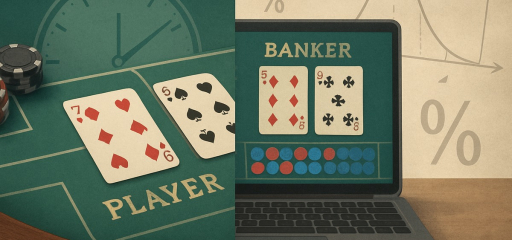
The house edge in baccarat doesn’t care whether you’re sitting on red velvet in Macau or tapping a phone in your kitchen, the percentages are identical down to the fourth decimal. What changes, and changes dramatically, is how fast that edge gets to chew on your bankroll. I’ve watched players who’d call themselves “low-stakes” lose more in two hours of online baccarat vs land baccarat sessions than they’d lose in a full Friday night at a brick-and-mortar pit. The cards didn’t betray them. The clock did.
The rules and edges match, exactly
Let’s settle this part fast, because it’s the part people argue about and shouldn’t. Banker bets carry a 1.06% house edge. Player bets sit at 1.24%. The Tie bet is a 14.36% trap whether it’s dealt by a tuxedoed croupier or a random number generator humming in a Maltese data center. These figures come straight from the standard 8-deck baccarat rules every reputable operator uses, and you can cross-check them against the breakdown at Wizard of Odds. Same drawing rules, same 5% commission on Banker, same payouts. If you’re hunting for some hidden online discount on the math itself, there isn’t one, and there shouldn’t be, since regulators in jurisdictions like the UK actively police that through bodies like the UK Gambling Commission.
So if the edges are equal, why do online players bleed faster? It’s pace. It’s always pace.
Pace: 6 seconds vs. 60 to 80 seconds per round
A live pit game is slow on purpose. The dealer shuffles, burns cards, calls the action, collects bets, pays winners, and chats with whoever’s holding court at seat 4. Round time on a normal land table runs somewhere between 60 and 80 seconds, sometimes longer if there’s a “squeeze” ritual happening at a high-limit table. Mini-baccarat speeds it up but still hovers around 40 to 50 seconds.

Online RNG baccarat? You can deal a hand, see the result, collect or lose, and re-bet in roughly six seconds. I’ve timed it. Click, animation, payout, click again. There’s no human friction, no shuffle, no chip handling, just a relentless loop. That’s the engine behind everything that follows.
Hands-per-hour math
Pace times sixty equals hands per hour, and the gap is brutal once you write it out. A leisurely land table churns through 45 to 70 hands per hour depending on table size and how many players are wagering. Online RNG can hit 600 hands per hour without breaking a sweat, and that’s assuming you’re not playing two tables at once, which plenty of online players do because the interface lets them.
Here’s the comparison I keep coming back to when friends ask why their online sessions feel “unlucky”:
| Format | Round time | Hands/hour | Banker edge | Expected loss/hr @ $25/hand |
|---|---|---|---|---|
| Land baccarat (full table) | ~72 sec | 50 | 1.06% | $13.25 |
| Land mini-baccarat | ~45 sec | ~80 | 1.06% | $21.20 |
| Live dealer online | ~50 sec | ~70 | 1.06% | $18.55 |
| Online RNG baccarat | ~6 sec | 600 | 1.06% | $159.00 |
That’s a 12x expected-loss multiplier between a regular land table and online RNG. Same game. Same edge. Twelve times the damage. And if you push the online figure up because you’re multi-tabling, which I’d argue most app-based players do without thinking, you can comfortably double it again.
RNG vs. Shuffled shoe: statistically identical
I’ll say this clearly because it’s the conspiracy theory I hear most often: a properly certified RNG produces results that are statistically indistinguishable from a freshly shuffled 8-deck shoe. The distribution of Banker/Player/Tie outcomes converges on the same long-run frequencies. Reputable RNG software is audited by independent labs, eCOGRA, iTech Labs, GLI, and the certification reports are public. If the certificate isn’t there, that’s the operator you don’t play with. It’s that simple.
The reason this matters is that some folks will say “the RNG ate my bankroll faster” and conclude it’s rigged. It isn’t rigged. It’s just feeding you 12x the trials, and the law of large numbers does the rest. You can’t outrun variance when you’re playing 600 hands an hour against a negative-EV game, the math will find you. Always does.
Live dealer online sits squarely between
Live dealer baccarat is the format people don’t talk about enough, and I think it’s the most honest version of online play. A real dealer, real cards, a real shoe, streamed from a studio. You can’t deal hands faster than the dealer can physically deal them, so pace lands around 50 seconds per round, close to mini-baccarat. That’s ~70 hands per hour, which gives you the expected hourly loss of $25 × 70 × 0.0106 = $18.55 on Banker.
If you want online convenience but don’t want the RNG flywheel, this is the compromise. You’re paying a small premium in pace vs. A full land table, but you’re not getting steamrolled by the 6-second loop. I’d recommend it over RNG for anyone whose self-control is honest enough to admit it has limits, and most of us should admit that.
Side bets get more aggressive online
Land casinos run a tight menu: Banker, Player, Tie, sometimes Banker Pair and Player Pair. House edges on the pair bets sit around 10.36%, which is already rough. Online operators, freed from physical felt and dealer training, pile on side bets like it’s a buffet, Dragon Bonus, Lucky 6, Panda 8, Tiger, Big/Small, Either Pair, Perfect Pair. Edges on these typically run between 5% and 14%, and some niche ones climb past 20%.
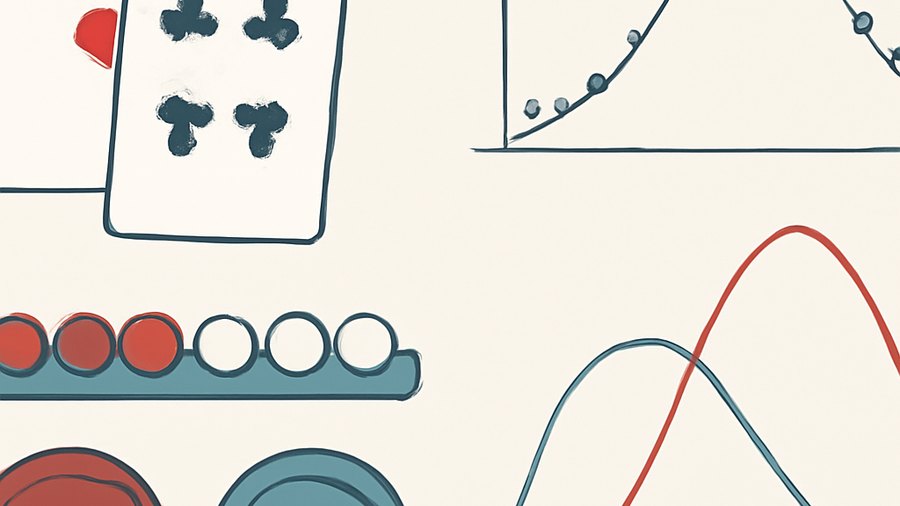
- Banker Pair / Player Pair: ~10.36% edge, bad on land, bad online.
- Tie: 14.36% edge, universally awful.
- Dragon Bonus: ~2.65% on Player, ~9.37% on Banker.
- Lucky 6: ~16% edge, one of the worst regular offerings.
- Panda 8 / Dragon 7: ~10.19% / ~7.61%, popular and punishing.
- Perfect Pair: ~13.05% edge, looks cute, isn’t.
The exposure problem isn’t just that the edges are higher. It’s that online interfaces nudge you toward stacking them. Land dealers don’t push side bets. Online interfaces highlight them with glowing buttons and animated payouts. Combine a 10%+ side bet with 600 hands per hour and you’ve built a money incinerator. I’m not trying to be dramatic about it; that’s literally what the EV calculation says.
Table minimums and bankroll dynamics differ
Land tables in major US markets usually start at $25 minimum, often $50 on weekends, and high-limit rooms push to $100+. That natural friction caps how many hands a casual player can sit through before tapping out. Online RNG tables routinely start at $1, sometimes $0.10 on certain platforms. Sounds friendlier, right? It isn’t, necessarily.
What happens is that the low minimum lets players sit indefinitely, and the high pace lets them play thousands of hands. Even at $1 per hand, 600 hands per hour at 1.06% is an expected loss of $6.36/hr, modest in isolation, but most online players don’t stay at the minimum. They ratchet up after a few wins, ratchet up further after a loss they want to recover, and end up averaging $10, $25/hand by hour two. That’s when the math from the table above starts applying.
There’s also a deposit/withdrawal asymmetry online that I think gets undersold. Money flows in instantly through stored cards, but cashouts often take 1 to 5 business days. That delay does exactly what it’s designed to do. It lets winnings sit in your account, available to be re-wagered, when at a land casino you’d have walked out with chips and cashed them. I’ve seen sharp players who can manage this discipline. I’ve seen many more who can’t. For broader gambling math literacy beyond baccarat, the same probability principles apply across every casino format you’ll encounter, and free practice with those foundations is available at EffortlessMath.
Variance feels worse online, and there’s a reason
Here’s something I don’t see discussed enough: the subjective experience of variance is wildly different across formats, and it tricks players into bad decisions. At a land table, a 10-hand losing streak takes roughly 12 minutes. You’ve got time to breathe, sip your drink, watch other players, maybe walk away. Online RNG can deliver that same 10-hand streak in 60 seconds flat, and your reflex is to keep clicking because the next round is already loaded and waiting.
Statistically, the distribution of streaks is identical. Banker still hits roughly 45.86% of resolved hands, Player 44.62%, Tie 9.52%. But the emotional density of those streaks compresses online, and that compression is what drives chase-betting. I’ve watched smart, mathematically literate people double their stakes after a four-hand losing run that, at a land table, would’ve barely registered. The clock matters. The interface matters. Don’t let anyone tell you otherwise.
Bonuses, wagering requirements, and the hidden friction
Online operators offer deposit bonuses that land casinos can’t really match, but the wagering requirements attached often disqualify baccarat or weight it at 10 to 20% of contribution. That means a $100 bonus with a 30x rollover might require $30,000 of baccarat action to clear, and over that volume your expected loss on Banker alone is $30,000 × 0.0106 = $318. The bonus is $100. You can do that arithmetic yourself. Most “free money” promotions in baccarat are negative-EV by design once you read the fine print, and the fine print is where regulators like the UK Gambling Commission focus a lot of their consumer-protection work.
What it actually adds up to
If you take nothing else from this article, take the multiplier. Same edge, same rules, same game, but 8 to 12x the expected hourly loss when you move from a brick-and-mortar table to an online RNG client, and that’s before side bets or multi-tabling. Live dealer online lands close to land mini-baccarat. Full land tables remain the slowest, gentlest version of the game your bankroll will encounter. It’s not that online is “worse.” It’s that online compresses time, and time is what you’re really betting against in a negative-EV game.
FAQ
Q: Is online baccarat rigged because I lose faster?
No. Certified RNGs produce statistically identical outcomes to shuffled shoes. You’re losing faster because you’re playing 8 to 12x more hands per hour, and the house edge is doing its job on more trials. It’s volume, not corruption.
Q: Is the Banker bet still the best option online?
Yes. The 1.06% Banker edge is the lowest on the felt regardless of format. Player at 1.24% is close behind. Tie at 14.36% is a trap in any venue.
Q: Does live dealer online give me a better deal than RNG?
The edge is identical, but pace is much slower, about 70 hands/hr vs. 600 hands/hr. That alone cuts your expected hourly loss to roughly an eighth of what RNG inflicts. It’s the closest online format to a real land session.
Q: Should I avoid baccarat side bets entirely?
If you care about EV, yes. Edges of 7 to 16% will eat through your bankroll dramatically faster than the main bets. The occasional side bet for fun is a personal call, but don’t pretend it’s a strategy.
Q: Can I beat baccarat with a betting system like Martingale?
No betting progression changes the underlying house edge. They just rearrange when and how the variance hits you, and with table limits and finite bankrolls, the math still wins long-term. Pace is what determines how fast you discover this.
Gambling outcomes are uncertain; no strategy guarantees profit.

Related to This Article
More math articles
- Math Books for 8th Graders: Compare Four Options by Learning Need
- Registered voters
- Long Division Calculator (Step by Step)
- 10 Most Common 8th Grade Common Core Math Questions
- The Housing Bubble, Financial Crisis, and Great Recession
- Top 10 ACT Math Practice Questions
- 5th Grade SBAC Math Practice Test Questions
- Issue ownership and party cues
- The Best Grade 5 ELA Practice Tests for Texas Students
- Visual Cleanliness Inspection









What people say about "Online Baccarat vs. Land Baccarat: Where the Math Actually Diverges - Effortless Math"?
No one replied yet.