Baccarat Scoreboards: What the Big Eye Road Actually Tracks
Walk into any baccarat pit in Macau, Manila, or a Las Vegas high-limit room and you will see something that looks almost nothing like blackjack or craps. Players hunch over little paper grids, or peer at the giant LED scoreboards above the table, scribbling red and blue marks. They are tracking baccarat scoreboards, and depending on who you ask, those grids are either a deep tradition of the game or one of the most elaborate exercises in pattern-finding in all of gambling. This article walks through what each road on the board actually records, how the derived roads are built mechanically from the main one, and what all of that does and does not tell you about the next hand.
The Bead Plate: Raw Results, Hand by Hand
The simplest scoreboard on a baccarat table is the bead plate. It is a grid that fills top to bottom, then wraps to the next column. Each cell records one hand: a red mark for Banker, a blue mark for Player, and a green mark for a Tie. Some boards also add a small corner dot for a Banker Pair or Player Pair side bet result.
That is it. The bead plate is just a chronological log. It is the raw data feed that every other road on the board is built from.
The Big Road: Streaks Collapsed Into Columns
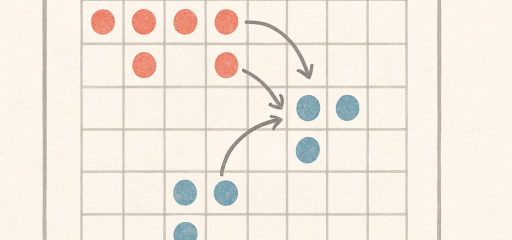
The big road is the headline scoreboard, the one that takes up the most space and looks like a wall of red and blue circles. Its rule differs from the bead plate: a new column starts only when the result changes. Ties do not start a new column; they get drawn as a green slash through the most recent Banker or Player circle, with a small number sometimes indicating multiple ties in a row.

So if the first three hands are Banker, Banker, Banker, the big road shows three red circles stacked vertically in column one. If hand four is Player, a new column starts with a blue circle. The big road is a streak-collapsed view of the same data the bead plate holds, and it is the only roadmap that records actual outcomes. The three derived roads we discuss next are built from the shape of the big road, not from the underlying results.
How the Big Eye Road Is Derived
The Big Eye Road, sometimes called the Big Eye Boy, is where things get strange. The marks are still red and blue, but they no longer mean Banker and Player. They mean roughly “the pattern is repeating” (red) or “the pattern is choppy” (blue). It starts being drawn from the second hand of the second column of the big road onward.
The rule looks one column back. If you are placing a mark for the top cell of a new column on the big road, compare the previous two columns. Same length means red, different length means blue. If you are placing a mark deeper into a column, compare the cell to the immediate left. If a cell exists there, mark red. If empty, mark blue.
This is deterministic. Given any big road, two people drawing the Big Eye Road from it will produce the same pattern every time. The Wizard of Odds page on baccarat scorecards walks through the same rules with diagrams.
The Small Road: Looking Two Columns Back
The Small Road uses identical comparison logic as the Big Eye Road, with one change: it looks two columns back instead of one. It starts being drawn from the second hand of the third column of the big road. Same length means red, different means blue; cell exists two columns to the left at the same row means red, empty means blue. Because it skips a column, the Small Road often diverges from the Big Eye Road where short streaks alternate with long ones.
The Cockroach Road: Three Columns Back
The Cockroach Road, sometimes called the Cockroach Pig, applies the same rule once more, this time looking three columns back. It begins from the second hand of the fourth column of the big road. There is nothing special about stopping at three. The rule generalizes to any lookback distance; the tradition stopped at three for visual reasons. Beyond that, the marks become too sparse to feel meaningful.
Side-by-Side Derivation Rules
Here is a compact reference for what each road tracks and how each derived road is built:
| Road | What It Records | Column Lookback | Mark Meaning |
|---|---|---|---|
| Bead Plate | Raw hand results in order | None | Red = Banker, Blue = Player, Green = Tie |
| Big Road | Streaks of Banker or Player, ties overlaid | None | Red = Banker, Blue = Player |
| Big Eye Road | Pattern regularity of big road | 1 column | Red = repeating, Blue = non-repeating |
| Small Road | Pattern regularity of big road | 2 columns | Red = repeating, Blue = non-repeating |
| Cockroach Road | Pattern regularity of big road | 3 columns | Red = repeating, Blue = non-repeating |
A Worked Ten-Hand Example
Suppose the first ten hands of a shoe come out in this order: Banker, Banker, Player, Player, Player, Banker, Player, Banker, Banker, Banker. Ignore ties for clarity, since they would just be overlays. The big road, built by starting a new column on each change, looks like this:
- Column 1: B, B (two red circles)
- Column 2: P, P, P (three blue circles)
- Column 3: B (one red)
- Column 4: P (one blue)
- Column 5: B, B, B (three red)
Now derive the Big Eye Road. The first mark goes at the top of column 2 of the Big Eye Road, corresponding to a top-of-new-column event on column 3 of the big road. Compare column 2 (length 3) with column 1 (length 2). Different lengths, so the mark is blue. At the top of column 4 on the big road, compare column 3 (length 1) with column 2 (length 3). Different lengths, mark blue. At the top of column 5, compare column 4 (length 1) with column 3 (length 1). Same lengths, mark red. The next two hands extend column 5 downward; column 4 has only one cell, so rows 2 and 3 are empty, and both marks are blue.
The Small Road starts later, from column 3 of the big road’s second hand, and compares against two columns back. The Cockroach Road starts from column 4 and compares against three columns back. The point isn’t the specific colors that come out. It’s that every mark on every derived road is forced by the big road. There is no new information anywhere on the display.
How the Marks Are Actually Drawn on the Display
The derived roads do not occupy the same grid as the big road. Each has its own grid, drawn beside or below the big road at a smaller scale. When a hand finishes, the display recomputes all three derived roads from scratch in milliseconds, applying the same logic a pit clerk used to apply by hand with red and blue pens.
What These Roads Do Not Predict
Here is the part that the boards themselves never tell you. The probability of the next hand being Banker, Player, or Tie depends only on the composition of the remaining cards in the shoe. In an eight-deck shoe near the start, the house edge is about 1.06 percent on Banker, 1.24 percent on Player, and roughly 14.4 percent on the Tie. Card removal across a shoe changes these numbers by tiny amounts, almost always too small to overcome the edge.
None of the four roadmaps reads the remaining cards. They read past outcomes. The bead plate and big road are honest summaries of history. The Big Eye, Small, and Cockroach roads are summaries of summaries. None of them changes the math of the next hand. A long red streak on the big road is the same kind of object as a long run of heads on a fair coin: it happened, and the next flip does not know about it.
Why Players Still Use Them
If the roads carry no predictive information, why does an entire global gambling subculture revolve around them? A few honest reasons:
- They give the player something to do between hands, which slows betting and can reduce total amount wagered per hour.
- They impose a structure on a game that otherwise feels like pure waiting, which makes long sessions more tolerable.
- They create shared vocabulary at the table, which is part of the social experience of baccarat.
- They occasionally produce moments where all three derived roads “agree,” and acting on those moments feels like skill even when the underlying odds are unchanged.
None of these reasons require the roads to predict anything. They are entertainment infrastructure, and treating them honestly as entertainment infrastructure is a healthier framing than treating them as a forecasting tool. For readers who like working through the underlying numbers themselves, the kind of arithmetic and probability practice on Effortless Math is a better foundation than any pattern reading at the table.
The Psychology of Pattern-Seeking
Humans are extremely good at finding patterns, including in places where no pattern exists. Show a person a string of coin flips and they will instinctively label the streaks, the “switchy” stretches, the “due” outcomes. The brain treats short sequences of a random process as if they should look more balanced than they actually do, a tendency well documented in studies of the gambler’s fallacy and the related “hot hand” effect.
Baccarat scoreboards are pattern-seeking made architectural. The casino has built a display that lets the player draw conclusions from random data using deterministic transformations of that random data. Because the transformations are deterministic, the player gets the comforting feeling of working with structure. Because the underlying outcomes are independent, the structure does not connect to the next result. Recognizing this gap isn’t the same as refusing to enjoy the game. It’s just being clear about which part is math and which part is theater.
There is also a feedback element. A player who has decided the roads predict something will tend to remember the hands where the prediction worked and forget the hands where it did not. In a near fifty-fifty game played for hundreds of hands a session, plenty of guesses will look correct by accident.
FAQ
Q: Do baccarat scoreboards work in any sense at all?
They work as accurate records of past hands and as deterministic transformations of those records. They do not work as forecasts of the next hand. Each hand stays independent of the displayed history.
Q: If three derived roads all show red, should I bet on a repeat?
The roads agreeing is a property of the big road’s recent shape, not a property of the cards still to be dealt. The house edge on Banker and Player is what it is regardless of road agreement.
Q: Why is Banker drawn red and Player drawn blue?
It is convention from Macau and Hong Kong baccarat tradition. Red is the more auspicious color in Chinese custom, and Banker has the slightly lower house edge, which fits the association. The colors carry no mathematical content.
Q: Are the derived roads used in any other casino game?
The specific Big Eye, Small, and Cockroach road system is essentially unique to baccarat. Other games have scoreboards (roulette boards showing recent numbers, for example), but the layered derivation idea did not migrate.
Q: Can a computer program beat baccarat by reading the roads?
No. The roads are functions of past results, and past results in baccarat have negligible influence on the deck composition going forward. Without changing the underlying probabilities, no transformation of history creates an edge.
Gambling outcomes are uncertain; no strategy guarantees profit.

Related to This Article
More math articles
- Free Grade 5 English Worksheets for Rhode Island Students
- Intelligent Math Puzzle – Challenge 92
- Free Grade 7 English Worksheets for Virginia Students
- Impression Management and Regions
- Algebra Puzzle – Challenge 55
- Grade 3 Math Flashcards (Free Online: Formulas, Terms & Concepts)
- Word Problems: Multiplication for 4th Grade
- p-Series in Infinite Sums: Convergence Test Simplified
- Entry eliminates long-run economic profit
- The Best Algebra 1 Book for Oklahoma Students










What people say about "Baccarat Scoreboards: What the Big Eye Road Actually Tracks - Effortless Math"?
No one replied yet.