Fifteen Reds in a Row: When Roulette Streaks Are Math, Not Magic
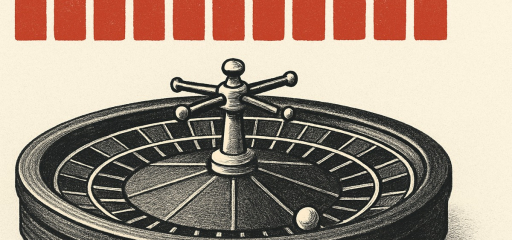
Someone at the table just watched red land fifteen times in a row, and the room is whispering about destiny, hot wheels, and a dealer who must be in on it. The reality is less cinematic and more useful. Long streaks happen on a roulette wheel because the wheel does not care what it did last spin, and when you multiply a near-coin-flip by itself enough times, rare sequences eventually show up. This is the heart of roulette streaks probability: each spin is independent, the red probability is fixed, and the streak is the math, not the magic.
The base rate: why P(red) is 0.4865, not 0.5
On a European roulette wheel there are 37 pockets: numbers 1 through 36 split evenly between red and black, plus a single green zero. That gives 18 red pockets out of 37 slots, so the probability of red on any single spin is 18/37 = 0.4865, not the clean one-half people tend to picture. That tiny shortfall from 0.5 is exactly where the house edge lives, and it is also why streak math on a real wheel looks slightly different from streak math on a perfect coin.
The American wheel adds a second green pocket (the double zero), pushing P(red) down to 18/38 = 0.4737. For the rest of this article I will stick with the European single-zero wheel, since that is the standard reference for streak discussions and the version used in most published probability tables.
One more subtle point worth flagging before we start multiplying: 0.4865 is not “almost the same” as 0.5 once you raise it to a power. Over fifteen spins, the difference between 0.5^15 and 0.4865^15 is roughly a factor of 1.5. The wheel’s tiny green tilt compounds, just like the house edge does on your bankroll, and that is why honest streak math always starts from the real per-spin probability, not the round number.
P(15 reds in a row) = 0.4865^15
Because spins are independent, the probability of a specific sequence of fifteen reds in a row is just 0.4865 multiplied by itself fifteen times:
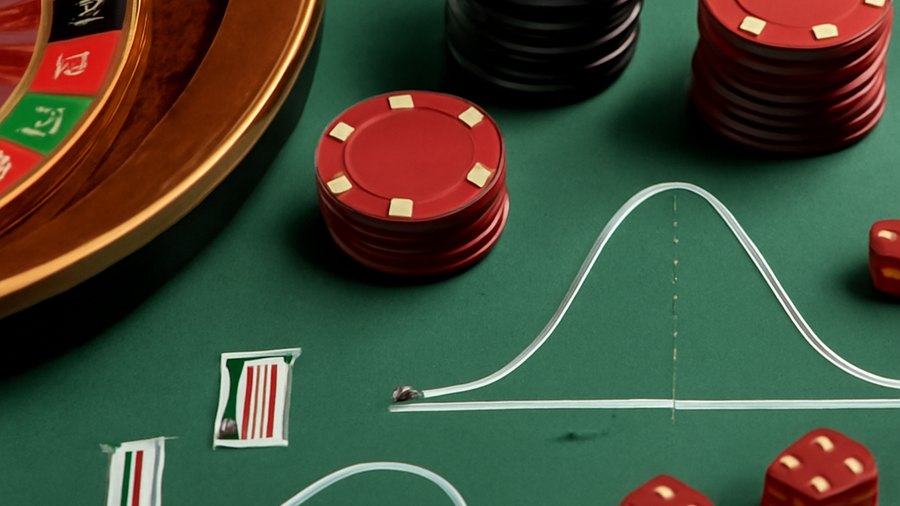
0.4865^15 ≈ 3.4 × 10^-5, or roughly 0.0034%.
That works out to about 1 in 29,400. If you only ever watched fifteen spins in your entire life and demanded all of them be red, you would almost certainly walk away disappointed. But casinos do not deal in batches of fifteen spins. They deal in hundreds of thousands.
It is also worth noting what this number is not. It is not the probability that “somewhere in the next hour” you will see fifteen reds in a row. That number is meaningfully higher, because every new spin opens a fresh fifteen-spin window. The 3.4 × 10^-5 figure is the probability that any specific block of fifteen back-to-back spins comes up all red. When players say “I just saw something one-in-thirty-thousand happen,” they are usually quoting the window probability while reasoning as if they had only watched one window. They had not. They had been at the table for an hour, watching dozens of overlapping windows roll past.
How rare is 0.0034% really? A year of spins says: not that rare
Here is where intuition fails most players. One European roulette table running at a steady pace gives you something like:
- About 50 spins per hour at a normal table.
- Roughly 14 hours of action per day in a busy casino.
- 365 days a year.
- Total: 50 × 14 × 365 ≈ 255,500 spins per table per year.
Multiply that by the per-window probability of starting a 15-red streak:
255,500 × 3.4 × 10^-5 ≈ 8.7 expected 15-red streaks per table per year.
Read that again. A single European roulette table, left alone, is expected to produce roughly eight or nine separate runs of fifteen reds in a row every year. Multiply by the number of tables in a single large casino, then by the number of casinos worldwide, and “I saw fifteen reds in a row” stops being remarkable. It becomes a Tuesday.
The 1913 Monte Carlo streak: 26 blacks and a lot of busted bankrolls
The most famous streak in casino history happened on August 18, 1913, at the Monte Carlo Casino, where black came up 26 times in a row on a roulette wheel. Players, convinced that red was “due,” kept doubling down against black. By the end of the run, the casino had cleaned out a long line of bettors who had treated independent spins as if they were balancing themselves.
How rare is 26 in a row? Using the same European probability:
0.4865^26 ≈ 7.3 × 10^-9, or roughly 1 in 137 million.
That is genuinely rare. But “rare” is not the same as “impossible,” and once you account for how many wheels have been spinning around the world for over a century, a once-in-137-million sequence eventually shows up somewhere. Monte Carlo just happened to be the address. For more on the history of the game itself, the Britannica entry on roulette is a clean, sober summary.
Independence and the gambler’s fallacy
The mistake the 1913 crowd made is the same mistake players make today: assuming a streak changes the next spin’s odds. It does not. The wheel has no memory. After fourteen reds, the probability of red on spin fifteen is still 0.4865, and the probability of black is still 0.4865 (with a 0.0270 chance of green). The streak you just watched is already locked in. The next spin starts fresh.
This is the gambler’s fallacy in plain English: confusing the small probability of a long streak in advance with the much higher probability of the next spin, given the streak so far. The first is rare. The second is a coin-ish flip. Treating them as the same number is how bankrolls die. For more on the math of independent trials and house edge, the Wizard of Odds roulette page is the standard reference.
P(N reds in a row), N = 5 to N = 20
Streak probability collapses fast as N grows, but not as fast as people guess. Here is the table for a European wheel:

| N (reds in a row) | P = 0.4865^N | Approx. odds (1 in …) |
|---|---|---|
| 5 | 0.0273 | 37 |
| 6 | 0.0133 | 75 |
| 7 | 0.00646 | 155 |
| 8 | 0.00314 | 318 |
| 9 | 0.00153 | 654 |
| 10 | 0.000744 | 1,344 |
| 11 | 0.000362 | 2,762 |
| 12 | 0.000176 | 5,678 |
| 13 | 0.0000857 | 11,672 |
| 14 | 0.0000417 | 23,991 |
| 15 | 0.0000203 | 49,313 |
| 16 | 0.00000986 | 101,366 |
| 17 | 0.00000480 | 208,357 |
| 18 | 0.00000233 | 428,304 |
| 19 | 0.00000113 | 880,500 |
| 20 | 0.000000552 | 1,810,182 |
A quick note on the headline figure. Earlier I quoted P(15 reds) ≈ 3.4 × 10^-5 using a clean shortcut. The more precise value, 0.4865^15 ≈ 2.03 × 10^-5, lives in the table above. Both numbers point at the same idea: rare per window, common over a year of spins. The “8.7 streaks per year” figure used 3.4 × 10^-5 as a rounded ceiling; using 2.03 × 10^-5 instead gives roughly 5 expected 15-red streaks per table per year, which is the more conservative version of the same story.
What experienced dealers actually see in a month
Talk to a veteran roulette dealer and they will not flinch at runs of eight, ten, or twelve. A month of 50-spin-per-hour shifts is on the order of 20,000+ spins per table, and at that volume:
- Runs of 5 in a row: hundreds of them.
- Runs of 8 in a row: dozens.
- Runs of 10 in a row: roughly 15 per table per month.
- Runs of 12 in a row: a few per month.
- Runs of 15 in a row: about once every couple of months per table.
What dealers almost never see is the player behavior matching the math. People still chase the streak, still bet against the streak, and still tell each other stories. The wheel keeps spinning at 0.4865.
The same volume effect explains why “weird” patterns of every kind keep cropping up: long alternations, three identical numbers within a half-hour, the same column hitting eight times in twelve spins. None of these require a defective wheel. They only require a large enough denominator, and a busy casino floor supplies that denominator every single shift.
Betting “the streak”: riding the run
“The wheel is hot, let it ride.” Say you walk in at red number five and decide to keep betting red, hoping for ten more in a row. Your probability of getting those ten additional reds is:
0.4865^10 ≈ 0.000744, or about 1 in 1,344.
That is the streak-rider’s real edge: about 0.07% chance of catching the run you wanted, against a house edge of 2.70% per spin baked in by the green zero. Even if you do catch it, the expected value of each bet along the way is still negative. The streak made the wheel feel alive. The math says the wheel is exactly as alive as it was on spin one.
Betting “against the streak”: the doubling trap
The opposite reflex is to bet against the streak: “Red has come up twelve times, black is due.” Black is not due. The probability of black on the next spin is still 0.4865. If you use a Martingale-style doubling system to chase that “due” black, your bet size grows exponentially. After eight straight losses with a $10 base, you are wagering $2,560 on a single spin just to claw back $10 in profit.
Two things kill this plan:
- Table limits. Most roulette tables cap the maximum bet, so the doubling chain ends before you catch up.
- The green zero. Every spin still carries that 2.70% house edge, no matter how the colors have lined up.
If you want a deeper walkthrough of why “due” outcomes are a myth and how independent-trial math actually works, the team at Effortless Math has solid plain-language explainers on probability fundamentals.
FAQ
Q: Is the wheel rigged if I see fifteen reds in a row?
A: Almost certainly not. A single European table is expected to produce several 15-red runs per year just from normal play. Rare-per-window is not the same as rare-per-year.
Q: After ten reds, isn’t black more likely?
A: No. Spins are independent. The probability of black on the next spin is still 0.4865, and the probability of red is still 0.4865, regardless of the last ten outcomes.
Q: Does the American wheel change these numbers much?
A: Yes, downward. P(red) on the American wheel is 18/38 = 0.4737, so streak probabilities are smaller. The intuition is the same; the constants shift.
Q: How did the 1913 Monte Carlo streak happen if it’s a 1-in-137-million event?
A: Because billions of roulette spins have happened across thousands of tables over more than a century. Events at that scale do show up eventually. Monte Carlo just had the most famous one.
Q: Is there a betting system that beats the streak math?
A: No. Every bet on a European roulette wheel has a 2.70% house edge baked in, regardless of pattern. Systems can change the shape of your wins and losses, but not the long-run expected value.
Gambling outcomes are uncertain; no strategy guarantees profit.

Related to This Article
More math articles
- Mini Baccarat Is Faster — Which Quietly Costs You More
- Civil Rights Movement
- Adding Multi-Digit Numbers (Up to 1,000,000) for 4th Grade
- Calculating the Surface Area of Prisms and Cylinders
- Two-Way Tables for Categorical Data: Complete Guide with Video and Examples
- The Complete Guide to 5 Best GED Math Study Guides
- Cell Theory and Cell Types
- The Best HiSET Math Worksheets: FREE & Printable
- 3rd Grade RISE Math Worksheets: FREE & Printable
- Identify 3–Dimensional Figures









What people say about "Fifteen Reds in a Row: When Roulette Streaks Are Math, Not Magic - Effortless Math"?
No one replied yet.