Predicting Crash Points: Why the Math Says No

Crash games look like they should be predictable. A multiplier ticks upward, players cash out one by one, and then at some unknowable moment the curve snaps and everyone still holding loses. Watch a few rounds and your brain starts whispering that there must be a rhythm to it, some hidden tell that explains why the last three rounds busted under 1.5x and the one before that ran to 47x. There is no rhythm. The math behind crash game prediction is closed at both ends: the next multiplier is generated from a cryptographic hash, and the hash is designed specifically to defeat the kind of pattern matching humans are good at. This article walks through how the seeds work, why the distribution is memoryless, why the prediction industry is selling you nothing, and how to actually verify that a round was honest.
The cryptographic seed structure
Most crash games use a three-part input to decide each round’s multiplier: a server seed, a client seed, and a nonce. The server seed is a long random string the operator generates before any round is played. The client seed is something you (or your browser) supply, often editable from your account settings. The nonce is just a counter that goes up by one each round. The operator concatenates these three values and runs them through a cryptographic hash like HMAC-SHA256 or SHA-512.
The output is a hexadecimal string. The game takes some slice of that string, treats it as an integer, and runs a small formula to convert it into a crash multiplier. A common version looks like this:
crash_point = floor((2^32 / (hash_value % 10^7)) * 0.99) / 100
The 0.99 factor is the house edge baked directly into the formula. The modulo and division turn a uniform integer into a multiplier whose distribution is heavy on small values and thin on large ones. Because the hash output is indistinguishable from uniform random for any computationally bounded observer, the resulting multiplier is, for your purposes, drawn from a fixed distribution every round.
Pre-committed seeds and why they matter
The clever part of the setup is that the server seed is committed to before you bet. The operator publishes a hash of the server seed (not the seed itself) at the start of a session or batch of rounds. You can save that hash. After the rounds are done, the operator reveals the original seed, and you can hash it yourself and confirm it matches what was published earlier.

That means the operator could not have changed the seed mid-session to punish a player on a hot streak. The seed was locked in before anyone knew what the client seeds and nonces would be. Combined with the fact that you can choose your own client seed, you end up with a system where neither side can manipulate a specific round without being caught after the fact. This is the actual cryptographic guarantee. It is not a guarantee that you will win.
The memoryless property of the crash distribution
Here is the single most important fact about crash games, and the one the prediction sellers refuse to acknowledge: the multiplier distribution is essentially memoryless. The standard formula above produces something close to an exponential distribution, and exponential distributions have the property that
P(X > a + b | X > a) = P(X > b)
In plain English, knowing that the current round has already passed 2x tells you nothing useful about whether it will reach 5x. Each new round is also independent of every previous round. The hash that produced last round’s crash and the hash that will produce next round’s crash share no information beyond what the nonce contributes, and the nonce changes deterministically. So:
P(next crash | last 10 crashes) = P(next crash)
That equation isn’t an approximation. It’s what independence means. The last ten crashes, the last thousand crashes, the entire history of the game, all of it contributes zero information to the next round’s outcome. If you think you have spotted a pattern, what you have actually spotted is the human tendency to find faces in clouds.
Common prediction scams
An entire micro-industry has grown up around selling things that cannot work. The pitches vary, but the underlying claim is always the same: that there is a hidden structure in the multiplier sequence that the seller has cracked.
- Paid AI signals. A Telegram channel or Discord bot that tells you when to bet and when to cash out, often for a monthly fee. The signals are random or lightly tuned to the long-run average, and the seller cherry-picks screenshots of winning calls.
- Pattern overlay tools. Browser extensions that draw lines and zones on the multiplier history. They predict what should happen next based on what looks like trend analysis. The overlays are mathematical theater.
- Predictor apps. Mobile apps that ask you to enter recent crash points and then output a “next crash” number. These cannot work for the reason explained above. Past crashes carry no information.
- “Hacked” seed sellers. Sites claiming to sell upcoming server seeds. If they actually had the seed before a round, the operator would notice the abnormal win rate and revoke or rotate the seed. They do not have the seed.
- Free predictors with affiliate links. The predictor itself is useless, but the link sends you to a casino where the seller earns a commission on your losses.
Why past crashes carry zero information
The reason this point needs repeating is that it feels wrong to almost everyone. If the last six rounds crashed under 1.3x, surely a big one is “due”? No. That is the gambler’s fallacy in its purest form. The next round draws from the same distribution as the previous round, regardless of what came before. There is no cosmic ledger balancing out short crashes with long ones.
You can test this yourself with the published seed history of any provably fair crash game. Take a thousand consecutive rounds, label each one as “above median” or “below median”, and compute the conditional probability of an “above median” round given the previous five outcomes. You will find it sits at almost exactly 0.5 no matter what the previous five were. The correlation is zero within sampling noise. That is what independence looks like in real data.
There is one subtle exception worth naming, because the prediction crowd will sometimes wave at it as if it were a loophole. If you and another player share the same client seed and the operator does not isolate your nonce streams, your outcomes will be correlated. That is not a way to win money, it is just a setup detail. Every serious crash implementation separates nonce counters per player precisely so that no shared client seed gives anyone an information edge. The correlations you can engineer this way are visible to the operator and to anyone reading the verification output, and they cancel against the house edge anyway.
What “provably fair” means and what it doesn’t
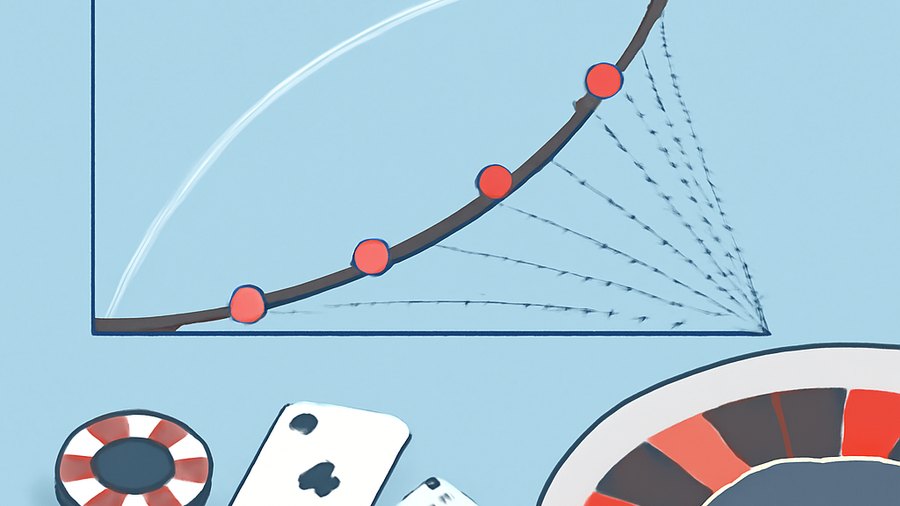
Provably fair is one of the more misunderstood phrases in online gambling. It means the math is honest. It does not mean the math is in your favor. The 0.99 factor in the crash formula above is the house edge, and it sits there in plain sight in the published code. A provably fair game can be a 1% house edge game, or a 5% house edge game, or in principle a 50% house edge game. The fairness claim is about verifiability, not generosity.
What provably fair gives you:
- The ability to confirm the server seed was committed before the round.
- The ability to recompute the multiplier from the revealed seeds and nonce.
- Protection against the operator targeting your specific bet.
What it does not give you:
- A positive expected value.
- Any way to predict the next outcome.
- Protection against your own decisions to keep playing a negative-EV game.
How to verify a round was honest
The verification process is genuinely useful and worth doing once so you understand what is being claimed. The steps are roughly:
- Before the session, save the published hash of the server seed.
- Note the client seed your account is using, and the starting nonce.
- After the session ends, retrieve the revealed server seed from the operator.
- Hash that revealed seed yourself with the same algorithm and confirm it matches the hash from step 1.
- Concatenate (server_seed, client_seed, nonce) for any round you want to check and run the operator’s published formula.
- Confirm the multiplier you compute matches the multiplier that was displayed.
If all six steps line up, the round was fair in the cryptographic sense. If any one of them fails, you have caught the operator in something serious and should stop playing there immediately. Most major crash sites provide a verification page that runs steps 4 through 6 for you, but doing it once with your own script is the way to actually trust the system.
The actual expected value of “prediction strategies”
Because every round draws from the same fixed distribution with the same fixed house edge, every betting strategy on top of it has the same expected value per unit wagered. The strategy can change the variance, the bet sizing, the timing, the cash-out target, but it cannot change the underlying minus-1% per unit. The table below shows what this looks like for some of the more common approaches sold as systems.
| Strategy | Claim | Actual long-run EV per unit bet |
|---|---|---|
| Auto-cash at 1.5x with Martingale doubling | “Almost never loses” | -1% |
| Wait for 5 reds, then bet | “A big one is due” | -1% |
| AI signal subscription at 2.0x target | “70% win rate” | -1% (minus subscription fee) |
| Cash at exactly 1.01x every round | “Guaranteed small profit” | -1% |
| Pattern overlay with support/resistance | “Reads the chart” | -1% |
| No strategy, fixed bet, random cash-out | “Just for fun” | -1% |
The number in the right column is the same because the house edge is a property of the game, not the player. If the formula uses 0.97 instead of 0.99, the column becomes -3% across the board. Strategy moves nothing.
FAQ
Can a neural network predict crash points from a long history of rounds? No. The hash function is designed to make its output statistically indistinguishable from uniform. A network trained on a million past rounds will perform exactly at chance on a held-out test set, and any apparent edge in training will not survive validation.
Are some crash games more predictable than others? Only in the sense that some are less honestly implemented. A poorly built game with a weak random number generator could in principle leak information, but for any game using a standard cryptographic hash and a committed server seed, the answer is no.
What about cashing out very early, like at 1.01x? You win small amounts most of the time and lose your whole bet the small fraction of rounds that crash at exactly 1.00x. The math works out to the same house edge. You just feel it less per round.
Is there any way to play crash with a positive expected value? Not against the house itself. Some platforms offer player-versus-player crash variants or promotional rebates that can shift the math, but on a standard house-banked game the edge is locked in by the formula.
Why do prediction sellers post so many winning screenshots? Because in a game where the average call wins something like half the time at a 2x target, you can generate an unlimited supply of winning screenshots by simply discarding the losing ones. The screenshots are real. The pattern they imply is not.
If you want to read more about how randomness actually behaves in games and tests, EffortlessMath has approachable explainers on probability and expected value. For external reference on market-style prediction and regulated platforms, see Kalshi’s learning resources and the consumer guidance from the UK Gambling Commission. Gambling outcomes are uncertain; no strategy guarantees profit.

Related to This Article
More math articles
- West Virginia WVGSA Grade 6 Math Free Worksheets: Printable Grade 6 Math Practice with Answer Keys
- The Best Grade 7 ELA Practice Tests for Wisconsin Students
- The Best Grade 8 ELA Practice Tests for California Students
- Number Properties Puzzle – Challenge 10
- Reviewing Place Value on Numbers Up to a Billion
- Linkage, Nondisjunction, and Pedigrees: Worked Examples
- Free Grade 3 English Worksheets for Michigan Students
- The Best Grade 6 ELA Practice Tests for Missouri Students
- TABE Math Practice Test Questions
- 6th Grade Wisconsin Forward Math Worksheets: FREE & Printable









What people say about "Predicting Crash Points: Why the Math Says No - Effortless Math"?
No one replied yet.