Crash Cash-Out Targets: 1.5x vs 2x vs 5x Compared
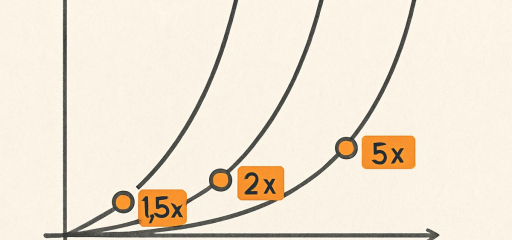
Crash games look simple from the outside. A multiplier counts up from 1.00x, you tap a button before the curve breaks, and whatever number you locked in is what you keep. The hidden choice, the one that decides how your bankroll behaves over hundreds of rounds, is the auto-cashout target. Pick 1.5x and you win most rounds but stack up tiny profits. Pick 5x and you stare at long droughts hoping for a single rocket. Below I walk through what each common crash cashout target actually does to your win rate, your expected value, and the size of the losing streaks you should brace for.
How the auto-cashout mechanic actually works
Every round, the server picks a random crash point from a distribution that is engineered to give the house a roughly 1% edge. You set a target, say 2x, and the game cashes you out automatically the instant the curve touches that number. If the rocket explodes before your target, you lose the bet. There is no skill in reading the curve, no pattern in past crashes that predicts the next one, and no advantage to manual cashouts over auto-cashouts in the long run. The auto button just removes the panic and the lag.
The cleanest way to model a fair crash game is this: the probability of reaching a multiplier of x is about 1/x. The house shaves a small slice off that to create its edge, so the real probability of reaching x is closer to 0.99/x. That single formula drives everything that follows.
The 1.5x target: frequent wins, tiny profits
A 1.5x auto-cashout hits about 66% of the time (0.99/1.5 ≈ 0.66). When it hits, you net half a unit on top of your stake. When it misses, you lose one full unit. So a typical cycle looks like:

- Win probability: ~66%
- Net profit on a win: +0.5 units
- Net loss on a miss: −1 unit
- Expected value per round: 0.66 × 0.5 − 0.34 × 1 = −0.01
That last line is the whole story. Even at the cuddliest target on the menu, you are still bleeding about 1% per round. The wins just come often enough that your balance graph looks like a slow, friendly leak instead of a cliff. A lot of players read the high hit rate as a “safe” strategy and end up playing far more rounds than they planned, which is exactly how the 1% edge does its real damage.
The 2x target: the coin-flip cashout
Set the target to 2x and you are roughly playing a slightly-worse-than-even coin flip. The probability of reaching 2x is about 0.99/2 = 49.5%. A win doubles your stake, so the net is +1 unit. A loss is −1 unit. Expected value per round comes out to 0.495 × 1 − 0.505 × 1 = −0.01. Same 1% edge, just packaged differently.
The 2x target is where most casual players camp because the math feels intuitive: half the time you double up, half the time you lose. The variance is already noticeably bigger than at 1.5x, though. Losing four or five in a row at 2x is normal, not a sign that something is “due.” If you flat-bet 100 rounds at 2x, you should expect a stretch of six or seven losses somewhere in there without blinking.
The 3x target: the middle ground
A 3x target hits roughly 33% of the time (0.99/3 ≈ 0.33). The net on a win is +2 units, and a loss is still −1. Expected value: 0.33 × 2 − 0.67 × 1 = −0.01. The arithmetic is suspiciously consistent, and that is on purpose, because every cashout target on a fixed-RTP crash game has to settle on the same house edge. You can move the variance around, but you cannot move the edge.
Where 3x earns its place is in the bankroll-curve shape. You lose roughly two rounds for every one you win, but each win is worth twice a loss, so your equity drifts sideways with bigger spikes than 1.5x or 2x. A lot of grinders pick 3x because it gives them a visible “win moment” often enough to stay engaged without the brutal dry spells of higher targets.
The 5x target: wild swings, rare payoffs
At 5x, the probability of cashing out is about 0.99/5 ≈ 19.8%. A win pays +4 units, a loss costs you −1. Expected value: 0.198 × 4 − 0.802 × 1 = −0.01. Same edge, dramatically different ride.
Roughly one round in five turns into a winner. That means four-loss strings are routine, ten-loss strings are common over the course of a session, and the cluster of small losses between wins can easily outrun a thin bankroll before the next hit lands. The session graph at 5x looks like a flat-then-spike pattern: long downhill walks interrupted by occasional cliffs in your favor. If you are not emotionally ready to sit through 15 losses before a single +4, this target will chew on your discipline.
The 10x target: lottery-mode crash
A 10x target hits about 9.9% of the time. A win pays +9 units, a loss is −1. Expected value: 0.099 × 9 − 0.901 × 1 = −0.01 (the rounding hides a hair more edge in practice, but the design target is the same 1%).

This is the closest a crash game gets to a slot-style payout pattern. You will sit through 20-loss streaks more often than you think, and the wins, when they come, feel like a jackpot. The math has not changed, and your hourly loss rate is essentially identical to the 1.5x grinder sitting next to you. You just live a much louder version of the same expected value.
Identical 99% RTP across every target
Here is the part that catches a lot of new players off guard: every cashout target on a properly calibrated crash game returns the same 99% RTP. The math earlier was not a coincidence; it was the design. The provider picks the crash distribution so that no matter what number you set, your long-run return is the same.
What changes with the target is not the edge but the shape of the loss. Low targets give you a slow, smooth grind down. High targets give you long dry spells punctuated by big wins. Same trip, different roads. If you ever see a crash game advertising different RTPs at different targets, read the rules carefully, because the provider is doing something non-standard with the distribution.
Variance: why 5x sessions feel like a roller coaster
Variance is the technical word for “how far your bankroll can wander from its expected path in a session.” At 1.5x, variance per round is small because the win is small and frequent. At 5x or 10x, variance is enormous because almost all the value is concentrated in rare events.
A practical way to feel this: if two players each bet $1 per round for 500 rounds, the 1.5x player will almost always end the session somewhere between −$20 and +$10. The 5x player can easily end the same session at −$80 or at +$60, with a similar expected loss of about $5 in both cases. The averages line up; the experiences do not.
The longest losing streak you should expect
The expected longest losing streak in N rounds at miss probability q is roughly log(N) / log(1/q). That formula is rough, but it gets you close. Plug in 1000 rounds at each target:
| Target | Win rate | Net win | EV / round | Variance | Expected longest losing streak (1000 rounds) |
|---|---|---|---|---|---|
| 1.5x | ~66% | +0.5 | −0.01 | Very low | ~6 to 7 |
| 2x | ~49.5% | +1.0 | −0.01 | Low | ~10 |
| 3x | ~33% | +2.0 | −0.01 | Moderate | ~17 |
| 5x | ~19.8% | +4.0 | −0.01 | High | ~25 to 30 |
| 10x | ~9.9% | +9.0 | −0.01 | Very high | ~65 |
The 5x column is the one most people underestimate. A 25-loss streak inside a 1000-round session is not bad luck; it is the expected worst stretch. If your bankroll cannot absorb 25 flat-stake losses in a row, you are not actually playing the 5x target you signed up for, you are playing a much shorter game that ends in ruin before the math has time to average out.
Picking a target that matches your bankroll, not your mood
Since all targets share the same expected value, the right way to choose is by variance tolerance and bankroll size:
- Small bankroll, short session: 1.5x or 2x. You will see frequent wins, and your worst streaks are short enough to survive.
- Moderate bankroll, want a real “win moment”: 3x. Wins are meaningful without forcing you to absorb 20-loss streaks.
- Large bankroll, chasing big swings: 5x. Plan around 25-loss streaks, not around the average.
- Entertainment-only, lottery feel: 10x. Treat the cost like a movie ticket; the math will not save you.
One more thing worth saying out loud: doubling up after a loss (martingale) on a 5x or 10x target is mathematically how bankrolls evaporate the fastest. A 25-round losing streak with doubling means your final bet is over 33 million times your starting unit. Table limits and your own balance will stop you long before the streak does.
FAQ
Q: Does a lower cashout target give a better RTP?
A: No. On a standard crash game, the RTP is approximately 99% regardless of the target. Lower targets only reduce variance, not the house edge.
Q: If 2x is a coin flip, why do I lose more than I win?
A: Because it is not a 50/50 flip. The probability of reaching 2x is about 49.5%, not 50%, and that half-percent is the entire house edge. Over a long enough session, the small bias is what bleeds bankrolls.
Q: Can I beat crash by switching targets when I see a pattern?
A: No. Each round is independent. The crash point is generated fresh, usually from a provably fair seed, and previous crashes give no information about the next one. Pattern-spotting is the most common way players end a session faster than the math predicts.
Q: Which target has the smallest worst-case drawdown?
A: 1.5x. The combination of a high hit rate and a small loss-to-win ratio gives you the smoothest equity curve, though you still lose at the same long-run rate as every other target.
Q: Is the “auto-cashout” any different from manually cashing out?
A: Mathematically, no. The auto-cashout is just a more reliable way to hit your planned target without slipping due to network lag or hesitation. Over a long session, that consistency is worth a small amount in practice, but it does not change the underlying expected value.
If you want to brush up on the simple probability and expected-value tools behind everything above, you can find clear walkthroughs on Effortless Math. For deeper game-by-game odds tables across casino formats, Wizard of Odds is the standard reference.
Gambling outcomes are uncertain; no strategy guarantees profit.

Related to This Article
More math articles
- 10 Most Common SSAT Upper-Level Math Questions
- What Skills Do I Need for the ASVAB Math Subtests?
- Full-Length 7th Grade MCAS Math Practice Test-Answers and Explanations
- SAT Math Flashcards (Free Online: Formulas, Terms & Concepts)
- The Best Grade 5 ELA Practice Tests for Tennessee Students
- Free Grade 5 English Worksheets for New Hampshire Students
- The Ultimate PSAT 10 Math Formula Cheat Sheet
- Idaho ISAT Grade 4 Math Free Worksheets: 72 Free PDF Worksheets, One Skill at a Time
- Using Number Lines to Represent Rational Numbers
- FREE 7th Grade MEAP Math Practice Test











What people say about "Crash Cash-Out Targets: 1.5x vs 2x vs 5x Compared - Effortless Math"?
No one replied yet.