Aviator Crash Game Math: The Multiplier Distribution Explained

Aviator looks simple. A little plane lifts off, a multiplier ticks upward from 1.00x, and your job is to tap “cash out” before it crashes. Miss the moment and your bet is gone. Most players treat the rising number like a thing they can read, a streak, a feel, a pattern. The aviator crash math says otherwise. The crash point is drawn from a fixed probability distribution before the round even starts, and once you know what that distribution looks like, the game stops being mystical and starts being arithmetic.
How Aviator Actually Works
Each round, the server picks a crash multiplier from a known distribution, usually before the plane even takes off. The multiplier then climbs on screen, 1.00x, 1.05x, 1.10x, and so on, until it hits the pre-selected crash value. You can cash out at any point during the climb and win your stake times the current multiplier. If the plane crashes before you tap out, you lose the bet. That is the entire game loop. Animations, sound effects, chat messages from other players, none of it influences when the round ends.
The key thing to internalize: the crash value is fixed at round start. You are not racing a live random process, you are guessing where a number already lives.
The Underlying Distribution
Most crash games, including Aviator, use a distribution that is close to a shifted exponential, tuned so the house edge lands at a specific value. The standard 99% RTP version has a clean formula:

P(crash ≥ X) = 0.99 / X
That is the probability that the round survives to at least multiplier X. The flip side, probability the round crashes before X, is:
P(crash < X) = 1 − 0.99 / X
The 0.99 in the numerator is where the house edge lives. In 1% of rounds the plane crashes immediately at 1.00x with no chance to cash out at all. The remaining 99% of rounds follow the smooth 1/X tail. Higher RTP versions push that constant closer to 1; lower-RTP variants drop it further. Always check the rules screen for the version you are playing, because operators do change the constant.
What the 1/X Tail Means for Common Cashout Targets
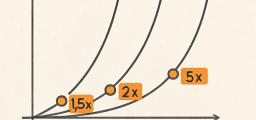
The 1/X shape is harsh in a way that surprises new players. Doubling your target multiplier roughly halves your chance of reaching it. Going from 2x to 10x is not “five times harder” in any soft sense. It is five times less likely.
Here are the headline numbers under 99% RTP:
- P(reach 1.5x) = 0.99 / 1.5 = 0.660, about 66%.
- P(reach 2x) = 0.99 / 2 = 0.495, about 49.5%. Coin flip with a small tax.
- P(reach 3x) = 0.99 / 3 = 0.330, about 33%.
- P(reach 5x) = 0.99 / 5 = 0.198, about 19.8%. One in five rounds.
- P(reach 10x) = 0.99 / 10 = 0.099, about 9.9%. One in ten.
- P(reach 100x) = 0.0099, about one in a hundred.
And every single round, regardless of target, has a 1% chance of crashing at 1.00x before anyone gets out. That instant-bust risk is the price of admission.
Full Probability Table from 1.1x to 10x
This is the table I wish every new Aviator player saw before they started clicking. The middle column is the chance the round reaches that multiplier or higher. The right column is the expected return per $1 bet if you commit to cashing out exactly at X, payout X times the probability of getting there.
| Cashout Target X | P(reach X) = 0.99 / X | Expected Return per $1 = X · P(reach X) |
|---|---|---|
| 1.1x | 0.9000 (90.0%) | $0.99 |
| 1.25x | 0.7920 (79.2%) | $0.99 |
| 1.5x | 0.6600 (66.0%) | $0.99 |
| 1.75x | 0.5657 (56.6%) | $0.99 |
| 2x | 0.4950 (49.5%) | $0.99 |
| 2.5x | 0.3960 (39.6%) | $0.99 |
| 3x | 0.3300 (33.0%) | $0.99 |
| 4x | 0.2475 (24.75%) | $0.99 |
| 5x | 0.1980 (19.8%) | $0.99 |
| 7x | 0.1414 (14.14%) | $0.99 |
| 10x | 0.0990 (9.9%) | $0.99 |
Stare at the right column. Every target returns exactly $0.99 on the dollar in expectation. That is not a coincidence. It is the whole point. A 99% RTP game gives back 99 cents per dollar no matter what cashout strategy you pick, as long as the strategy is a fixed target. Auto-cash at 1.1x, auto-cash at 10x, hold for 100x, all the same expected value. The variance is wildly different. The edge is identical.
The Memoryless Property
Each Aviator round is independent. The seed for round 4,217 has nothing to do with round 4,216. If you just watched five rounds in a row crash below 1.5x, the next round’s chance of reaching 1.5x is still 66%. The plane does not feel bad for you. It does not owe you a big multiplier.
This is the same property that makes roulette wheels and dice fair, and the same property that human brains refuse to accept. Players will swear they saw a “due” pattern. They will move bet size based on the last few crashes. None of it changes the math. The probability lookup table above applies to every round independently, forever.
One subtlety worth flagging: within a single round, the conditional probability does shift. If the plane has already climbed to 2x without crashing, the conditional probability of reaching 4x given you are at 2x is P(reach 4x) / P(reach 2x) = 0.2475 / 0.495 = 0.50. So mid-round, “double from here” is roughly a coin flip. That is the closest thing to a memoryless exponential-style behavior the game has, and it is genuinely useful to know when you are deciding whether to let it ride.
Provably Fair Seed Mechanism
Reputable crash games publish a provably fair scheme. Before the round, the server commits to a hashed seed. After the round, the seed is revealed. You can independently hash the revealed seed and confirm it matches the pre-round commitment, then run the seed through the published crash-point formula and verify the resulting multiplier matches what the game showed. The math is usually some variant of taking a SHA-256 hash, converting part of it to a number between 0 and 1, and plugging into the inverse CDF of the crash distribution.

Provably fair does not mean the game is generous. It means the game cannot lie about the crash point after the fact. The house edge is still baked into the distribution itself. A 99% RTP provably fair Aviator round is still a 99% RTP game, verifiable honesty about an unfavorable bet. For independent breakdowns of crash-style RNG verification, Wizard of Odds has detailed analyses of similar formats.
Common Myths Aviator Players Believe
- “It’s due for a big multiplier.” No round is due for anything. The plane does not track recent history.
- “Cash out early to grind small profits.” A 1.1x auto-cashout has the same 99% expected return as a 10x target. You will hit small wins more often, but each small win is also smaller, and the 10% of rounds you still lose grind you down at the same long-run rate.
- “The crowd’s behavior tips off the algorithm.” The crash point is set before anyone places a bet. Watching other players cash out tells you nothing about when the round will end.
- “Doubling after a loss recovers everything.” Martingale on a game with a 1% instant-bust chance and uncapped multipliers up top is a bankroll bomb. The 1% chance of immediate crash means even big targets do not save you.
- “There’s a pattern in the seeds.” Provably fair seeds are designed specifically to be statistically indistinguishable from random. No, you did not crack it.
What 10,000 Rounds Look Like
Take a player betting $1 per round at a 2x auto-cashout target for 10,000 rounds. Each round either pays $2 (gross, net $1 profit) with probability 0.495 or pays $0 (net −$1) with probability 0.505. Expected loss per round is $0.01. Over 10,000 rounds, expected total loss is $100. Standard deviation is roughly $100 as well, so a typical outcome falls somewhere between losing about $200 and roughly breaking even, with occasional sessions outside that band.
Now compare a player chasing 10x. Each round pays $10 with probability 0.099 or $0 with probability 0.901. Same expected loss of $0.01 per round, same $100 expected loss over 10,000 rounds. But standard deviation per round is about $3 instead of $1, so over 10,000 rounds the swing is roughly $300. You might be up $200 or down $400. The edge is identical; the bankroll volatility is triple.
Which is why “strategy” in Aviator is really just variance management. You cannot beat 1/X. You can only choose how bumpy the ride is on the way to losing the house edge. For the broader picture on how regulators monitor these mechanics, UK Gambling Commission publishes guidance on online RNG verification standards. If you want to brush up on the underlying probability tools before opening a calculator, Effortless Math has approachable walkthroughs of exponential and survival distributions.
A few more sim observations worth carrying with you. The longest streak of sub-1.5x crashes in a 10,000-round run is, on average, somewhere around 16 in a row, purely from the 34% per-round chance compounding. Players who watch this happen live almost always assume the game is rigged or “due.” It is neither. Same with the upside: a 50x round will show up roughly 198 times in 10,000 rounds. If you were holding for it, you needed to also survive the 9,802 rounds where it did not happen, and your average bankroll position during that wait is the issue, not the eventual hit. Pick a session bankroll you would be fine setting on fire, pick a cashout target whose volatility matches your patience, and accept that the long-run answer is always the same 1% drip.
FAQ
Q: Is there an optimal cashout multiplier?
A: For pure expected value, no, all fixed targets return the same 99 cents per dollar. Pick the volatility you can stomach. Lower targets feel safer and bleed slowly; higher targets are lottery-like.
Q: Does using two simultaneous bets help?
A: Aviator lets you place two bets per round with different cashout points. Mathematically, this is just two independent bets on the same outcome. Expected return is still 99% on each. It gives you a smoother emotional experience, not a better edge.
Q: What’s the chance of seeing a 100x round?
A: About 0.99% per round, so roughly one in 101 rounds. In a session of 200 rounds you would expect to see one or two. Whether you cash out before it crashes is the harder problem.
Q: Can I verify a round was fair?
A: Yes, if the operator publishes a provably fair scheme. You hash the revealed seed and check it against the pre-round commitment, then re-derive the crash point from the seed using the documented formula. If both match, the operator did not tamper.
Q: Why do streaks of low crashes feel so common?
A: Because they are. With P(crash < 2x) ≈ 50.5%, runs of three or four sub-2x rounds happen constantly. The brain remembers the streak and forgets the average. It is signal-free.
Gambling outcomes are uncertain; no strategy guarantees profit.

Related to This Article
More math articles
- The Ultimate TABE Math Course (+FREE Worksheets & Tests)
- The Best Grade 5 Math Book for Massachusetts Students
- Ease Your Integration: The Partial Fractions Technique
- Courts, Civil Liberties, and Equal Protection
- Impartial jury
- The Best SAT Math Book for Students Starting From the Basics
- How to Graph Exponential Functions?
- Hawaii SBAC Third-Grade Math: 49 Free Printable Worksheets, Chapter by Chapter
- SIFT Math Flashcards (Free Online: Formulas, Terms & Concepts)
- Best Free Apps That Solve Math Problems for You











What people say about "Aviator Crash Game Math: The Multiplier Distribution Explained - Effortless Math"?
No one replied yet.