Hit Frequency vs. RTP: Two Numbers That Tell Different Stories
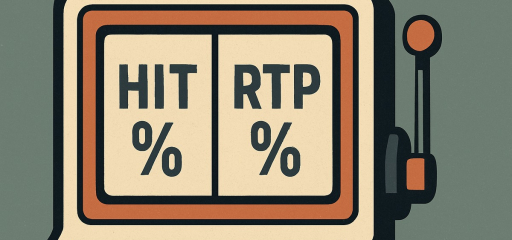
Two slot numbers get quoted constantly, and most players use them as if they mean the same thing. They don’t. Hit frequency tells you how often a spin returns something, anything, while RTP tells you, over a very long run, how many of your wagered dollars come back. A game can hit on nearly half your spins and still bleed your bankroll quietly, because most of those “hits” pay less than you put in. Understanding the gap between hit frequency vs RTP is the difference between feeling like you’re winning and actually keeping money.
What hit frequency actually measures
Hit frequency is the percentage of spins that return a payout greater than zero. If a game advertises a 30% hit frequency, then out of 100 spins you can expect, on average, about 30 of them to show something on the pay line. The other 70 return nothing.
That’s the entire definition. It says nothing about how much those 30 hits pay. A 0.20x return on your stake counts as a hit. A 500x jackpot counts as a hit. Both are lumped into the same bucket when the math team reports the number.
What RTP actually measures
Return to player is the long-run ratio of total money paid out to total money wagered, usually expressed as a percentage. A slot with a 96% RTP returns, in theory, $96 for every $100 wagered across an enormous sample of spins, think millions, not your Saturday night session.
RTP is an average. It absorbs the big wins, the small wins, and the dead spins all into one number. It says nothing about how those returns are distributed. A 96% RTP game could pay back via one giant jackpot once every 50,000 spins, or via constant small returns, or anything in between.
Why a high hit frequency doesn’t mean a high payout
This is where most players get fooled. A game with a 40% hit frequency feels generous. The reels stop, a number lights up, a small sound plays, your brain registers a win. But check the amount: it’s often less than what you bet. You spun $1, you got back $0.40. Technically a hit. Practically a loss of $0.60.
Modern slot design leans hard on this. Sub-stake returns, payouts under 1x your bet, keep the screen busy and the dopamine flowing while the bankroll erodes. The hit frequency number is doing exactly what marketing wants it to do.
A worked example: 40% hit, 96% RTP
Take a fictional slot with a 40% hit frequency and a 96% RTP. Spin it 100 times at $1 per spin. You’ve wagered $100 total.
Expected outcome: 40 hits, 60 misses. If the average hit returns 0.6x your bet, that’s 40 × $0.60 = $24 back from base-game hits. But the advertised RTP is 96%, meaning the long-run average return is $96 on $100 wagered. Where’s the other $72 coming from?
It comes from the bonus features. A common split in modern slot design is roughly 70% of the RTP from base-game spins and 30% from bonus rounds (free spins, pick games, multipliers). So:
- Base-game contribution: 70% of 96 = 67.2 units per 100 wagered.
- Bonus-game contribution: 30% of 96 = 28.8 units per 100 wagered.
- Total: 96 units returned per 100 wagered, the 96% RTP.
But here’s the catch: bonuses are rare. You might spin 500 times without triggering one. The base-game math has to carry you through those dry stretches, and at 0.6x average per hit, it cannot. Most sessions, you’re losing money waiting for the bonus that pays the bill.
The perception gap between hit feel and bankroll reality
Players track wins by sound and animation, not by net dollars. A 0.4x payout on a $2 bet, $0.80 returned, produces the same chime as a 5x payout. Your ears say “win.” Your wallet says “I just lost $1.20.”
Multiply that across a session. Fifty hits in 120 spins feels like a hot run. If those hits average 0.5x your bet, you returned 25 units on 120 wagered, then watched 70 misses subtract the rest. The session feels active and engaging right up until you check the cashout screen.
There’s a name for this in behavioral research: losses disguised as wins. The industry has studied it, and players consistently overestimate how well they did during sessions full of sub-stake “hits.” If you walk away thinking “I was up most of the night and only lost a little at the end,” that’s the design working as intended. You weren’t up. You were trickling down the whole time with intermittent reinforcement masking the drift.
How slot designers calibrate the two numbers
Math designers tune hit frequency and RTP independently, then balance them against volatility targets. A high-hit-frequency slot needs small average payouts to keep the RTP in line, otherwise the house edge collapses. A low-hit-frequency slot can afford larger payouts because hits are rare.

This is why the trade-off is real and predictable. You don’t get both. A game with 45% hit frequency will pay tiny amounts on most hits. A game with 20% hit frequency can support meaningful per-hit payouts. The RTP can be identical in both cases.
The internal levers designers pull include the reel-strip composition, the paytable values, the number of paylines or ways-to-win, and the bonus trigger probability. A game with 243 ways to win will naturally have a higher hit frequency than a 25-line game, because more line combinations means more spins land on something. To keep the RTP from blowing past target, the per-line payouts shrink. The math is a closed system: push one number up, another comes down.
Bonus features are the designer’s escape valve. Putting a chunk of RTP into a rare-but-large bonus lets the base game run lean. That’s how a slot can show you ten dead spins in a row, hit on the eleventh for 0.4x, and still average to 96%, the missing percentage is parked in a free-spins round you haven’t triggered yet.
Sample slots: what hits actually pay
| Slot profile | Hit frequency | RTP | Typical hit size | What it feels like |
|---|---|---|---|---|
| High-hit classic | 42% | 96.0% | 0.2x, 0.6x | Constant small returns, slow bleed |
| Mid-volatility video | 28% | 96.2% | 0.5x, 2x | Balanced; occasional real wins |
| High-volatility | 18% | 96.5% | 1x, 10x, rare 100x+ | Long droughts, occasional spikes |
| Jackpot-driven | 22% | 94.5% | 0.4x, 1.5x base, jackpot rare | Steady losses, lottery hope |
| Bonus-heavy | 25% | 96.0% | 0.3x, 0.8x base, bonus = big | Quiet base game, bonus carries RTP |
Base-game vs bonus hit frequency
The hit frequency you see quoted is almost always the base-game figure. Bonus rounds have their own internal hit rate, and it’s usually much higher, sometimes near 100%, because the bonus is the reward structure itself. A free-spins round with sticky multipliers might hit on every spin, which is why a single bonus trigger can pay 50x or more.
This matters because the bonus contribution to RTP is concentrated. You’re not getting bonus money spread evenly across your session. You’re getting it in occasional bursts, and the dry spells in between are paid for by the base-game math, which, as we’ve seen, often loses you money on every hit.
Bonus trigger frequency varies by game, but a rough benchmark is one trigger every 100 to 300 base-game spins. Multiply by your spin rate and bet size to see why short sessions rarely see them. If you play 80 spins at $1, the most likely outcome is zero bonus triggers and a base-game return of roughly 67 cents on the dollar, well below the advertised RTP. The math only catches up if you stay long enough to see the bonus distribution play out, and most players don’t.
What to actually look for as a player
- Don’t shop on hit frequency alone. A 45% hit rate with 0.3x average hits is worse for your bankroll than a 25% rate with 1x average hits.
- Read the paytable. If the smallest payouts are 2-coin returns on a 5-coin bet, you’re in sub-stake territory.
- Check the volatility rating. High volatility usually means lower hit frequency but bigger swings, useful if you have bankroll for the dry stretches.
- Understand bonus dependency. If most of the RTP lives in the bonus, sessions without a bonus trigger are losing sessions by design.
- Track net, not hit count. The only number that matters at the end of a session is the cashout figure.
For deeper math breakdowns on specific titles, Wizard of Odds slot analysis publishes RTP and volatility data that goes well beyond what casino marketing pages disclose. If you want to sharpen the underlying probability skills, Effortless Math has free resources for the basics.
What hit frequency vs RTP really tells you
Hit frequency tells you how often the screen will reward you with a sound. RTP tells you what happens to your money over the long run. They’re answering different questions, and confusing them is exactly what slot designers count on. A game can hit constantly and still take your money. A game can hit rarely and pay back fairly. The two numbers belong on the same page, but they tell very different stories.
FAQ
Q: Is a higher hit frequency always better?
No. A higher hit frequency typically means smaller average payouts per hit. Many of those hits return less than your bet, so a “hit-heavy” game can drain your bankroll faster than a low-frequency game with bigger payouts.
Q: Can I find the exact hit frequency for a slot?
Sometimes. Reputable game studios publish it in the info screen or paytable. Many don’t. Third-party reviewers and math-focused sites like Wizard of Odds publish measured or disclosed figures for popular titles.
Q: Does RTP guarantee I’ll get back 96% of my money?
No. RTP is a long-run statistical average over millions of spins. Any single session can vary wildly. You might cash out up, you might lose your entire deposit. The 96% is the casino’s expected return across all players combined.
Q: Why do casinos advertise hit frequency at all if it’s misleading?
Because it sells. A high number feels generous. Most players don’t parse the difference between “hit” and “profitable hit,” and the marketing relies on that gap.
Q: How does volatility connect to these two numbers?
Volatility describes the size of the swings around the RTP. Low volatility = small frequent payouts (often high hit frequency). High volatility = rare large payouts (often low hit frequency). Two games with identical RTP can play very differently based on volatility. Match the game to your bankroll: short sessions and small budgets handle low volatility better, while bigger bankrolls can absorb the dry stretches that high-volatility games demand before a meaningful hit arrives.
Gambling outcomes are uncertain; no strategy guarantees profit.

Related to This Article
More math articles
- Chance is not coincidence, but the mathematics of fate
- Chapter 41: Political Behavior and Data Analysis
- How to Calculate Limits of Functions
- Prepare for the SAT Math: The Right Combination of Hard Work and Time Management
- Final 48-Hour Review
- How to Round Amounts of Money
- Market demand adds individual quantities
- The Hidden Arithmetic That Breaks the Martingale System Every Time
- Illinois Algebra 1 Free Worksheets: Printable Algebra 1 Practice, Answers Included
- CLEP U.S. History I 043: Federalists and Democratic-Republicans








What people say about "Hit Frequency vs. RTP: Two Numbers That Tell Different Stories - Effortless Math"?
No one replied yet.