Doubling Down: When the EV Curve Bends Toward You
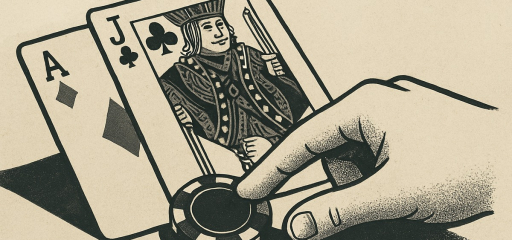
Doubling down is the one moment in blackjack where the math screams at you to put more money on the table. You give up flexibility, accept exactly one more card, and in return you get to double your stake on a hand the dealer is statistically about to lose. When the situation is right, the expected value curve bends sharply in your favor, and walking away from that bet is the same as leaving cash on the felt. When the situation is wrong, doubling is a fast way to lose twice as much, twice as fast. Knowing which is which is most of the edge a basic-strategy player ever gets.
How Doubling Actually Works
The rule is simple, and that simplicity is what makes the math clean. After you see your first two cards and the dealer’s upcard, you can choose to double your original wager. The casino deals you exactly one more card, sideways across your stack, and your hand is locked. You cannot hit again, you cannot surrender, you cannot change your mind. Whatever total you land on has to face the dealer.
That single-card constraint is the cost of the option. In exchange, the casino lets you put twice as much money on a hand where you, the player, already hold the advantage before the third card arrives. The doubling decision is really a comparison between two numbers: the expected value of taking one card with a doubled bet, and the expected value of playing the hand normally with a hit or a stand. If doubling wins by enough to overcome the loss of flexibility, you do it.
The Doubles That Are Not Optional
Basic strategy charts agree on a short list of hands where doubling is so profitable that not doubling is a strategy error. These are the hands where the player total is strong, the dealer upcard is weak, and a single drawn card is very likely to finish the hand near 20.
- Hard 11 against every dealer upcard except an Ace (and in S17 games, the Ace is also a double in some rule sets).
- Hard 10 against every dealer upcard except 10 and Ace.
- Hard 9 against dealer 3 through 6.
- Soft 18 (A-7) against dealer 3 through 6.
- Soft 17 (A-6) against dealer 3 through 6.
- Soft 16, 15, 13 against dealer 4 through 6 in most multi-deck games.
Notice the pattern. The dealer’s weakest upcards are 4, 5, and 6, because those are the cards most likely to force a dealer bust. Almost every profitable double in the game lives in that column. The player’s strongest doubling totals are 9, 10, and 11, because one drawn card has a high chance of landing in the 19-21 range. Where those two patterns intersect, doubling stops being aggressive and starts being mandatory.
The 11 vs 6 Showdown
If there is a textbook double in blackjack, this is it. You hold a two-card 11, the dealer shows a 6, and the math is brutal in the dealer’s direction. The dealer has to draw, the dealer busts on roughly 42 percent of completions, and your single card is overwhelmingly likely to make a strong hand.
Run the numbers per dollar of original wager:
- Double EV ≈ +0.667 per unit (you win two-thirds of a unit on average, over a doubled stake).
- Hit EV ≈ +0.470 per unit on the same hand at the original wager.
The double earns about 19.7 cents per dollar more than the hit, even after accounting for the lost flexibility of being stuck on the third card. That gap is enormous by blackjack standards, where most decisions move EV by a penny or two. Refusing to double 11 against a 6 is, in the long run, exactly equivalent to skipping the most profitable bet the game ever offers you.
EV Table for the Strong Doubles
The numbers below come from standard six-deck, S17, double-after-split rule sets. Values are per dollar of the original bet and assume basic strategy on every other decision.
| Player Hand | Dealer Upcard | Double EV | Best Non-Double EV | Gain From Doubling |
|---|---|---|---|---|
| Hard 11 | 6 | +0.667 | +0.470 (hit) | +0.197 |
| Hard 11 | 5 | +0.622 | +0.452 (hit) | +0.170 |
| Hard 10 | 6 | +0.567 | +0.396 (hit) | +0.171 |
| Hard 9 | 6 | +0.402 | +0.275 (hit) | +0.127 |
| Soft 18 (A-7) | 6 | +0.470 | +0.300 (stand) | +0.170 |
| Hard 11 | Ace (S17) | +0.193 | +0.234 (hit) | −0.041 |
The last row is the warning. Against a dealer Ace in an S17 game, the EV of doubling 11 actually trails the EV of hitting, because the dealer’s natural-blackjack and 17-stand risk eats the extra unit before the player’s third card can rescue it. Which is why most six-deck S17 charts hit 11 vs A rather than doubling, and why the H17 charts often flip the decision back. Small rule changes, real money difference.
The Marginal Doubles
A good chunk of the disagreement between blackjack players comes from the soft-hand doubles. Soft 13 through soft 15 against dealer 4, 5, or 6 are correct doubles in most multi-deck games, but the EV gap over simply hitting is razor thin. We are talking about gains of one to three cents per dollar, not the 17-cent monsters at the top of the chart.
These hands feel weird to double because the player total is low and a single bad card can leave you stuck on 14 or 15 with double the money at risk. The reason it still works is the Ace. If your one drawn card busts the soft hand, the Ace converts to a 1 and you simply have a hard total. You cannot bust on the double itself, so the only question is whether the dealer’s weak upcard gives away enough equity to justify doubling the wager. On a 4, 5, or 6 it usually does. On a 2 or 3, the edge is thin enough that some single-deck charts back off the double entirely.
When Doubling Actually Loses You Money
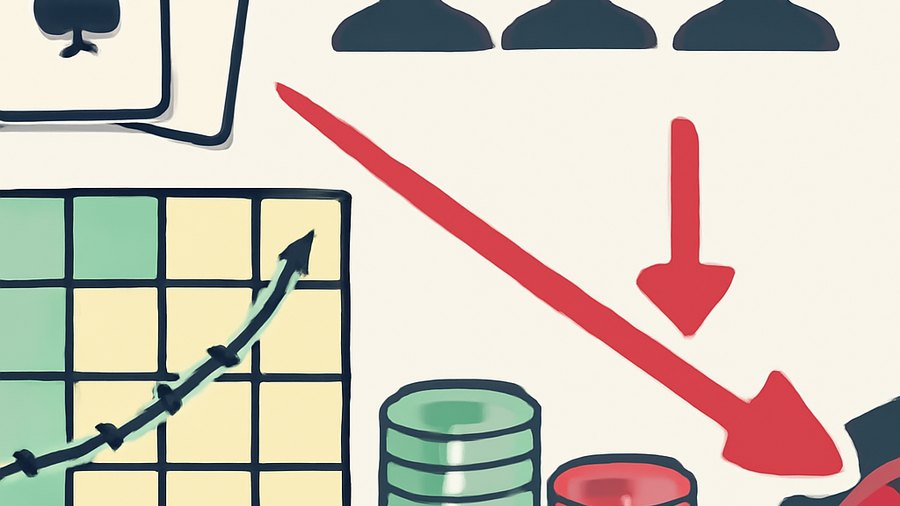
Doubling has a reputation as a power move, but the casino is happy to let you do it on hands where it costs you. The trap cases:
- Hard 10 vs dealer 10 or Ace. The dealer’s upcard is too strong; your drawn card is too likely to land short of theirs.
- Hard 11 vs Ace in S17. As shown in the table, hit beats double by about four cents per dollar.
- Hard 9 vs dealer 2, 7, or higher. A 9 against a 2 is close, but the standard call is to hit, not double, in multi-deck games.
- Soft 17 or 18 vs dealer 7 or higher. Doubling here locks you into a mediocre total against a likely 17-20 dealer hand.
- Any total of 8 or lower. Even with a perfect draw, you cap out at a hand the dealer can match or beat without busting.
The simulations behind every modern strategy chart agree on these. A live player who doubles 10 vs Ace because it “feels right” is donating roughly 10 to 15 cents per dollar of the extra wager, every time the situation comes up. Over a few hundred hands that is real money.
Double After Split, and Why It Matters
Double-after-split (DAS) is one of those rule lines you skim past on the felt placard, but it is worth real basis points to the player. When the casino allows DAS, splitting low pairs like 2-2, 3-3, 6-6, and 7-7 becomes correct against a wider range of dealer upcards, because the player can now follow a productive split with a profitable double on the resulting hand. Without DAS, many of those splits revert to hits.
The EV impact of DAS for a basic-strategy player is roughly +0.14 percent on the house edge in a typical six-deck S17 game. That is small per hand, but it changes how aggressively you should split pairs in the first place. The doubling decision and the splitting decision are not independent; the chart you should use literally depends on whether DAS is on the table.
How Rule Variations Squeeze the Double
Casinos have spent decades looking for ways to tighten the doubling rule without scaring players away. The two most common restrictions:
- Double on 9, 10, or 11 only (D9/D10/D11). You can still hit the big doubles, but soft-hand doubles and the marginal 8-double in single-deck games disappear.
- Double on 10 or 11 only (D10). A more aggressive restriction. Hard 9 vs 6 is no longer a double, and every soft double is dead.
- No doubling after split. Discussed above; quietly costs the player about 0.14 percent.
The cumulative effect is significant. A six-deck S17 game with full doubling and DAS sits near a 0.4 percent house edge under basic strategy. The same game with D10-only and no DAS climbs to roughly 0.6-0.7 percent. The doubling rules are doing more of the work than the deck count in many comparisons.
Practical Doubling Discipline
The hardest part of doubling correctly is not the math; it is the muscle memory to do it when the bankroll is tight or the table is cold. The EV chart does not care that you just lost three hands in a row. An 11 vs 6 is +0.667 per unit whether you walked in flush or short. Players who skip the double when they are nervous and only take it when they are riding a heater are giving back the very edge the rule provides.
If you want to drill the decision tree without burning chips, the Wizard of Odds blackjack strategy calculator lets you punch in any hand, dealer upcard, and rule set and see the exact EV of every option. Pair that with the kind of arithmetic drills covered at EffortlessMath and the chart stops feeling like memorization and starts feeling like a rule you derived yourself.
FAQ
Q: Should I ever double for less than the full original bet?
A: Almost never. The casinos that allow it are betting you will, because doubling for less keeps your edge on the hand but reduces the dollar value of that edge. If the EV says double, double for the full amount.
Q: Is doubling soft 18 vs 6 really better than standing?
A: Yes, by about 17 cents per dollar. Standing on soft 18 returns about +0.300 per unit; doubling returns about +0.470. The card you draw can only improve or leave the hand intact, because the Ace absorbs any bust.
Q: What if the casino does not allow doubling on soft hands?
A: Then you stand or hit per the no-double chart, and you accept a slightly worse house edge. Soft doubles are worth roughly 0.13-0.15 percent in total; not catastrophic, but real.
Q: Does card counting change the doubling thresholds?
A: Yes. High counts (more tens and Aces left in the deck) push more borderline doubles into the correct column, especially 9 vs 2, 10 vs Ace, and 11 vs Ace. Low counts pull marginal soft doubles back toward hitting. Basic strategy ignores the count; counters use index plays that override the chart at specific true-count thresholds.
Q: Why is doubling 11 vs Ace correct in some rule sets but not others?
A: In H17 games the dealer hits soft 17, which raises dealer bust frequency just enough to make the double worth it. In S17 games the dealer stands on soft 17, the bust rate drops, and hitting becomes the better play by a few hundredths of a unit.
Gambling outcomes are uncertain; no strategy guarantees profit.

Related to This Article
More math articles
- Republican Governance, Tax Policy, and Normalcy
- Newton’s Method Calculator (Free, with Iteration Table)
- Political knowledge
- Appointment and removal powers
- What’s A Good ACT Score?
- Free Utah Grade 2 Math Worksheets
- Word Problems Involving Money
- The Best Algebra 1 Book for Nevada Students
- Absolute Value Equation Solver — |ax + b| = c (Free)
- How to Decipher Patterns: A Comprehensive Guide to Understanding Mathematical Sequences





What people say about "Doubling Down: When the EV Curve Bends Toward You - Effortless Math"?
No one replied yet.