Surrender in Blackjack: The Math of Giving Up Early
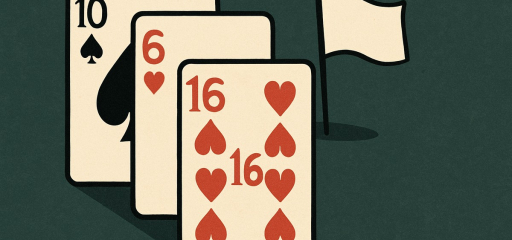
Most blackjack players hate the surrender button. It feels like quitting, and quitting feels like losing on purpose. But the math tells a different story: in a handful of specific spots, raising your hand and forfeiting half the bet is the cheapest way to play. You are not giving up to the dealer’s good fortune so much as you are paying a fixed 50-cent price on a one-dollar problem that, if you swing at it, costs you 54 cents on average. That four-cent gap is what surrender is for, and over thousands of hands it adds up.
Late surrender vs early surrender
Surrender comes in two flavors, and they are not equally generous. Late surrender, the common version found in some Strip pits and most online tables, lets you fold a 16 (or 15, or whatever you are holding) only after the dealer has checked the hole card for blackjack. If the dealer has it, the round is already over and you lose the whole bet, no surrender allowed.
Early surrender is the rarer, juicier rule. You can bail before the dealer peeks, which means you can also surrender against an ace or a ten when a dealer blackjack is still possible. That timing difference is worth a lot. Late surrender shaves roughly 0.07% to 0.10% off the house edge in a typical six-deck game. Early surrender against a ten and an ace combined is worth about 0.62%, almost ten times as much. If you ever see “early surrender” advertised on a felt, look twice. It is one of the best rules in the building.
The math of “give back half”
The surrender decision is one of the cleanest expected-value comparisons in blackjack. You are choosing between three numbers:
- Hit EV, what one unit becomes on average if you take another card and play the rest of the hand correctly.
- Stand EV, what one unit becomes if you stop here and let the dealer play.
- Surrender EV, exactly −0.500, every time, regardless of count, deck, or mood.
The rule is simple: if the better of hit or stand is worse than −0.500, you surrender. If the better of hit or stand beats −0.500, you play the hand. Surrender is not “I feel bad about this.” It is “the alternatives cost more.”
16 vs 10: the textbook surrender hand
If surrender has a poster child, it is hard 16 against a dealer ten. Your sixteen is already terrible, you bust on any card 6 through 10, which is a healthy chunk of the deck, and the dealer is showing a card that finishes around 17 or better roughly three times out of four. When you run the simulation, hitting your sixteen returns about −0.540 per unit. Standing is even worse, around −0.540 as well, because the dealer’s expected final hand crushes you either way.
Surrender locks in −0.500. That is a four-cent improvement per dollar over the next-best play. It does not feel like a win, because you are still losing money. You are just losing less of it, and “less” is the entire point of basic strategy. If your table offers late surrender, 16 vs 10 is the first hand you should learn to fold.
15 vs 10 also surrenders
Hard 15 against a ten is the same shape with slightly different numbers. You still bust on 7 through ten, a little less often than with 16, because a deuce on 15 gives you 17 instead of breaking, but the dealer ten still wins most of the time. The hit EV comes in near −0.540, the stand EV also lands around −0.540, and surrender at −0.500 once again wins by a few cents.
The intuition here is worth holding onto. Whenever both hit and stand are worse than half a bet lost, surrender is correct. You do not need a calculator at the table. You need to know the chart.
EV by action for the key surrender hands
The table below pulls the standard six-deck, dealer-stands-on-soft-17 numbers for the hands where surrender is on the bubble or clearly correct. EV is in units per one-unit bet, so −0.500 means you expect to lose 50 cents on a one-dollar wager.
| Hand | Hit EV | Stand EV | Surrender EV | Correct play |
|---|---|---|---|---|
| Hard 16 vs 10 | −0.540 | −0.540 | −0.500 | Surrender |
| Hard 16 vs 9 | −0.474 | −0.529 | −0.500 | Hit |
| Hard 16 vs Ace | −0.512 | −0.667 | −0.500 | Surrender |
| Hard 15 vs 10 | −0.540 | −0.540 | −0.500 | Surrender |
| Hard 15 vs 9 | −0.404 | −0.512 | −0.500 | Hit |
| Hard 14 vs 10 | −0.464 | −0.539 | −0.500 | Hit |
Notice 16 vs 9. The hit EV is about −0.474, which beats surrender by a couple of cents. That is the line most players get wrong in both directions. They either surrender too often (every stiff vs every face card) or never surrender at all. The math says surrender 16 vs 9, but only sometimes; in single-deck or very specific rule sets the hit can edge it out. In standard multi-deck shoes, surrender is correct against 9, 10, and Ace.
The complete late-surrender chart
Six-deck, dealer stands on soft 17, late surrender available, the chart you actually need to memorize is tiny:
- Hard 16 vs dealer 9, 10, or Ace, surrender.
- Hard 15 vs dealer 10, surrender.
- Everything else, play it out with normal basic strategy.
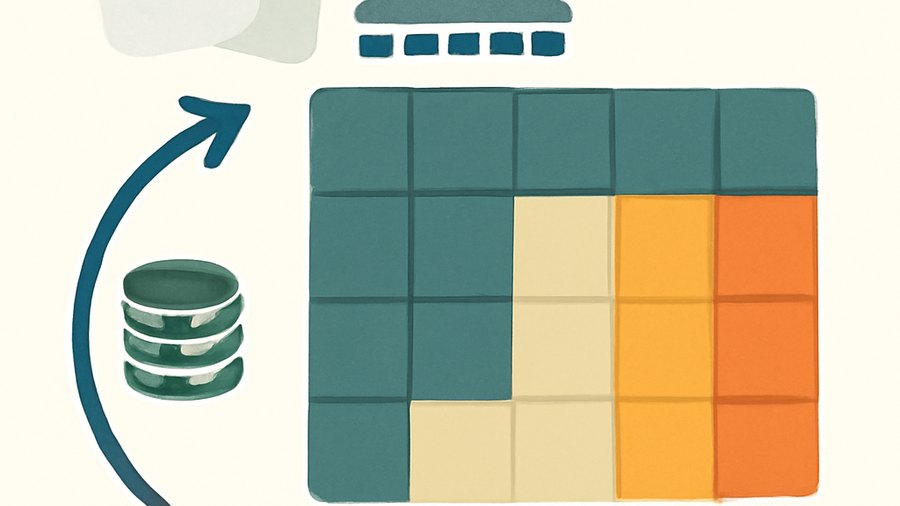
That is it. Four cells on a chart with hundreds of cells. If the dealer hits soft 17, add one more: surrender hard 15 vs Ace and hard 17 vs Ace as well. Pair 8s against a 10 is a borderline case where some charts surrender and some split, both are close to identical EV, and the difference is small enough that it will not move your bankroll.
Early surrender opens the door against aces
Where early surrender exists, the chart expands a lot, because you get to fold before the dealer checks for blackjack. The valuable additions are against the ace, since roughly one in thirteen times the dealer just has the natural and your surrender saves a whole bet that late surrender would not have saved.
Under early surrender vs ace, you fold hard 5 through 7, hard 12 through 17, and pair 3s, 6s, 7s, and 8s. Vs a ten you also add hard 14 through 16 and pair 7s and 8s. The list is long because the dealer ace is brutal even when it does not become blackjack. If you ever sit down at a table with early surrender, they exist mostly in some international and a handful of online rule sets, print the chart and bring it.
How surrender impacts the house edge
The house edge in a stock six-deck, S17, double-after-split, late-surrender game runs around 0.40% with perfect basic strategy. Strip out surrender and the edge climbs to about 0.48% to 0.50%. So late surrender is worth roughly 0.07% to 0.10% of edge to the player. That is not a fortune, but it is real, and it costs you nothing except the willingness to fold four specific hands.
Early surrender is a different animal. In a game that already offered every other good rule, adding early surrender against ten and ace shifts the edge by about 0.62% in your favor. That can flip a marginal game into a near-even one. Casinos figured this out decades ago, which is why early surrender is essentially extinct in the United States and uncommon worldwide.
Where to find tables that offer it
Late surrender is increasingly common at higher-limit blackjack pits, $25 minimum and up on the Las Vegas Strip, a lot of the downtown Vegas casinos, plenty of regional properties, and most reputable online blackjack games. Low-limit $5 and $10 tables often drop surrender to make the rules less generous, which is fair warning: cheap tables usually cost more per hour than mid-limit tables once you account for rule changes and 6-to-5 blackjack payouts.
If you are unsure, ask the dealer or check the felt for “late surrender allowed.” If you want to verify how a specific rule combination affects the edge, run it through the Wizard of Odds blackjack strategy calculator before you sit down. It is the cleanest free tool for spotting whether a table is worth your time.
FAQ
Q: Does surrender ever apply to soft hands like soft 17?
A: No, not in basic strategy. Soft hands give you a free pull because the ace can fall back to 1, so hit EV is always better than −0.500 against any dealer card. Surrender is a hard-hand decision.
Q: Should I surrender 16 vs 10 if I am card counting and the count is high?
A: Not always, at high positive counts, standing on 16 vs 10 gets relatively better because more tens in the deck means the dealer busts more often. Counters surrender 16 vs 10 at neutral or negative counts and stand at high counts. If you are not counting, just surrender every time.
Q: Can the dealer refuse to surrender my hand?
A: Only if the table does not offer the rule. Where surrender is on the felt, the dealer must accept it as a standard option. The signal is usually a horizontal hand wave behind your bet or simply saying “surrender” out loud. Watch the dealer for the takeaway. They collect half your chips and push the other half back.
Q: Why is hard 16 vs 9 close enough that the right play depends on the deck?
A: Because the dealer 9 is not quite as strong as a 10. The dealer finishes 17 through 21 less often with a 9 up, which makes hitting your 16 marginally more profitable than folding. In six-deck shoes the gap favors surrender; in single deck it can flip. The rule of thumb: if you are not sure of the deck count, surrender. You will be wrong by at most a couple of cents.
Q: Is surrender available in online blackjack?
A: Often, yes, especially in dedicated software titles. Live-dealer online tables sometimes drop it. Check the rules screen before you bet. For drills on the underlying probabilities, the resources at Effortless Math can sharpen the conditional-probability instinct that surrender decisions rely on.
Surrender is the quietest profitable rule in blackjack. It does not feel exciting, it does not generate war stories, and it never wins you a hand. What it does is shave a small, repeatable amount off your long-run loss rate, and for four specific cells of the basic-strategy chart, that is the best thing you can do with your money. Learn the four cells, look for tables that offer the rule, and use it without flinching when the chart says so. Gambling outcomes are uncertain; no strategy guarantees profit.

Related to This Article
More math articles
- Implied Powers and Interstate Commerce: McCulloch, Gibbons and Their Limits
- Second Amendment
- Eliminate, Flag, and Review
- 8th Grade RISE Math Worksheets: FREE & Printable
- Felony disenfranchisement
- How do You Simplify Radicals with Fractions?
- Best Calculator For 8th Grade Students
- Assembly, Positioning, Protection, and Organizers
- Reconstruction Amendments
- Free Grade 8 English Worksheets for Colorado Students



What people say about "Surrender in Blackjack: The Math of Giving Up Early - Effortless Math"?
No one replied yet.