Blackjack Insurance Sounds Smart Until You Do the Probability
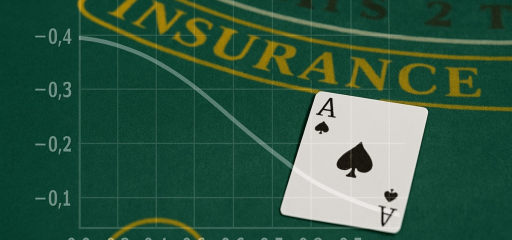
The dealer flips an Ace, looks around the table, and asks the question that has separated bankrolls from players for about seventy years: “Insurance, anyone?” It sounds protective. It sounds responsible. It sounds like the smart, hedged play for someone who actually understands risk. And yet, run the probabilities for ninety seconds and you’ll see why the casino industry keeps that little side bet on every felt surface it can find. It’s quietly one of the worst wagers in the entire pit.
What Insurance Actually Is
When the dealer’s upcard is an Ace, you’re offered a side bet up to half your original wager. The proposition is simple: you’re betting that the hidden hole card is a ten-value card, which would give the dealer blackjack. If you’re right, insurance pays 2:1. If you’re wrong, you lose the side bet and the main hand plays out normally.
On paper, it’s framed as risk mitigation. You’re “protecting” your hand against the dealer’s natural. The casino even uses the word insurance, which borrows credibility from an entire industry built on actuarial math. Clever branding. I’d argue it’s one of the most successful sales lines in casino history, right up there with “the next spin is due.”
Here’s the catch. It isn’t really insurance at all. It’s an isolated proposition bet on whether one specific card belongs to a specific group. Whether you’re holding a 20, a 12, or a blackjack of your own, the side bet doesn’t care. It’s just a wager on the hole card.
The Probability of a Ten in the Hole
Let’s count cards the way the math demands. A standard six-deck shoe contains 312 cards. Of those, 96 are “ten-value”, the 10, Jack, Queen, and King across all four suits and six decks (4 × 4 × 6 = 96). The dealer’s Ace is already exposed, so it’s removed from the unseen pool. That leaves 311 unseen cards, 96 of which complete a blackjack.
So before anyone at the table has shown a card, the raw probability of the dealer holding a ten in the hole is 96/311 ≈ 0.3087, or about 30.87%. The probability of a non-ten is 215/311 ≈ 0.6913, roughly 69.13%.
| Scenario | Cards remaining | Probability |
|---|---|---|
| Hole card is a ten-value (dealer blackjack) | 96 of 311 | 30.87% |
| Hole card is anything else | 215 of 311 | 69.13% |
| Total | 311 of 311 | 100.00% |
This is the cleanest version of the calculation, no other cards visible, fresh shoe assumptions. Real-life shoes have already dealt some cards, which is why card counters care so much about what’s left. We’ll get to that.
Running the Expected Value
For a $1 insurance bet, the payoff structure looks like this: win $2 if the dealer has a ten, lose $1 otherwise. Plugging in the probabilities:
EV = (0.3087 × +$2) + (0.6913 × −$1)
EV = $0.6174 − $0.6913
EV = −$0.0739 per dollar wagered.
You’re paying about 7.39 cents on every dollar of insurance you put down. That’s a house edge of roughly 7.4%, which puts it in the same neighborhood as American roulette’s worst bets and well below basic-strategy blackjack itself, which typically runs a house edge under 1%.
| Outcome | Probability | Payoff per $1 | Contribution to EV |
|---|---|---|---|
| Dealer has blackjack | 0.3087 | +$2.00 | +$0.6174 |
| Dealer doesn’t | 0.6913 | −$1.00 | −$0.6913 |
| Total EV | 1.0000 | , | −$0.0739 |
Think about that for a second. Players will avoid roulette because they’ve heard the edge is bad, then happily hand the casino a side bet that’s worse than nearly every roulette wager except the five-number basket. The framing wins again.
“Even Money” Is the Same Trap with a Bow on It
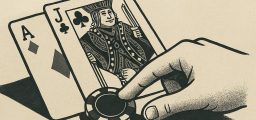
You’re dealt a blackjack. The dealer shows an Ace. Before checking the hole card, the dealer offers you “even money”, take a guaranteed 1:1 payout right now, instead of waiting to see whether the dealer also has blackjack (in which case you push) or doesn’t (in which case you collect your usual 3:2).
It feels like a free win. You’re guaranteed to be paid. Who turns that down?
Mathematically, taking even money is identical to placing the maximum insurance bet on your blackjack. The same −7.39% EV applies. Let me show the comparison directly using a $100 wager:
- Declining even money: 30.87% chance of pushing (win $0), 69.13% chance of collecting 3:2 (win $150). EV = 0.6913 × $150 = $103.70.
- Taking even money: Guaranteed $100.
- Difference: Roughly $3.70 per hand left on the felt, about 3.7% of the wager, which corresponds to 7.4% of the insurance-sized half-bet you effectively just made.
The casino has packaged the worst side bet in the game in a way that makes refusing it feel reckless. Slick marketing, and a great example of why “feeling safe” and “being right” aren’t the same calculation. Over a few hands the volatility might bite. Over a few thousand, the EV always wins.
When Insurance Actually Becomes Profitable
The −7.39% number assumes you have no information beyond the dealer’s Ace. Card counters do. The Hi-Lo system assigns +1 to low cards (2 to 6), 0 to neutral cards (7 to 9), and −1 to ten-values and Aces. When the running count divided by remaining decks (the “true count”) climbs, it means the unseen shoe is now disproportionately stacked with ten-value cards, exactly the cards that win insurance bets.
The breakeven point sits right around a true count of +3. At that level, the proportion of tens in the remaining shoe has shifted just enough that the EV of insurance crosses from negative to positive. Above +3, insurance is a +EV bet. Below it, you’re feeding the house.
| True count (Hi-Lo) | Approximate insurance EV | Take the bet? |
|---|---|---|
| 0 (neutral shoe) | −7.4% | No |
| +1 | −5% | No |
| +2 | −2% | No |
| +3 | ~0% (breakeven) | Marginal |
| +4 or higher | Positive | Yes |
This is the small but important caveat that gets missed in beginner advice. Insurance isn’t always bad. It’s bad when you don’t have a reason to believe the shoe is tens-rich. For 99.9% of recreational players, that condition never gets met, because tracking the running count through a six-deck shoe while a pit boss watches you isn’t exactly a casual hobby. (And yes, casinos have spent decades getting very good at spotting people who try.)
Why the Pitch Works So Well Anyway
If the math is this lopsided, why do so many otherwise smart players take insurance? A few reasons I’ve watched play out at tables over the years:
- Loss aversion. The pain of watching the dealer flip a ten and steal your hand is sharper than the dull ache of a quietly bleeding side bet. Insurance feels like it cancels that pain, even though it usually doesn’t.
- The word itself. Calling it “insurance” rather than “ten-card side prop” reframes the wager as defensive rather than speculative. The vocabulary is doing real work.
- Recency bias. If the dealer just hit two blackjacks in the last shoe, players overweight the chance it’ll happen again, even though the cards reshuffle that expectation.
- The dealer’s prompt. When the person running your game asks if you’d like protection, the social pressure to take it is real. Saying “no” can feel like you’re skipping a safety belt.
- Confusion between probability and frequency. Dealer blackjacks happen often enough, about 31% of the time given an Ace upcard, that the bet wins enough to feel “live.” The 2:1 payoff just doesn’t compensate for the frequency it loses.
My personal observation: I’ve sat at tables where the same player declined insurance for an hour, then took it the one time they had a 20 in their hand because “this hand is worth protecting.” The hand doesn’t matter. The bet’s EV is the same whether you’re holding a hard 16 or a soft 13. Hands don’t change probabilities. Only the unseen cards do.
A Quick Sanity Check Against Other Casino Bets
Here’s where insurance sits compared to other common wagers, just to anchor the 7.4% number in context:
| Bet | House edge |
|---|---|
| Blackjack (basic strategy, 6-deck, dealer stands on soft 17) | ~0.5% |
| Baccarat (banker bet) | 1.06% |
| European roulette (single zero) | 2.70% |
| American roulette (single number) | 5.26% |
| Blackjack insurance (uncounted) | ~7.39% |
| Tie bet in baccarat | ~14.4% |
| Most carnival side bets | 5 to 15% |
You’re playing the best table game in the casino and then voluntarily attaching one of the worst bets onto it. The cognitive dissonance is wild when you lay it out side by side.
FAQ
Q: Does it matter what cards I’m holding when I decide?
Only slightly, and only because your two cards reduce the unseen pool by two. If you’re holding a blackjack, one of your cards is an Ace and the other is a ten, which actually worsens insurance’s EV further, because you’ve removed a ten from the unseen cards. The −7.4% baseline gets a bit worse, not better.
Q: What about single-deck or double-deck games?
The math shifts a little, but not enough to flip the conclusion. In single-deck, with 16 tens out of 51 unseen cards, P(ten) ≈ 31.37%, and the EV is around −5.9%, better, but still bad. Double-deck lands somewhere between.
Q: Can’t I just take insurance “sometimes” and break even?
Not without information. Random sampling of insurance bets produces the same long-run −7.4% you’d get by always taking it. You need a reason, a true count, an unusually ten-heavy table, to make a particular bet +EV.
Q: Is there any version of this side bet that’s a good bet?
Some casinos offer a variant where insurance pays 3:1 instead of 2:1. At 3:1, the breakeven is 25% ten-density, which the shoe already exceeds, so that version would be +EV from the start. You won’t find it on the Vegas Strip. For mainstream tables, the 2:1 payoff is universal, and the answer is to skip the bet.
Q: Where can I read more about the underlying math?
The Wizard of Odds’ blackjack basics page is the go-to resource for verified house-edge numbers and the conditional probability breakdowns behind them. For sharpening the probability foundations themselves, our explainers at Effortless Math walk through the same expected-value mechanics in a much friendlier setting than a pit boss leaning over your shoulder.
Closing Thought
Insurance survives because it’s been engineered to feel like the responsible choice in a moment when your brain is running on cortisol instead of arithmetic. The dealer’s Ace is showing. The 2:1 payoff looks generous. The word “insurance” is doing its quiet work. And the math is sitting there, ignored, charging you about seven and a half cents on every dollar you push out.
You don’t need a counting system to beat this one. You just need to decline. Wave it off, let the dealer peek, and play your hand the way basic strategy says to play it. Over a thousand Aces, that single habit alone is worth more than most “systems” people pay good money to learn. The casino built a beautiful trap. You’re allowed to walk around it.

Related to This Article
More math articles
- Grade 6 Math: Area of Polygons on the Coordinate Plane
- Algebra Puzzle – Challenge 32
- DNA, RNA, and Protein Synthesis
- How Is the ALEKS Test Scored?
- 5th Grade NHSAS Math Worksheets: FREE & Printable
- Congressional oversight
- Top 10 4th Grade Common Core Math Practice Questions
- Linear Equation Solver — Solve for x Step by Step (Free)
- Solicitor general
- Exponential Growth & Decay Calculator (Free)


What people say about "Blackjack Insurance Sounds Smart Until You Do the Probability - Effortless Math"?
No one replied yet.