Labouchere Cancellation System: The Math of Why ‘Eraser Tape’ Fails
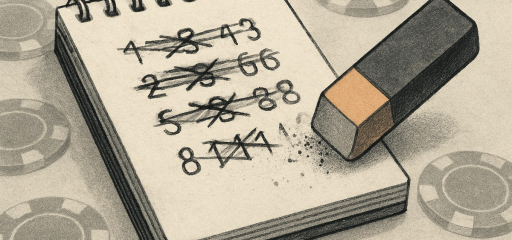
The labouchere system, sometimes called the cancellation system or “split martingale,” dresses up roulette betting in the costume of a budgeting spreadsheet. You write down a short row of numbers, treat them as a profit target, and start crossing them off one by one. The pitch sounds tidy: pick how much you want to win, design the sequence, work through it, walk away ahead. The math behind the pitch is far less tidy. Every wager you place on red still carries the same -2.70% expected return on a European wheel, and the sequence has no memory of that fact. What the labouchere system does instead is shuffle the size of your bets around in a way that quietly inflates risk during losing runs. This article walks through the mechanics, builds a 10-bet table, and shows why the “eraser tape” eventually runs out.
Writing down the sequence
The labouchere system starts with a target. You pick a profit goal in units, then break that goal into a small sequence of positive numbers that add up to it. A common starter sequence is 1-2-3-4. Add those numbers together and you get 10, so the target for the cycle is +10 units. The numbers do not have to be consecutive and they do not have to be small. Some players use 1-1-1-1-1-1-1-1-1-1 for a flat +10 target, others use 2-3-5 for +10 with fewer entries. The sequence is the contract you are writing with yourself for that betting cycle.
Once the sequence is on paper, you ignore the table for a moment and look only at the two ends. Whatever number sits on the left and whatever sits on the right are the only two that matter for the next bet. The middle entries wait their turn. This is why the system feels structured: you are never staring at the full bankroll, only at two numbers and a pen.
The bet is first plus last
The rule for the next wager is simple. Take the first number in the sequence, take the last number, add them together, and bet that amount on an even-money proposition. With a starting sequence of 1-2-3-4, the first bet is 1 + 4 = 5 units. You place that bet on red, black, odd, even, or any of the other roughly even-money roulette wagers. The wheel spins. One of two things happens.

If the bet wins, you cross out both the first and the last number. The sequence shrinks from both ends. From 1-2-3-4 it becomes 2-3, and your next bet is 2 + 3 = 5 units again, by coincidence. If that bet also wins, both 2 and 3 get crossed off, the sequence is empty, and the cycle is complete. Your net profit on a finished sequence equals the sum of the original numbers, which in this case is +10 units.
What happens when you lose
Losses do not erase. Losses append. If you bet 5 units on 1-2-3-4 and the spin loses, you write the amount you just lost onto the right end of the sequence. The row becomes 1-2-3-4-5. The first and last entries are now 1 and 5, so the next bet is 1 + 5 = 6 units. Lose again and the sequence grows to 1-2-3-4-5-6, with the next bet at 1 + 6 = 7 units. Each loss feeds the sequence and pushes the right-hand number higher, which is what makes the next bet larger.
This is the structural feature that makes the labouchere system look smart in the short run and dangerous in the long run. A single win removes two numbers. A single loss adds one. As long as wins and losses alternate evenly, the sequence shortens overall. As soon as losses cluster, the sequence grows faster than wins can trim it back.
Finishing the sequence on a friendly shoe
When the wheel cooperates and you reach the point where every number has been crossed off, the cycle is closed and you have booked the original target profit. With 1-2-3-4 that profit is +10 units, regardless of how many spins it took to get there. Whether the cycle closed in two wins or eighteen spins of mixed results, the arithmetic of crossing pairs off the ends guarantees that a completed sequence returns exactly the sum of its starting numbers.
The catch is the word “completed.” The number of spins required to finish a labouchere cycle scales roughly with the square of the sequence length once losing streaks enter the picture, because every loss makes future cycles longer and slower to wind down. A short sequence on a friendly shoe can close in a handful of spins. A short sequence on an ugly shoe can balloon into a row of fifteen numbers that needs dozens of wins to clear.
Why losing streaks balloon the sequence
Walk the run more carefully. Start at 1-2-3-4. Lose six in a row. Each loss appends the size of that lost bet to the right end. A representative ballooned sequence after six consecutive losses might look like 1-2-3-4-5-7-9, where 5, 7, and 9 are the losing bet sizes that have been written onto the right edge. The next wager from that state is 1 + 9 = 10 units, and the total cash already sunk into the cycle is the sum of those six losing bets.
The point is not that six losses in a row is rare. On European roulette, the probability of losing six even-money bets in a row is roughly (19/37)^6, or about 1.86%. That is roughly one cycle in fifty-four. If you sit down for a few sessions per month, you will see this pattern. The labouchere system does not protect you from it. It simply rearranges the loss into a queue of pending bets that all have to be cleared before the cycle finishes.
The table-limit trap
The other quiet problem with the labouchere system is the ceiling. Casinos publish maximum bets on every layout. A common European roulette table might allow even-money wagers up to 500 or 1,000 units. The labouchere bet size grows with the right-hand entry, which grows with losing streaks, which means a long losing run can push the required next bet above the table maximum. When that happens, the system has no rule for what to do. You either split the wager across multiple spins, walk to a higher-limit table, or accept that the cycle cannot be finished as designed and book the running loss.

None of those options recover the original target. The walking-away version simply locks in whatever deficit the sequence carries. The higher-limit table just moves the same problem onto a layout with a bigger ceiling, where one more losing streak will hit the same wall again. The system was never designed with table limits in mind.
A 10-bet walk-through
Here is a single hypothetical cycle starting from 1-2-3-4 on European red. The outcomes are mixed so you can see how the sequence breathes during normal play. Each row shows the sequence before the bet, the bet size, the spin result, and the running profit or loss for the cycle.
| Bet # | Sequence before bet | Bet size | Result | Running P/L (units) |
|---|---|---|---|---|
| 1 | 1-2-3-4 | 5 | Loss | -5 |
| 2 | 1-2-3-4-5 | 6 | Loss | -11 |
| 3 | 1-2-3-4-5-6 | 7 | Win | -4 |
| 4 | 2-3-4-5 | 7 | Loss | -11 |
| 5 | 2-3-4-5-7 | 9 | Loss | -20 |
| 6 | 2-3-4-5-7-9 | 11 | Win | -9 |
| 7 | 3-4-5-7 | 10 | Loss | -19 |
| 8 | 3-4-5-7-10 | 13 | Win | -6 |
| 9 | 4-5-7 | 11 | Win | +5 |
| 10 | 5 | 5 | Win | +10 |
This cycle closes at the original +10 target, but notice the path. The running deficit hit -20 units after five spins, more than twice the eventual profit. The peak bet was 13 units, well above the starting 5. The cycle needed ten spins to book ten units of profit, against six losing spins along the way. The math worked because the wins arrived in time. They do not always arrive in time.
Cumulative exposure during a 10-loss streak
To see the exposure problem more clearly, imagine the wheel does not cooperate at all. Starting from 1-2-3-4, here are the bet sizes for ten consecutive losses and the cumulative cash lost:
- Loss 1: bet 5, total lost 5, sequence 1-2-3-4-5
- Loss 2: bet 6, total lost 11, sequence 1-2-3-4-5-6
- Loss 3: bet 7, total lost 18, sequence 1-2-3-4-5-6-7
- Loss 4: bet 8, total lost 26, sequence 1-2-3-4-5-6-7-8
- Loss 5: bet 9, total lost 35, sequence 1-2-3-4-5-6-7-8-9
- Loss 6: bet 10, total lost 45, sequence 1-2-3-4-5-6-7-8-9-10
- Loss 7: bet 11, total lost 56, sequence grows by 11
- Loss 8: bet 12, total lost 68, sequence grows by 12
- Loss 9: bet 13, total lost 81, sequence grows by 13
- Loss 10: bet 14, total lost 95, sequence grows by 14
After ten consecutive losses, the cycle has consumed 95 units of bankroll and the next bet is 1 + 14 = 15 units. The original target was +10. To recover the 95 units already lost and book the +10 profit, you now have to grind through a sequence whose right-hand numbers are 14 and growing. None of this changes the per-spin probability. Each spin is still an independent 18/37 chance to win, and the house edge on every single bet is the same -2.70%.
The expected-value floor
Whatever shape the sequence takes, every wager you place on European red carries the same expected return. The payout is even money. The win probability is 18/37 and the loss probability is 19/37. The expected value per unit wagered is (18/37)(+1) + (19/37)(-1) = -1/37, which is approximately -0.0270, or -2.70%. That number does not change when the sequence is long, when the sequence is short, when you are up, or when you are down. It applies to a 5-unit bet, a 15-unit bet, and a 500-unit bet identically.
This is the part the labouchere system cannot rewrite. Linearity of expectation means the total expected loss across a session equals -2.70% times the total amount wagered. Because the labouchere system tends to put more money on the table during losing streaks, the total amount wagered per cycle is usually higher than a flat-bet strategy would produce. The expected loss in dollars is therefore typically larger, not smaller. If you want to refresh how expectation works on simple sequences and totals, the Effortless Math reference notes on weighted averages and probability are a useful starting point. For a longer, casino-focused breakdown of cancellation-style systems, the Wizard of Odds betting systems page covers the same arithmetic in more detail.
Consider the wager total in the 10-bet table above. The bet sizes sum to 84 units handled. The cycle closed at +10, but the expected baseline on 84 units wagered is about -2.27 units. That cycle outran its expectation, which is what a finished cycle is supposed to do. Over hundreds of cycles, the ones that fail to finish, hit the table cap, or take 40 spins to grind out a small target pull realized return back toward the -2.70% floor. The sequence cannot outrun the floor long term because the floor is recomputed every spin.
FAQ
Q: Does the labouchere system have a smaller house edge than flat betting?
No. The per-spin house edge is fixed at -2.70% on European roulette and -5.26% on American. The system changes bet sizes but not probabilities.
Q: Can I just pick a longer sequence to make the target easier?
A longer sequence with smaller numbers does take more wins to close, but it also accumulates losses for longer before any single win cancels much. The expected loss scales with total amount wagered, not with sequence design.
Q: What happens if I hit the table maximum mid-cycle?
The system stops working as designed. You either split the bet across spins, change tables, or stop the cycle and lock in the current loss. None of those moves restore the original target.
Q: Is “reverse labouchere,” where you append on wins instead of losses, any better?
It rearranges the risk profile but not the expected value. The house edge is the same -2.70% per bet, and reverse cycles tend to give back small wins while waiting for a long winning streak that may not arrive.
Q: How likely is a 10-loss streak on even-money roulette?
On European red, the probability is (19/37)^10, roughly 0.13%. That is about one cycle in 770. Across a month of regular play it is uncommon but not rare.
Gambling outcomes are uncertain; no strategy guarantees profit.

Related to This Article
More math articles
- Understanding Decimals (Tenths and Hundredths) for 4th Grade
- 4th Grade OST Math FREE Sample Practice Questions
- Majority Rule and Minority Rights
- The Best Grade 3 Math Book for Missouri Students
- Algebra Puzzle – Critical Thinking 15
- Grade 3 Math: Area
- Calculator Tools: Choose a Model and Check Exam Rules
- Aviator Crash Game Math: The Multiplier Distribution Explained
- The Ultimate Praxis Core Math Course (+FREE Worksheets & Tests)
- Top 10 Free Websites for GED Math Preparation







What people say about "Labouchere Cancellation System: The Math of Why ‘Eraser Tape’ Fails - Effortless Math"?
No one replied yet.