Paroli (Reverse Martingale): The Math of Riding Streaks

The Paroli system, sometimes called the reverse Martingale, flips a familiar idea on its head. Instead of doubling your bet after a loss, you double after each win and walk away from the table once you hit a target streak, usually three in a row. The pitch is appealing: risk one chip, hope to ride a hot run, and book a tidy profit using “house money.” But casinos do not pay out based on slogans. They pay out based on probabilities, and the paroli system is no exception. This article walks through the actual math, the per-cycle expected value, and where this betting pattern fits honestly into a player’s toolkit.
How the Paroli System Actually Works
The mechanics are simple, which is part of the reason the paroli system has stuck around for centuries. You pick a base unit, say $1, and place it on an even-money bet such as red at roulette, the player line at baccarat, or a pass line bet at craps. If you lose, the cycle ends and you start over with a fresh $1. If you win, you let the original stake and the winnings ride for the next bet, turning $1 into $2. Win again, and the $2 becomes $4. Win a third time, and you cash out $8, banking a $7 profit before resetting.
The reset rule is the part players often skip. A disciplined paroli stops after three consecutive wins or after any single loss, whichever comes first. Without a hard stop, the wheel eventually catches up and one bad spin erases every dollar you built. The three-win cap is what makes the strategy survive contact with reality, because it forces you to lock in profit instead of pressing forever. Some players use a two-win or four-win variant, but the three-win version is the textbook default and the one most strategy guides describe.
Why the Downside Is Small
The reason this approach gets recommended for beginners is the bounded risk per cycle. You only ever bet your original unit from your own pocket. After the first win, every subsequent chip on the table came from the casino. If a loss arrives on the second or third spin, you give back winnings rather than reaching deeper into your bankroll.

That matters psychologically and practically. Compare it to a Martingale, where a six-spin losing streak forces a $64 bet to recover a $1 target. With paroli, the worst single-cycle loss is your $1 unit. Even a string of unlucky cycles drains the bankroll linearly, not exponentially. For a player with $100 to spend on a Friday night, the paroli system can run for a long stretch without a sudden, catastrophic wipeout.
The Probability of a Three-Win Streak
The headline question is how often the dream actually happens. On a European roulette wheel, red shows up on 18 of 37 numbers, giving a per-spin win probability of 18/37 ≈ 0.4865. Three independent wins in a row carry probability:
0.4865 × 0.4865 × 0.4865 ≈ 0.1152, or about 11.52%.
That means roughly 1 in 8.7 cycles ends with the celebrated +7 unit haul. The other 88.5% of the time, the cycle ends in a loss of 1 unit, or in a partial run that gets clipped before the third win. Baccarat’s player bet sits at 0.4932 per resolved hand, so the three-in-a-row probability there is slightly higher at about 0.1199. The pass line at craps, treating it as roughly 0.4929 over the long bet resolution, lands near 0.1197. The numbers move a little; the basic story does not.
Mapping Every Cycle Outcome
There are only four ways a paroli cycle can end on red at European roulette. Listing them with probabilities and net payoffs is the cleanest way to see what you are signing up for.
| Outcome | Sequence | Probability | Net Result (units) |
|---|---|---|---|
| Three-win streak (cash out) | W W W | 0.1152 | +7 |
| Two wins, then a loss | W W L | 0.1216 | −1 |
| One win, then a loss | W L | 0.2499 | −1 |
| First bet loss | L | 0.5135 | −1 |
The probabilities sum to 1.0002, which is just rounding from the 0.4865 figure. Notice the symmetry: every losing cycle costs exactly one unit, because winnings are always recycled into the next bet. The only positive outcome is the full streak, and it shows up roughly once every nine cycles.
Expected Value: The House Edge Does Not Move
People sometimes pitch the paroli system as a way to flip the math in the player’s favor. It is not. The expected value per cycle is the sum of each outcome’s probability times its result:
EV = (0.1152)(+7) + (0.1216)(−1) + (0.2499)(−1) + (0.5135)(−1)
EV ≈ 0.8064 − 0.1216 − 0.2499 − 0.5135
EV ≈ −0.0786 units per cycle.
That looks small in isolation, but you need to compare it to how much you actually wagered. Across the four outcomes, the expected amount wagered per cycle is:
(0.1152)(7) + (0.1216)(7) + (0.2499)(3) + (0.5135)(1) ≈ 2.92 units.
Divide the EV by the expected wager: −0.0786 / 2.92 ≈ −0.0269, or −2.70%. That is the European single-zero house edge on red, untouched. Every dollar that crosses the felt loses 2.7 cents on average, no matter how you sequence the bets. The paroli system rearranges variance; it does not bend probability.
Paroli vs. Martingale: Two Mirror Images
It helps to put the two side by side, because they target opposite kinds of failure.
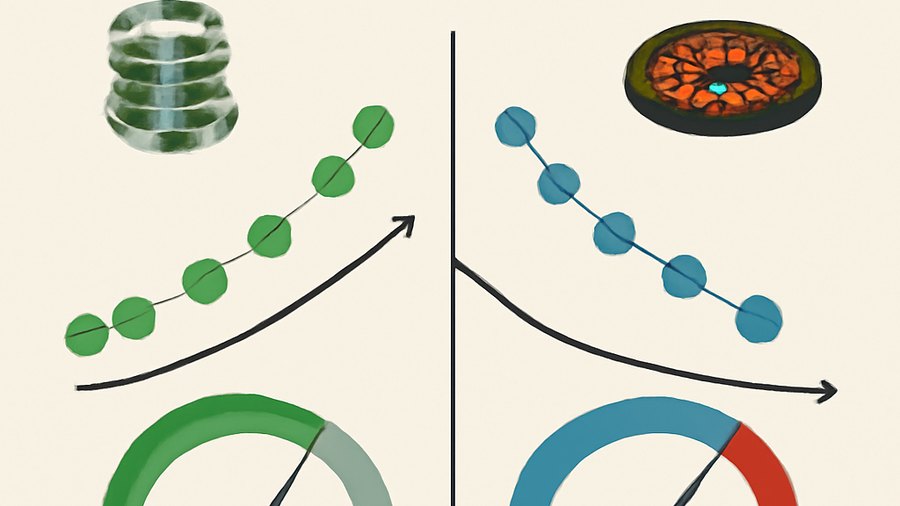
- Martingale: Wins a small target (typically 1 unit) very often, but a single long losing streak demands an enormous bet to recover. The variance hides in the rare catastrophe.
- Paroli: Loses a small unit very often, but a rare hot streak books a 7-unit gain. The variance shows up in the rare windfall.
- Martingale exposure: Unbounded in theory, capped only by table limits and your bankroll.
- Paroli exposure: Capped at one unit per cycle, period.
- Martingale ceiling: Targets one unit of profit per resolved cycle.
- Paroli ceiling: Targets seven units of profit per resolved cycle.
- Long-run EV: Identical. Both systems pay the same house edge per dollar wagered.
The honest framing is that both systems trade certainty in one direction for tail risk in the other. Martingale buys frequent small wins with the risk of a session-ending blowup. Paroli accepts frequent small losses for the chance of a memorable streak. Neither rearrangement changes what the wheel pays.
When Paroli Is the Reasonable Choice
If you treat the casino as paid entertainment with a known cost, the paroli system fits a specific personality of player. You want long sessions, you want most hands to feel low-stakes, and you want occasional moments of celebration without ever facing a “I have to bet $128 now” decision. The bounded downside is the real selling point. A player walking in with $50 can plausibly spread that across 50 cycles on a $1 base, knowing the worst single cycle costs $1.
It is a poor choice if your goal is to grind out steady profit, to beat the house edge, or to maximize the number of winning sessions. Most cycles end at −1 unit, so the win rate per cycle is well under 12%. You will lose more cycles than you win; you are betting on those wins being big enough to matter. For anyone who needs the dopamine of frequent green chips, this is the wrong system. If you want to reduce variance even further, flat betting is mathematically equivalent in EV and far simpler to track. A short refresher on probability and expected value over at Effortless Math can sharpen how you weigh that tradeoff before sitting down.
Practical Notes on Running a Paroli Cycle
A few details separate a clean paroli session from a sloppy one. Pick the base unit before you sit down and do not move it midstream; chasing losses by upping the base is how a capped system turns into an uncapped one. Decide in advance whether you stop at three wins or four, and stick to it. The math above assumes three, which is the standard. Going to four wins drops the streak probability to 0.4865⁴ ≈ 0.0561, or roughly 1 in 17.8, while the payoff jumps to +15 units. The EV per dollar wagered does not change, but the variance climbs sharply.
Avoid mixing the paroli system with side bets, insurance, or “just one more” exceptions. Every deviation chips away at the only real benefit, which is the predictable cap on per-cycle loss. It also helps to keep a small written tally of cycle outcomes, because human memory tends to remember the +7 streaks vividly and forget the long runs of −1 losses, which is exactly the bias that makes losing systems feel like winning ones. For independent third-party math on betting systems and why none of them defeat the house edge, the breakdowns at Wizard of Odds are worth a careful read.
FAQ
Q: Does the paroli system work better at baccarat than at roulette?
A: Slightly, in the sense that the per-hand win probability is a hair higher on the player bet, so three-streaks arrive more often. The house edge is also lower (about 1.24% on player), so the per-dollar loss is smaller. The structural conclusion is the same: you cannot escape the edge.
Q: Should I stop at three wins or chase a fourth?
A: Three is the textbook stop. A fourth win pushes the streak probability from about 11.52% down to 5.61% on European red, and you risk a 7-unit profit instead of a 1-unit base. The EV per dollar wagered is identical, but the swings get larger.
Q: Is the paroli system safer than the Martingale?
A: “Safer” is the right word, with a caveat. The maximum loss per cycle is bounded at one unit, so you cannot have a single-spin catastrophe. The long-run cost in expected dollars lost is the same, because both systems pay the same house edge on every wager.
Q: Can I combine paroli with card counting or wheel bias?
A: Only if you have a genuine edge first. The paroli sequence amplifies whatever edge or disadvantage you already carry. Stacking it on top of a fair negative-EV game just amplifies the variance of a losing proposition.
Q: How many cycles can I expect to run on a fixed bankroll?
A: With a $1 base and a $100 bankroll, the average loss per cycle is about 7.9 cents, so you would expect roughly 1,260 cycles on average before going bust, ignoring variance. In practice the spread is wide; some sessions end early on a bad run, some last much longer when a streak lands. A useful sanity check is to multiply your average bet size by the number of hands you expect to play, then take 2.7% of that figure as your expected hourly cost on European roulette. That number, not any clever progression, is what you are really paying for the entertainment.
Gambling outcomes are uncertain; no strategy guarantees profit.

Related to This Article
More math articles
- 7th Grade SOL Math Worksheets: FREE & Printable
- Order of Decimals, Mixed Numbers and Fractions
- Iowa ISASP Grade 7 Math Worksheets: 95 Free Single-Skill PDFs with Step-by-Step Keys
- Ophthalmic Instruments and TASS Prevention
- Sound, Hearing, and Music
- Rhode Island Algebra 1 Free Worksheets: Printable Algebra 1 Practice, Fully Worked Keys
- Pre-Algebra Practice Test Questions
- 10 GED Math Mistakes: Worked Fixes and a Free Review Log
- The Best Grade 5 ELA Practice Tests for New Hampshire Students
- Congressional caucuses







What people say about "Paroli (Reverse Martingale): The Math of Riding Streaks - Effortless Math"?
No one replied yet.