Low-Volatility Slots: The Math of Steady Bleed
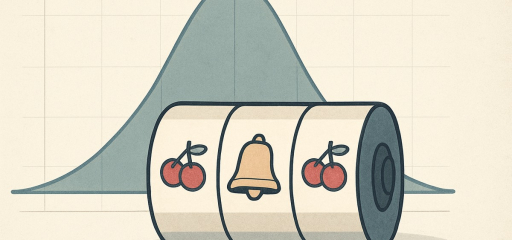
Walk past a row of low volatility slots on a Tuesday afternoon and you will see the same thing every time: lights flashing, coin sounds chiming, and players who look like they are winning. They are not. The reels are paying back a small fraction of what was bet a moment earlier, the screen flashes “WIN” anyway, and the credit meter drifts down one spin at a time. That is the steady bleed, and the math behind it is more interesting than most players ever stop to look at.
What “low volatility” actually means
Slot volatility is a measure of how spread out the outcomes are around the average. The technical version is the standard deviation of the payout per unit bet. A high-volatility slot might have a standard deviation of 10 or 15 times the bet; the rare jackpots pull that number up. A low-volatility slot usually sits somewhere between 2 and 4 times the bet, with most published low-vol titles landing near 2 to 3.
The other half of the definition is hit frequency, which is the share of spins that return anything at all. Low-vol games typically hit on 35 to 45 percent of spins. High-vol games can drop to 20 percent or below. So the headline is correct as far as it goes: low-vol slots really do pay out more often. The catch is in the size of those payouts.
Why “frequent small wins” is a misleading phrase
Open the paytable on most low-vol slots and look at the smallest combinations. A three-of-a-kind on the low-value symbols often pays back somewhere between 0.2 and 0.8 times the bet. If you wager $1 and the screen lights up showing you “won” $0.40, you did not win. You bet $1 and got $0.40 back. The net result of that spin is a $0.60 loss, presented with a happy sound effect.

Industry data on popular low-vol titles suggests that more than half of the “hits” return less than the bet. The remaining hits cluster around 1x to 3x bet, with occasional larger results from features. The average payout per spin still has to land at the RTP (typically 94 to 96 percent), so the math forces those small returns to dominate. The hit frequency is real. The wins, in the everyday sense of “I came out ahead on that spin,” are rarer than the noise suggests.
The slow-burn loss math
Take a 4 percent house edge, which is on the friendlier end of the slot floor (RTP 96%). Per spin at $1, the expected loss is $0.04. That is small enough that nobody notices. The damage comes from spin count.
A relaxed player on a high-volatility slot might run 300 spins in a session before they get bored or run out of money on a cold streak. The same player on a low-vol slot can easily push 800 to 1,200 spins. The session lasts longer because the bankroll bleeds slower, the constant little payouts feel rewarding, and there are no big drawdowns to trigger a walk-away.
Run the numbers on a 1,000-spin session at $1 per spin and a 4 percent edge:
- Expected loss: 1,000 × $0.04 = $40.
- Per-spin standard deviation: roughly 3 × bet = $3.
- Session standard deviation: $3 × √1000 ≈ $95.
- One-standard-deviation range: roughly −$135 to +$55.
- Probability of finishing the session ahead: a bit under 35 percent.
Compare that to a high-vol slot at the same RTP. The expected loss per spin is identical, but you might only manage 400 spins on the same starting bankroll because the variance eats it faster. The expected loss is $16 instead of $40, but the standard deviation is much larger, and the chance of either a big win or a wipeout is higher. Same edge, very different felt experience, and over a full evening the low-vol player usually loses more in absolute dollars because they get more spins in.
Why the brain keeps pulling the lever
Constant feedback is the engine. Behavioral research on slot design has shown for decades that variable-ratio reinforcement, the schedule where a reward could come at any moment, is one of the most persistent learning patterns there is. Low-vol slots are tuned to that schedule almost perfectly. Something happens on roughly four out of every ten spins. The screen lights up, a sound plays, and the brain registers it as a positive event even when the credit meter went down.
The industry term for this is “losses disguised as wins.” A 2010 study by Dixon and colleagues at the University of Waterloo measured player arousal during these sub-bet payouts and found responses similar to actual wins. The slot is not lying to anyone; the paytable is right there. But the audio-visual package is doing real work on attention and time-on-device, and the math is built around that.
Examples from the floor and the lobby
A few well-known low-vol titles give a sense of the range. Numbers below are taken from publisher specs and independent reviewer testing on Wizard of Odds. Real performance varies by configuration, jurisdiction, and operator.
| Slot | Provider | Approx. RTP | Hit Frequency | Std. Dev. (× bet) |
|---|---|---|---|---|
| Starburst | NetEnt | 96.1% | ~38% | ~2.3 |
| Blood Suckers | NetEnt | 98.0% | ~36% | ~2.6 |
| Esqueleto Explosivo | Thunderkick | 96.0% | ~40% | ~3.0 |
| Twin Spin | NetEnt | 96.6% | ~37% | ~2.8 |
| Wheel of Fortune (penny) | IGT | ~88-92% | ~35% | ~3.5 |
Blood Suckers is interesting because its 98 percent RTP is among the highest on the market, which keeps the slow-burn math even slower. That has made it a long-running favorite for players who want to clear casino bonus wagering with minimal expected loss. Starburst is the opposite end: lower RTP, very low std dev, almost no bonus rounds, and a near-constant trickle of small payouts. It is the canonical “session extender.”
Bankroll efficiency and time on device
If the only goal is to be entertained for a long time per dollar, low-vol slots are genuinely efficient. A $100 bankroll at $1 spins on a low-vol game can produce somewhere around 90 to 110 minutes of play on average, assuming a normal spin pace and the typical RTP range. The same $100 on a high-vol game might end in 25 minutes or last three hours, depending entirely on whether a feature triggers early.

So the trade is straightforward:
- Low volatility: long sessions, small drawdowns, small upsides, predictable expected loss in line with RTP.
- High volatility: short or wild sessions, big drawdowns, real shot at a meaningful win, identical expected loss per spin but fewer spins per bankroll.
- Penny mechanical slots: often the worst of both worlds. Lower published RTP (88 to 92 percent is common), multi-line forced bets that push the per-spin cost up, and hit frequencies that feel high because of small line wins on a 1-cent denomination but cost more per dollar bet.
Reading a paytable like a math person
Most players glance at the paytable, see a 5,000x line at the top, and stop reading. The useful information is at the bottom. Look at the three-of-a-kind payouts on the low-paying symbols (usually the playing-card ranks: 10, J, Q, K, A). If those land at 0.4x to 0.8x bet, you are looking at a classic low-vol design. If three-of-a-kind on the lowest symbol pays nothing and you have to hit four to score, that is a high-vol design even if the marketing says otherwise.
The other tell is the bonus trigger frequency. Low-vol slots typically have either no free-spin feature at all (Starburst is the cleanest example) or a feature that triggers roughly once every 100 to 150 base spins with a relatively small average payout. High-vol slots tend to push more of the RTP into rare features that average several hundred times the bet but trigger once every 250 to 500 spins. The average is the same; the rhythm is not.
The hourly-cost worksheet
A useful exercise before sitting down is to estimate the hourly expected loss in advance. The formula is simple:
Hourly expected loss = spins per hour × bet × house edge.
For a low-vol video slot at a relaxed pace of 500 spins per hour, $1 per spin, 4 percent edge: 500 × 1 × 0.04 = $20 per hour. If the same player runs 700 spins per hour at $2 per spin on the same machine, the cost jumps to $56 per hour. The edge did not change. The exposure (spins × bet) tripled.
This is why the most effective control on slot expected loss isn’t game selection. It’s bet size and pace. Slowing down by even 20 percent and dropping the bet from $1 to $0.50 cuts the hourly expected loss by more than half on the same machine.
1c penny slot versus low-vol video slot
This comparison trips a lot of players up. A 1c penny slot looks cheap because the per-line denomination is one cent. The reality is that most modern penny slots force a bet across 20, 30, 40, or more lines, so the actual cost per spin is $0.40 to $2.00 or more. Combine that with house edges in the 8 to 12 percent range and the hourly expected loss can exceed what you would see on a $1 low-vol video slot running at a 4 percent edge.
Worked example, 600 spins per hour:
- Penny slot, 30 lines × $0.01 × 2 (multiplier) = $0.60/spin, 10% edge → $36/hr expected loss.
- Low-vol video slot, $1/spin, 4% edge → $24/hr expected loss.
The penny slot feels smaller and safer. The math says otherwise. This is one of the most consistent traps on a casino floor, and it is worth running the numbers before assuming a lower denomination is a cheaper game. If you want a deeper refresher on percentages and expected value, the explainers at Effortless Math are a clean place to start.
FAQ
Q: If low-vol slots pay so often, why do I still lose?
A: Because most of those payouts return less than the bet. The RTP has to land in the 94 to 96 percent range, so the average outcome per spin is a small loss regardless of how often the screen flashes a win sound.
Q: Are low-vol slots a good choice for clearing a bonus?
A: Often, yes. High RTP combined with low variance means the expected wagering cost is lower and the chance of busting before completing the rollover is smaller. Blood Suckers at 98 percent is the textbook example. Check the operator’s bonus terms; some games are excluded or weighted differently.
Q: Can I beat a low-vol slot with a betting system?
A: No. Every spin is independent and the house edge applies on every bet, regardless of stake size or pattern. Betting systems change the shape of the variance, not the expected value.
Q: Is a 96% RTP slot fair?
A: It is mathematically transparent. Over the long run the machine keeps 4 percent of everything wagered. Whether that is “fair” depends on what you are paying for; if the entertainment value of two hours of play is worth $30-40 to you, it can be a reasonable trade. If it is not, the cheapest path is to play less.
Q: Why does the casino put low-vol slots near the entrance?
A: Two reasons. They produce visible activity (lots of small wins, lots of celebration sounds), which makes the floor look lively. And they are good at extending sessions for new players who might be intimidated by the dry stretches on a high-volatility machine.
Gambling outcomes are uncertain; no strategy guarantees profit.

Related to This Article
More math articles
- The Ultimate 6th Grade ILEARN Math Course (+FREE Worksheets)
- Chapter 2: The Articles of Confederation
- The Ultimate TASC Math Course (+FREE Worksheets & Tests)
- How to Graph the Cosine Function?
- Bridging the Gap: From Basic Math to Algebra with “Pre-Algebra for Beginners”
- How to Find Fractions of Time Units
- Free Grade 8 English Worksheets for California Students
- What Skills Do I Need for the ACCUPLACER Math Test?
- The Best Grade 5 ELA Practice Tests for Colorado Students
- How to Support Grade 6 Reading at Home: 12 Smart Strategies That Build Independence








What people say about "Low-Volatility Slots: The Math of Steady Bleed - Effortless Math"?
No one replied yet.