The 10,000x Max Win: How Often It Actually Hits
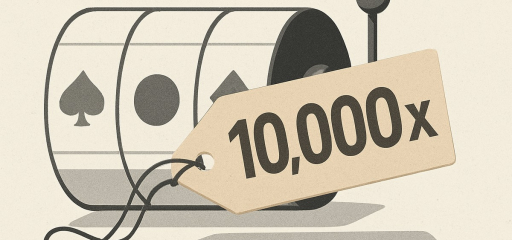
Open any online slot lobby and you will see the same banner repeated hundreds of times: “Max Win 10,000x.” It is the headline number, printed bigger than the RTP, bigger than the volatility label, sometimes bigger than the slot’s actual name. The pitch is obvious. Drop a $1 spin, walk away with $10,000. The math is less obvious, and once you work it out, the marketing starts to feel less like a promise and more like a lottery ticket pinned to the front of the cabinet. This article works through the actual slot max win probability for those 10,000x payouts, what they mean for one player versus a whole casino, and why streamers seem to hit them while you don’t.
Max Win as Marketing
Every modern slot has a published maximum win, usually expressed as a multiple of the bet. 5,000x, 10,000x, 25,000x, sometimes the dreaded “uncapped.” Studios know players scan for this number the way shoppers scan for sale tags, so it lives in the title card, the lobby tile, and the loading screen. What the lobby almost never shows is the probability of actually reaching that ceiling. The number you see is the maximum, not the expectation. Treating it like an expectation is the same mistake as judging a bond by its face value while ignoring duration and default risk.
It is worth saying plainly: the max win figure is not a lie. The math model genuinely permits that outcome. It is just that the model also permits a meteor strike during your bonus round, and the slot does not advertise that probability either.
Typical Max-Win Probabilities
Probabilities for hitting the printed max vary wildly by studio and game design. From public test reports, lab certifications, and provider math sheets, a few rough bands emerge:

- Low-volatility games with capped wins around 1,000x to 2,500x: hit rate roughly 1 in 100,000 to 1 in 500,000 spins.
- Mid-to-high volatility slots with 5,000x caps: typically 1 in 1 million to 1 in 3 million.
- High-volatility 10,000x titles, the most common modern tier: roughly 1 in 3 million to 1 in 10 million, with 1 in 5 million as a reasonable working number.
- Extreme volatility 25,000x to 50,000x games: 1 in 20 million to 1 in 50 million is not unusual.
For the rest of this piece, take 1 in 5,000,000 as the baseline for a 10,000x max win. That is conservative for some titles and generous for others, but it sits in the middle of where most published numbers cluster.
What 1 in 5 Million Means for One Player
Say you sit down and grind 10,000 spins, which is already a long session, at five seconds a spin that is close to fourteen hours of clicking. The probability of hitting the max at least once is:
P(at least one max) = 1 − (1 − 1/5,000,000)10,000 ≈ 1 − 0.998 ≈ 0.002, or about 0.2%.
One spinner, one marathon session, two-tenths of one percent. Push it further: 100,000 lifetime spins on the same game gets you to roughly 2%. A million lifetime spins, which almost no recreational player ever reaches, still leaves you under 20% of having ever seen it. The max win isn’t a number you should plan around. It’s a number that, for any single human, will almost certainly never appear.
What 1 in 5 Million Means for a Casino
Now zoom out. A mid-sized online casino can easily have 100,000 active spinners on a popular title in a day, each averaging around 100 spins. That is 10 million spins routed through the same RNG model. Expected max-win hits per day:
100,000 players × 100 spins × (1 / 5,000,000) = 2 hits per day.
So roughly two players, somewhere in the world, will scream into a microphone today because the same game that bored you for an hour gave them 10,000x. Multiply by 365 and that single title produces around 730 max-win hits per year across its entire player base. The headline is real, the testimonials are real, and yet the individual probability remains microscopic. Both things are true at once, and that is the part that breaks people’s intuition about slot max win probability.
Expected Hits Across Millions of Spinners
The strange shape of slot max win probability is that the same number feels impossible to one person and inevitable to a population. Hold the 1-in-5-million figure steady and walk it up the scale:
- 1 player, 100 spins per day: about one hit every 137 years of daily play.
- 1 player, 1,000 spins per day: about one hit every 14 years.
- 1,000 players, 100 spins per day: roughly one hit every 50 days across the group.
- 100,000 players, 100 spins per day: about 2 hits per day across the group.
- 1 million players, 100 spins per day: about 20 hits per day across the group.
Most popular online slots sit somewhere between the third and fifth row of that table at any given moment. So in any 24-hour window, a few unlucky-feeling players on the same game will have their accounts credited with a five-figure multiplier. None of them did anything different from the other 99,998 spinners. They just happened to be the ones the binomial distribution selected. That is not a story, that is a statistic, and the difference matters when you decide how to budget a session.
The Streamer Selection Bias
This is where things get sneaky. If you watch slot content on YouTube, Kick, or Twitch, max-win hits appear constantly. New thumbnail every week, screenshot of a 10,000x payout, big number, big face. So you start to think, “OK, maybe one in five million is wrong, these guys hit it all the time.” They don’t. You are seeing the survivorship-filtered tape.
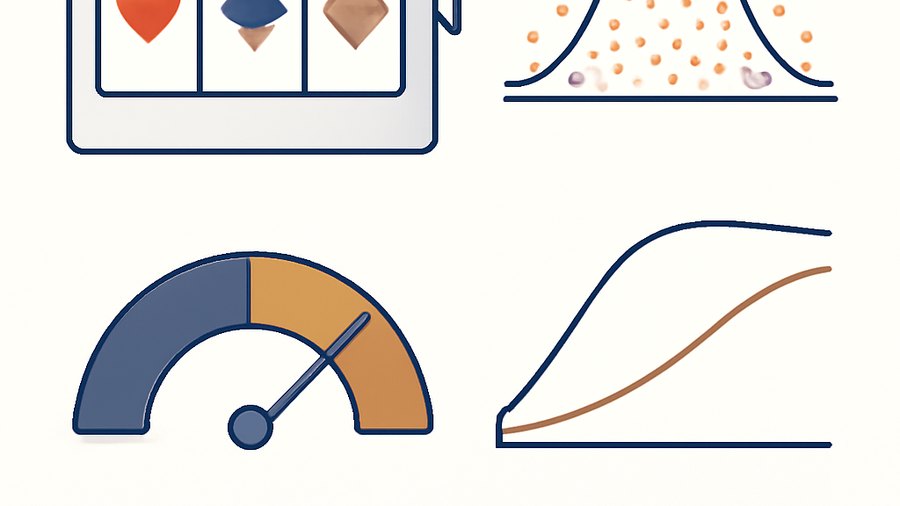
Consider what gets uploaded. A streamer running 10,000 spins per day across multiple titles, multiplied by hundreds of streamers, produces tens of millions of spins routed through cameras every single day. At one-in-five-million, that pool will manufacture several recorded max wins per day. Add highlight compilation channels that vacuum up clips from anywhere, and your feed sees a max win every time you open the app. The denominator, every losing session that nobody posts, is invisible. The clips are real, the math is also real, and the conclusion “this seems to happen all the time” is the wrong inference from a deliberately filtered sample.
Regulators are aware of this. The UK Gambling Commission and similar bodies have repeatedly flagged affiliate streaming content for distorting players’ sense of typical outcomes. The math on selection bias is not a complaint, it is a description.
Max-Win Cap Behavior
The cap itself is a design choice and varies by provider:
- Hard cap at 10,000x: The most common modern tier. If the math model would have paid 12,000x, you get 10,000x and the difference is absorbed into the studio’s risk model. Players rarely notice because hitting the cap is already the event of the year.
- Hard cap at 25,000x or 50,000x: Used for the high-volatility “extreme” line. Hit probability drops by roughly the ratio of cap increases, so a 25,000x ceiling is not 2.5x rarer than a 10,000x ceiling in the same engine. It can be 5x to 10x rarer depending on how the bonus distribution is shaped.
- Uncapped: A small number of games genuinely have no ceiling on the multiplier. In practice the distribution still has effectively zero density past some practical limit, so “uncapped” is more a marketing word than a meaningful operational difference.
The cap matters for one practical reason: when the published RTP is calculated, every spin that would have paid above the cap is rounded down to the cap. If you removed the cap, the RTP would technically rise slightly, but the variance would balloon, and the studio would not be able to price the game responsibly. Caps are a risk-management tool, not a player-hostile one.
Famous Slots: Published Max Wins and Approximate Hit Probability
Approximate figures based on public provider math sheets and independent test summaries. Treat all probabilities as ballpark, not certified.
| Slot Title | Published Max Win | Approx. Hit Probability | Volatility |
|---|---|---|---|
| Sugar Rush 1000 | 10,000x | ~1 in 7,000,000 | Very High |
| Sweet Bonanza | 21,100x | ~1 in 30,000,000 | High |
| Gates of Olympus | 5,000x | ~1 in 1,500,000 | High |
| Razor Shark | 50,000x | ~1 in 50,000,000 | Very High |
| Money Train 3 | 100,000x | ~1 in 100,000,000+ | Extreme |
| Book of Dead | 5,000x | ~1 in 2,000,000 | High |
| San Quentin xWays | 150,000x | ~1 in 100,000,000+ | Extreme |
| Big Bass Bonanza | 2,100x | ~1 in 250,000 | Medium-High |
The pattern is the same across the board: bigger headline number, smaller chance of touching it, with the rate of decay typically faster than the cap grows. For independent context on slot math design, the Wizard of Odds slots reference covers the underlying probability framework.
What a Math Practitioner Does With Max-Win Data
If you treat slots as math problems, the max win is not a goal, it is an input. The useful exercise is checking how much of the published RTP actually comes from that headline event. Using the working numbers:
Max-win contribution to RTP = 10,000 × (1 / 5,000,000) = 0.002, or 0.2% of total RTP.
A slot with a 96% advertised RTP, then, gets only 0.2% of that return from the max win, leaving 95.8% from everything else. Useful conclusions follow directly:
- If you remove the max-win event from your personal expectation, your effective RTP drops from 96% to roughly 95.8%. That is the realistic number for almost every player.
- Games with bigger caps tend to push more RTP into the tail. A 25,000x game might allocate 0.5% to 1% of RTP to that single event, which means the bulk of the time it pays back worse than its capped competitor.
- Volatility, not headline cap, is the variable you actually feel. If you cannot tolerate a 200-spin dry stretch, you cannot meaningfully chase 10,000x outcomes, and you are better off picking a lower-cap game with a denser pay distribution.
For broader probability background and worked examples, the Effortless Math probability section covers the binomial and rare-event math used throughout this kind of analysis.
FAQ
Q: If I play 100,000 spins, am I guaranteed a max win?
No. At 1 in 5,000,000, 100,000 spins gives about a 2% chance of seeing one. Most players who hit that many spins will never see the max on that title.
Q: Why do streamers hit max wins so often?
Aggregate volume and editing. Thousands of streamers running tens of millions of spins per day will produce several real max-win hits daily. You see the clips; you don’t see the empty sessions, so the rate looks far higher than it is.
Q: Does buying the bonus increase max-win odds?
Sometimes, depending on the title. Bonus-buy features generally raise the conditional probability of large payouts, but the cost rises in proportion. The expected return is usually within a few tenths of a percent of base-game play, and variance is much higher.
Q: Are uncapped slots actually different from 25,000x slots?
In theory, yes; in practice, barely. The probability density past 25,000x is so small that the realized difference in long-run RTP is typically under 0.05%.
Q: Is there any strategy to hit the max win?
No. RNG outcomes are independent. Spin selection, bet timing, and “lucky chairs” do not move the probability. The only thing under your control is the size of your sample, and a larger sample mostly means you pay more in expected loss before the rare event might or might not occur.
Gambling outcomes are uncertain; no strategy guarantees profit.

Related to This Article
More math articles
- AFOQT Math Prep Books: How to Choose a Study Guide
- The Best Grade 7 ELA Practice Tests for Pennsylvania Students
- Tracking, Hidden Curriculum, Credentials, and Unequal Signals
- Full-Length 7th Grade Common Core Math Practice Test
- AI Detection Guide to Identify AI Writing vs Human Authors
- How to Master the Average Rate of Change
- How to Solve Systems of Equations with Substitution?
- Reciprocals
- The Law of Sines
- The Math Behind Slots: Understanding Probability and Payouts







What people say about "The 10,000x Max Win: How Often It Actually Hits - Effortless Math"?
No one replied yet.