Flat Betting vs. Progressive Betting: A Variance Comparison

Pick any forum thread about betting systems and you will find the same fight: someone insists Martingale “wins more often,” someone else swears flat betting is the only honest approach, and a third person posts a screenshot of a Paroli streak as if it settles the argument. None of them are really arguing about expected value. They are arguing about variance, even when they do not use the word. The choice between flat vs progressive betting does not change how much the house keeps in the long run. It changes the shape of your session: how wide the swings get, how often you walk away ahead, and how brutal the bad nights are.
The EV Reality You Cannot Bet Around
Before we talk about variance, the foundation has to be set. In any negative expectation game, the per-unit edge is fixed by the rules. American roulette gives the house 5.26 percent on most bets. Double-zero straight-up pays 35 to 1 on a 37 to 1 shot. That edge does not care whether you stake one unit, ten units, or a doubling sequence after each loss.
If a flat bettor wagers 1 unit per spin for 1000 spins on red, the expected loss is 1000 × 1 × 0.0526 ≈ 52.6 units. If a Martingale player on the same wheel cycles through average bet sizes of, say, 1.85 units across those same 1000 spins, the expected loss is 1000 × 1.85 × 0.0526 ≈ 97.3 units. More money put at risk, more money lost on average. Progression systems do not “beat” the house edge; they amplify it in proportion to the average wager.
That is the part every honest discussion of betting systems has to start with. After that, the interesting question is what these systems actually do.
What Variance Actually Measures
Variance is the spread of outcomes around the mean. Standard deviation, its square root, is the more intuitive number because it is in the same units as your bet. For a single even-money roulette spin at 1 unit, the outcome is +1 with probability 18/38 and −1 with probability 20/38. The variance of that spin is approximately:

Var ≈ (1 − (−0.0526))² × (18/38) + (−1 − (−0.0526))² × (20/38) ≈ 0.9972.
Close enough to 1 that we usually just say the variance per even-money unit spin is bet². Standard deviation per spin is about 1 unit. Over n independent spins of the same flat bet, variance adds, so total variance is n × bet² and total standard deviation is bet × √n.
The key word there is “independent and identically sized.” Progression systems break the second half of that assumption. Bet size is no longer constant. It depends on the recent results. Which is where things get interesting.
Flat Betting: The Narrow Distribution
Flat betting is the cleanest case. Every spin risks the same amount, the variance per spin is bet², and the total standard deviation grows with √n.
For a 100-spin session at 1 unit per spin on red:
- Expected result: −5.26 units (the house edge in action).
- Standard deviation: about √100 ≈ 10 units.
- Roughly 68 percent of sessions land between −15 and +5 units. About 95 percent land between −25 and +15 units.
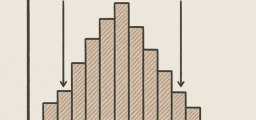
That is a calm distribution. You will rarely walk out of the casino down 50 units on this game, and you will rarely walk out up 50 either. The flat bettor’s session looks like a slow drift around a slightly negative average.
Positive Progression: Variance That Spikes on Streaks
Paroli and similar positive-progression systems raise the bet after a win and reset after a loss. A common version is 1, 2, 4, reset. Lose at any point, you lose only the current bet. Win three in a row, you book a fixed profit and start over.
The variance picture changes because the bet size on any given spin depends on how many wins just stacked up. Most spins are still 1-unit bets (you reset constantly on near-even-money games), but occasionally you risk 2 or 4 units in pursuit of the streak. Per-spin variance is no longer constant; it is a weighted average over the streak states.
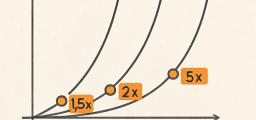
For 1-2-4 Paroli on red, a rough calculation gives an average bet size around 1.41 units across the cycle and average variance per spin near 2.0. Over 100 spins, total variance is roughly 200, standard deviation roughly 14 units. Wider than flat, but not violently so. The asymmetry is what people actually feel: most sessions look mildly losing, but a clean run of three or four streaks delivers a session that looks like a clear win. Paroli front-loads the upside into a few good clusters.
Negative Progression: Variance Dominated by Rare Disasters
Martingale is the cleanest example: after a loss, double the previous bet; after a win, reset to 1 unit. Starting from 1 and doubling, a streak of nine losses requires staking 1, 2, 4, 8, 16, 32, 64, 128, 256, a single bad run that costs 511 units before you reach the table limit.
On the surface, Martingale “wins” most sessions. You collect 1 unit at the end of nearly every short cycle. That is the trap. The session-win rate is high, but the loss when it comes is enormous. Variance is dominated almost entirely by the tail.
For a 100-spin Martingale session on red, with a reasonable table limit absorbing the worst streaks, simulation gives standard deviation in the neighborhood of 31 units, about three times the flat-bet figure. The expected result is still negative (worse than flat, because the average bet size is larger), and the distribution is heavily skewed: many small positive sessions, a handful of catastrophic ones. Variance and standard deviation hide the skew; the histogram screams it.
The Distortion of Session-Level “Win Rate”
This is the part that fools the most people. A Martingale player can run thirty sessions, finish ahead in twenty-five of them, and still be down hundreds of units after the run, because the five losing sessions each took out fifty or more units. The “I win 83 percent of my sessions” stat is true and useless.

Flat betting flips the optics. You finish ahead in maybe 35 to 45 percent of sessions, but the losing sessions look the same size as the winning ones. The honest reflection of the house edge sits on your shoulder the whole time.
Paroli is the middle case. You finish ahead in roughly 30 to 40 percent of sessions, the big wins come from streaks of three or more, and the losses are small but frequent.
If you ever judge a system by “I win most of the time I play it,” you are not measuring profit. You are measuring how the variance was packaged.
| Strategy | Avg bet (100 spins) | Expected loss | Std dev (units) | Approx session-win rate |
|---|---|---|---|---|
| Flat 1 unit | 1.00 | ≈ 5.3 | ≈ 10 | ~ 40% |
| Paroli 1-2-4 | ≈ 1.41 | ≈ 7.4 | ≈ 14 | ~ 35% |
| Martingale (cap 256) | ≈ 1.85 | ≈ 9.7 | ≈ 31 | ~ 80% (with rare deep losses) |
Picking a Style That Fits Your Goal
The right system depends entirely on what you want from the session. There is no “best” because the criteria differ. If you have not done the EV homework on the underlying game, no betting pattern will rescue it, start with the math at Effortless Math and build up from there.
- Entertainment with minimum drama: flat. You will lose slowly, predictably, and you can budget your bankroll against the standard deviation without nasty surprises.
- Long session time on a small bankroll: flat with small unit size. Time at the table scales with √n; doubling your bet size halves your durability.
- Chasing a few big swings without ruin: Paroli or a similar capped positive progression. The upside is concentrated in streaks; the downside is bounded.
- The illusion of “always winning”: Martingale. Most sessions look like wins. The math will eventually visit. The Wizard of Odds has a long-running breakdown of why negative progressions trade frequency for severity, see his betting systems analysis for the gory detail.
- Beating the house: none of the above. No bet sizing rule changes EV.
A 1000-Spin Simulation, Boiled Down
Running 1000-spin simulations on American-roulette red gives a tidy comparison that lines up with the math:
- Flat 1 unit: mean result around −53 units, standard deviation around 32 units. The distribution is a tight, slightly left-shifted bell.
- Paroli 1-2-4: mean around −74 units, standard deviation around 50 units. The distribution is wider with a longer right tail; occasional big winning sessions skew the look.
- Martingale capped at 256: mean around −95 units, standard deviation often over 200 units in a 1000-spin window because of how a single deep losing run dwarfs everything else. The median session is mildly positive; the average is deeply negative. That gap is the whole story.
The Martingale player who only looks at “most sessions” walks away convinced the system works. The Martingale player who looks at total bankroll after 1000 spins knows the truth.
Two practical observations come out of running these sims repeatedly. First, the variance gap between flat and Paroli is small enough that the choice between them is mostly a question of taste. Some people enjoy the rhythm of pressing a winning streak; others prefer the metronome of a constant bet. Either way, the long-run cost is similar, and neither rescues a negative-EV game. Second, the variance gap between flat and Martingale is so wide that the two strategies barely belong in the same conversation. They produce different shapes of risk, and judging them by the same yardstick, total profit, win frequency, biggest single session, will mislead you depending on which yardstick you pick. The honest comparison is the full distribution, and the full distribution always shows the same thing: the house edge is paid, one way or another.
FAQ
Does any betting system reduce the house edge?
No. The edge is fixed by the rules of the game and the payout structure. Bet sizing only changes how much money flows through the edge and how the swings feel.
If Martingale wins most sessions, why is it a bad system?
Because the few losing sessions are large enough to wipe out many winners. High session-win rate is not the same as positive expectation. The math averages over everything, including the table-limit busts.
Is Paroli safer than Martingale?
On variance, yes. Paroli risks only what you have already won on a streak, plus the seed bet. The catastrophic downside of Martingale comes from compounding losses, which Paroli structurally avoids.
How does table limit affect Martingale variance?
A lower table limit truncates the worst streaks, which actually reduces standard deviation and locks in the loss when the streak hits the cap. Higher limits stretch the tail; lower limits guarantee you cannot recover after a long run.
What is the practical use of knowing variance?
Bankroll planning. If your session standard deviation is 30 units, a 50-unit stop-loss is going to trigger often by chance alone. Matching bankroll to variance keeps you from misreading normal swings as a broken strategy.
Gambling outcomes are uncertain; no strategy guarantees profit.

Related to This Article
More math articles
- The Best Grade 7 Math Book for Nevada Students
- Free Grade 4 English Worksheets for Alabama Students
- How to Evaluate Credit Reports: Personal Financial Literacy
- 5th Grade LEAP Math Worksheets: FREE & Printable
- Ecclesia, Church, Denomination, Sect, and New Religious Movement
- Best Calculators For 10th Grade Students
- 5th Grade ACT Aspire Math Worksheets: FREE & Printable
- 5 Best Classroom Speakers for Teachers in 2026
- 8th Grade STAAR Math Worksheets: FREE & Printable
- How to Manage Your Time Effectively on the ISEE Math Test?










What people say about "Flat Betting vs. Progressive Betting: A Variance Comparison - Effortless Math"?
No one replied yet.