Measurement and Time for 4th Grade
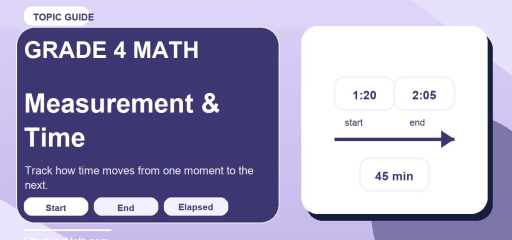
Measurement and Time for 4th Grade: this Effortless Math guide explains the topic in plain language, shows how it works through solved examples, and gives you free practice to try immediately, so the idea sticks instead of staying abstract.
Time is a measurement skill that helps students read schedules, solve elapsed-time problems, and interpret real-world events.
In Grade 4, students often add or subtract minutes and hours to decide when something starts, ends, or how long it lasts.
Key Ideas to Remember
- Read the hour and minute information separately before naming the full time.
- Use skip-counting by fives or a short timeline when the problem involves elapsed time.
- Check whether the final answer should be a clock time or a length of time.
Detailed Explanation
Elapsed time means the amount of time between two moments. Students can count forward, count backward, or use a number line to track the hours and minutes.
Breaking the time interval into friendly chunks, such as to the next hour and then to the ending time, makes these problems easier to solve accurately.
Worked Example
Problem: A movie starts at 1:20 and ends at 2:05. How long does it last?
- From 1:20 to 2:00 is 40 minutes.
- From 2:00 to 2:05 is 5 minutes.
- Add the parts: 40 + 5 = 45 minutes.
Answer: The movie lasts 45 minutes.
Practice Tip
Encourage students to draw a timeline when solving elapsed-time questions so each jump is visible.
Common Mistakes
Students usually improve faster in measurement and time when they slow down and watch for a few repeated mistakes. These are the ones worth checking first:
- Mixing up the hour hand and minute hand on an analog clock.
- Counting minutes by ones instead of by fives around the clock face.
- Forgetting whether the question asks for a clock time or an elapsed interval.
Practice Strategy
A short but consistent review routine helps students build confidence with measurement and time without getting overwhelmed.
- Read a few times from an analog or digital clock and explain how you know each answer.
- Create a short schedule for the day and solve one elapsed-time question from it.
- Use a number line to show how the minutes change from start time to end time.
Frequently Asked Questions
What should students focus on first in Measurement and Time problems?
Start by deciding whether the problem is asking you to read a clock, compare two times, or find elapsed time. That first decision tells you whether to focus on the hands, the digits, or a timeline.
How can students practice measurement and time at home?
Use a real clock, a microwave display, or a daily schedule. Ask students to read the time, explain it, and then create a related elapsed-time question.
How can you check the answer quickly?
Count forward or backward on a short timeline and make sure the answer matches the hour and minute information in the original problem.
Keep Practicing
After finishing this lesson on measurement and time, spend a few minutes on mixed review so the skill stays connected to the rest of Grade 4 math.
Need more Grade 4 review? Explore the Grade 4 Mathematics Worksheets hub for extra guided practice, review sets, and printable support.

Related to This Article
More math articles
- FREE SAT Math Practice Test
- How to Translate Phrases into an Algebraic Statement? (+FREE Worksheet!)
- How to Analyze Cross Sections of 3D Solids: A Step-by-Step Guide
- Is It Possible to Improve at Math Without Extra Tutoring
- Distance & Midpoint Calculator (Free, with Graph)
- Expansion of equality through legislation and judicial interpretation
- Algebra 1 Worksheets: 64 Free PDFs with Answers
- How to Use Grid Models to Convert Fractions to Percentages?
- 8th Grade Scantron Math Worksheets: FREE & Printable
- Top Tablets for Online Math Teaching




What people say about "Measurement and Time for 4th Grade"?
No one replied yet.