SBAC Algebra 1 Free Worksheets: Free Printable Smarter Balanced Algebra 1 Practice with Keys
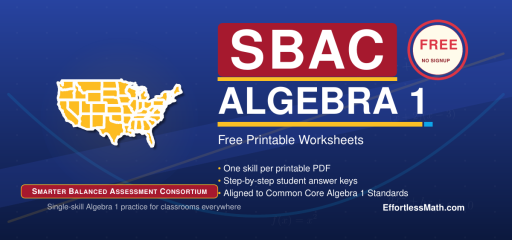
Most students walking into Algebra 1 already know how to do arithmetic. What they are about to learn is something different, how to argue with symbols. A linear equation is a small argument about two quantities. A system of equations is two arguments forced to agree at one point. A factored quadratic is an argument rewritten so its solutions are visible to the eye. The year-long project is to become comfortable doing those arguments quickly and correctly, and the only path there is steady, specific practice. The SBAC framework happens to assess exactly this kind of reasoning, which means good single-skill practice doubles as good test preparation almost automatically.
This page is a collection of 64 free PDFs aligned to the standards used by the Smarter Balanced Assessment Consortium for Algebra 1, which are the Common Core State Standards for Mathematics. Each worksheet takes a single SBAC-relevant skill and walks a student through it: one example, twelve practice problems, one student-facing answer key written in a tutoring voice. Whether a student is preparing for an SBAC test administered through their state’s assessment system or simply working from a Common Core-aligned classroom, the topics here are the topics SBAC measures.
Free, printable, account-free. Open, print, work.
Pre-Algebra for Beginners 2026 The Ultimate Step by Step Guide to Preparing for the Pre-Algebra Test
What’s on this page
Sixty-four single-skill worksheets aligned to the Common Core State Standards for Algebra 1, which SBAC uses as its framework. The set takes in the full course: algebraic expressions and the properties of operations, the linear-equation progression in every form, one-step, two-step, multi-step, variables on both sides, literal, plus inequalities and absolute-value equations. Functions, relations, domain and range, arithmetic and geometric sequences, slope, the equations of lines in slope-intercept, point-slope, and standard form, parallel and perpendicular lines, direct and inverse variation, systems of equations and inequalities, and linear-quadratic systems. Then exponent rules, polynomial operations and special products, factoring trinomials, three different methods for solving quadratics, statistics, probability, and exponential growth and decay.
Every PDF opens with a Quick Review: the skill in plain English, one worked example carried through start to finish, and a short note on the most common slip. Twelve practice problems follow, building gently from easy to harder. The final page is a student-facing answer key in a friendly, explanatory tone, readable by a ninth grader on their own, which matters because Algebra 1 is the age when students start wanting to handle their own work.
Foundations of Algebra
This chapter lays the groundwork, moving from numbers to letters and putting properties and order-of-operations to work on real problems. Steady practice now makes the SBAC feel far more manageable later.
- Variables, Expressions, and Properties
- Order of Operations and Evaluating Expressions
- Simplifying Algebraic Expressions
- Introduction to Equations and Solutions
- Personal Financial Literacy
Solving Linear Equations
Now the central skill of the course: isolating a variable, from one clean step through multi-step solves and rearranging formulas. Master it early and the rest of the SBAC course leans on it with ease.
- Solving One-Step Equations
- Solving Two-Step Equations
- Solving Multi-Step Equations
- Equations with Variables on Both Sides
- Literal Equations and Formulas
Inequalities and Absolute Value
Here a single answer becomes a set: solving and graphing inequalities, handling the sign-flip rule, and unpacking absolute value. It’s a frequent early hurdle for learners in classrooms nationwide and across the state.
- Solving One-Step Inequalities
- Solving Multi-Step Inequalities
- Compound Inequalities
- Absolute Value Equations and Inequalities
Relations, Functions, and Sequences
This unit introduces function thinking: notation, inputs and outputs, and the patterns that arithmetic and geometric sequences follow. These worksheets give SBAC students focused, low-pressure practice.
- Relations and Functions
- Function Notation and Evaluating Functions
- Domain and Range
- Graphing Functions and Transformations
- Arithmetic Sequences as Linear Functions
- Geometric Sequences
- Graphing Square Root, Cube Root, and Piecewise Functions
- Comparing Functions
- Combining Functions
- Inverse Functions
Linear Functions and Their Graphs
Linear graphs take focus: slope, intercepts, point-slope and slope-intercept forms, and special line relationships. For SBAC students, fluency here shows up directly on the SBAC.
- Slope and Rate of Change
- Slope-Intercept Form
- Point-Slope Form
- Standard Form of a Linear Equation
- Writing Linear Equations from Graphs and Tables
- Parallel and Perpendicular Lines
- Direct and Inverse Variation
- Understanding Graphs as Solution Sets
Systems of Equations and Inequalities
Here several equations are solved together, and systems of inequalities mark out whole regions of valid solutions. Getting comfortable here pays off all the way through the SBAC.
- Solving Systems by Graphing
- Solving Systems by Substitution
- Solving Systems by Elimination
- Applications of Systems of Equations
- Systems of Linear Inequalities
- Solving Linear-Quadratic Systems
Exponents, Polynomials, and Real Numbers
The algebra of powers and polynomials: exponent rules, adding and multiplying polynomials, special products, and real numbers. Time spent here is time saved when the SBAC rolls around.
- Properties of Exponents
- Adding and Subtracting Polynomials
- Multiplying Polynomials
- Special Products of Polynomials
- Rational and Irrational Numbers
Factoring
Students learn to rewrite polynomials as products: greatest common factor, trinomial factoring, and recognizable special forms. Across SBAC, this is one of the skills that rewards regular reps.
- Greatest Common Factor and GCF Factoring
- Factoring Trinomials: \(x^2 + bx + c\)
- Factoring Trinomials: \(ax^2 + bx + c\)
- Factoring Special Products
Quadratic Functions and Equations
The chapter covers parabolas and three solution paths for quadratics, plus what the discriminant reveals. It is worth the extra reps for SBAC learners aiming for a strong score on the SBAC.
- Graphing Quadratic Functions
- Characteristics of Quadratic Functions
- Solving Quadratics by Factoring
- Solving Quadratics by Completing the Square
- The Quadratic Formula and the Discriminant
- Solving Quadratics by Square Roots
- Quadratic Applications and Modeling
Statistics and Probability
Data analysis and probability close out the core, from box plots and histograms to counting principles. Classrooms nationwide families can use these pages to lock the skill in before it’s tested.
- Measures of Center and Spread
- Displaying Data: Histograms and Box Plots
- Scatter Plots and Correlation
- Lines of Best Fit and Predictions
- Probability and Counting Principles
- Two-Way Frequency Tables
Exponential Functions and Modeling
Here change compounds: exponential growth and decay, their graphs, and comparisons among model families. In classrooms nationwide classrooms it tends to separate confident students from hesitant ones.
- Graphing Exponential Functions
- Exponential Growth and Decay
- Comparing Linear, Quadratic, and Exponential Models
- Interpreting Functions and Parameters
How to use these worksheets at home
Don’t march through the 64 PDFs top to bottom. The SBAC framework, and the Common Core standards underneath it, is organized into clusters of related skills, and your student’s classroom is going to teach those clusters in its own order. Use the worksheets to mirror the order the class is moving in. When the class is on functions, print function pages. When the class is on systems, print systems pages. The set is here to support whatever is happening in the actual curriculum, not to replace it.
Pair related skills on consecutive days. “Solving Two-Step Equations” before “Solving Multi-Step Equations.” “Slope and Rate of Change” before “Slope-Intercept Form.” “Factoring Trinomials” earlier in the week, “Solving Quadratics by Factoring” later. These pairings reflect the way the standards build, and they make each subsequent worksheet feel like a small extension rather than a brand-new topic. They also reflect the way SBAC items are written, a typical item layers two or three of these skills inside a single problem, and a student who has practiced the skills as a sequence handles those layered items far more confidently.
Algebra 1 students are fourteen and fifteen, which is right at the age where independence pays off. Print the PDF the night before. Leave it on the desk. Keep the answer key out of reach until the work is done, students who can see the answers will check too early, and the practice loses most of its value. After the work, sit together for ten minutes and read through the explanations for the wrong answers. That short review is short enough that a tired student will agree to it, and it is exactly long enough to lock in what was almost-but-not-quite learned the first time.
A note about SBAC at Algebra 1
The Smarter Balanced Assessment Consortium administers a summative mathematics assessment used by a group of member states from elementary school through high school. At the high school level, SBAC is built on the Common Core State Standards for Mathematics, including the Algebra 1 standards. SBAC items are computer-adaptive, mixing standard multiple-choice work with constructed-response and performance tasks that ask students to interpret a situation, set up the math, solve it, and explain the reasoning. The exact testing window varies by state, but most administer the high school summative in the spring.
That structure is exactly why single-skill worksheets are useful preparation. SBAC tests reasoning, not memorization, and reasoning comes from having seen each skill enough times to recognize it inside a longer problem. After a classroom unit ends, two or three of the relevant worksheets work like a checklist, the standards inside the unit either feel solid or they don’t, and the ones that don’t get another short, focused session. Over a year, that habit produces the kind of fluency that makes SBAC items feel familiar instead of foreign.
A short closing
SBAC rewards students who have practiced the underlying skills, not students who have crammed for a test. Bookmark this page, pick one standard that feels almost-but-not-quite there, and print that PDF tonight. Tomorrow morning, that page on the desk is one specific next step, and a year of those steps is what makes the spring assessment feel like familiar territory instead of a surprise.
New to Algebra? Start with the basics


Related to This Article
More math articles
- Rhode Island Algebra 1 Free Worksheets: Printable Algebra 1 Practice, Fully Worked Keys
- AP Business with Personal Finance: Read a Cash-Flow Statement (2027 Prep)
- 4th Grade TNReady Math Worksheets: FREE & Printable
- 3rd Grade NYSE Math FREE Sample Practice Questions
- The Nixon Shock, Oil Crises, Stagflation, and Deindustrialization
- FREE 3rd Grade Georgia Milestones Assessment System Math Practice Test
- Top 10 4th Grade Georgia Milestones Assessment System Math Practice Questions
- Dealignment
- Equation of a Line Calculator (Free, with Graph)
- How to Use Grids to Multiply One-digit Numbers By Teen Numbers










What people say about "SBAC Algebra 1: Free Worksheets"?
No one replied yet.