Splitting Pairs: Eight Decisions Where Math Disagrees With Intuition
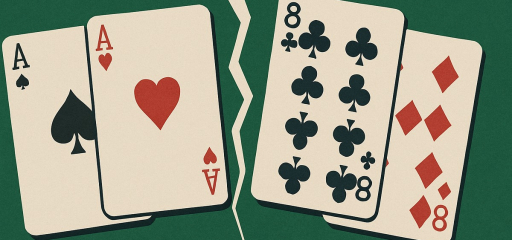
Splitting pairs is where blackjack players’ gut feelings go to die. The decisions that feel obvious are often wrong, and the ones that feel reckless are usually right. Splitting two tens against a dealer six feels like printing money, yet a stiff 20 is already worth roughly +0.66 expected value per unit bet, and breaking it apart throws most of that away. Splitting eights against a ten feels like begging to lose two bets instead of one, yet that ugly move is the least painful option on the table. This article walks through every pair-split decision a basic-strategy player faces and the EV numbers behind each call.
Why splitting is its own decision
A pair is the only starting hand where you can play two separate hands against the same dealer up-card. Each split hand gets a fresh card, plays independently, and pays or loses on its own. The value of splitting is not “what is my hand worth,” it is “what are two new hands worth, starting with this rank, compared to playing the pair as a single total?” A pair of nines totals 18. Stand against a dealer seven and 18 beats the most likely dealer total of 17. Split, and each nine starts a fresh hand against that same seven, and each is a strong favorite. The split wins more on average, even though the original 18 was already winning.
Always split: Aces and eights
Two decisions never change regardless of dealer card, deck count, or doubling rules. A pair of aces is split against every up-card from two through ace. Played as a single hand, A,A is a soft 12 that has to hit, and most of the strong cards push it back toward stiff territory. Split, each ace gets exactly one card (almost every casino enforces this), and the player draws to two hands starting at 11. The expected value gain runs from roughly +0.07 against an ace to north of +0.50 against weak up-cards like five and six, and against a dealer six the split EV is close to +0.91 per unit, one of the biggest edges in the game.
Eights are the famous “split the pain” hand. A hard 16 is the worst total in blackjack. Against a dealer ten, standing on 8,8 has an EV of about -0.535, hitting is roughly -0.540, and splitting comes in around -0.481. Splitting still loses money, but it loses less. Each eight starts a hand at 8, which can build into 18 or 19 without busting on the first card, and the dealer’s ten is not the monster against a fresh 8 that it is against a stiff 16. Against weaker dealer up-cards, the eight-split flips from “least bad” to actively positive, with EVs in the +0.30 to +0.45 range against five and six.
Never split: tens, fives, and fours (mostly)
Three pairs almost never get split under standard rules.
- Tens. A pair of tens is 20. Against every dealer up-card, standing has an EV between +0.40 and +0.85. Splitting two tens turns one near-certain winner into two hands that each start at 10. Even against a dealer six, the split EV is lower than the stand EV by roughly 0.20 to 0.30 per unit. Card counters with extremely positive counts occasionally split tens against weak dealer cards; basic-strategy players should not.
- Fives. A pair of fives is a hard 10, which is one of the best doubling hands in the game. Against a dealer six, doubling 10 has an EV near +0.42. Splitting fives breaks that 10 into two hands starting at 5, each of which is mediocre on the first card. The split EV against six is only about +0.05. Treat 5,5 as a 10, not as a pair.
- Fours. Two fours is a hard 8. Against most dealer cards it is a routine hit. The only edge case is dealer five or six with doubling allowed after split (DAS) on, where splitting fours becomes marginally better than hitting because each four can double into a strong hand. Without DAS, never split fours.
The conditional pairs: twos, threes, sixes, sevens, nines
The middle pairs are where rule variations and dealer up-card actually swing the call. The pattern is the same in each case: split against weak dealer cards, hit (or stand) against strong ones, and let the DAS rule decide the borderline cells.
Pairs of twos and threes are split against dealer two through seven when DAS is on, and only against four through seven when DAS is off. The reason is that splitting a low pair gives the player two hands that often want to double on the second card; if doubling after split is forbidden, the split loses some of its value and a few cells revert to hitting.
Pairs of sixes split against two through six with DAS on, and against three through six with DAS off. Six-pair against a dealer two is the single most rule-sensitive cell on the table.
Pairs of sevens split against two through seven. Against the dealer seven specifically, splitting has an EV near -0.07 while hitting 14 against a seven has an EV around -0.17, so the split saves roughly a tenth of a unit. Against eight or higher, 14 is hopeless either way, and basic strategy says hit.
Pairs of nines are the one mid-pair where standing competes with splitting. The rule is split against two through six, eight, and nine; stand against seven, ten, and ace. The seven exception is the famous one. Stand on 18 against a dealer seven and the EV is roughly +0.40 because the dealer’s most likely total is 17. But the nine-pair against a dealer nine is the more counterintuitive case. Standing on 18 has an EV near -0.18 (the dealer is favored to reach 19). Splitting the nines has an EV near +0.10. The swing is over a quarter of a unit per hand, and players who reflexively stand on any 18 leave that money on the table every time.
The math behind splitting aces
Aces deserve a closer look because the rules around them are unusually restrictive. In nearly every casino, split aces receive one card each and one card only; you cannot hit either hand again, even if you draw a two or three. Resplitting aces is often forbidden, and a ten on a split ace pays even money, not the 3:2 blackjack bonus. Despite all of that, splitting aces is still wildly profitable. The reason is that 31 percent of the deck (tens and face cards) turns a single split ace into a 21. Even with no further hitting allowed, each split ace draws to an average final total in the high 18s. Against a dealer six, that gives the player roughly +0.91 EV per unit bet on the original wager (which becomes two units after the split). Against a dealer ace, where the dealer is most dangerous, splitting still beats hitting soft 12 by about 0.18 per unit.
The eight-pair against a ten, line by line
The eight-pair against a ten is the move new players hate most. Six-deck shoe, dealer stands on soft 17, no surrender:
- Stand on 16: EV ≈ -0.535. The dealer makes 17 through 21 about 77 percent of the time, and 16 loses to all of those.
- Hit 16: EV ≈ -0.540. Slightly worse than standing because the player busts a large share of the time.
- Surrender (if allowed): EV = -0.500. Better than standing, but most tables do not offer it.
- Split: EV ≈ -0.481. Two hands, each starting at 8, against the same ten. Each new hand loses about 0.24 per unit on average, but they are independent draws, so the total expected loss is lower than the single 16.
The split does not turn the hand into a winner. It turns a 0.535-unit loss into a 0.481-unit loss. Over thousands of hands, that 0.05 per occurrence is real money.
Full pair-split table with EV deltas
The table below shows the basic-strategy decision for each pair against each dealer up-card under standard rules: six decks, dealer stands on soft 17, doubling after split allowed, no surrender. “Split EV − next-best EV” is the per-unit gain from splitting compared to the best non-split action.
| Pair | vs 2 | vs 3 | vs 4 | vs 5 | vs 6 | vs 7 | vs 8 | vs 9 | vs 10 | vs A | Split EV gain (best case) |
|---|---|---|---|---|---|---|---|---|---|---|---|
| A,A | SP | SP | SP | SP | SP | SP | SP | SP | SP | SP | +0.91 vs 6 |
| 10,10 | S | S | S | S | S | S | S | S | S | S | never split |
| 9,9 | SP | SP | SP | SP | SP | S | SP | SP | S | S | +0.28 vs 9 |
| 8,8 | SP | SP | SP | SP | SP | SP | SP | SP | SP | SP | +0.05 vs 10 (loss minimization) |
| 7,7 | SP | SP | SP | SP | SP | SP | H | H | H | H | +0.10 vs 7 |
| 6,6 | SP* | SP | SP | SP | SP | H | H | H | H | H | +0.15 vs 6 |
| 5,5 | D | D | D | D | D | D | D | D | H | H | never split |
| 4,4 | H | H | SP* | SP* | SP* | H | H | H | H | H | +0.04 vs 5 (DAS only) |
| 3,3 | SP* | SP* | SP | SP | SP | SP | H | H | H | H | +0.11 vs 6 |
| 2,2 | SP* | SP* | SP | SP | SP | SP | H | H | H | H | +0.13 vs 6 |
SP = split, S = stand, H = hit, D = double. Cells marked with an asterisk are split only when doubling after split is allowed; without DAS, hit instead.
Doubling after split, resplit limits, and house edge
Two rule variations swing the value of splitting more than any other. DAS (double after split) lets the player double on the new two-card hand created by a split. It is worth roughly 0.14 percent of house edge to the player and changes the strategy for 2s, 3s, 4s, 6s, and 7s in the low-dealer columns. Resplit limits govern how many times a player can keep splitting if more pairs appear. Most casinos cap splits at four hands total. Resplit aces is the bigger deal: when allowed, it adds roughly 0.08 percent to the player’s edge, because aces benefit more from extra splits than any other rank. A few representative shifts:
- DAS on vs DAS off changes 2,2 vs 2 and 2,2 vs 3 from split to hit.
- DAS on vs DAS off changes 4,4 vs 5 and 4,4 vs 6 from split to hit.
- Dealer hits soft 17 (H17) instead of stands (S17) does not change any pair-split decision in basic strategy, but it does cost the player about 0.20 percent of total house edge through other hands.
- No-resplit-aces vs resplit-aces-allowed costs about 0.08 percent.
- Split-aces-receive-one-card vs hit-split-aces (rare) costs about 0.18 percent.
FAQ
Q: Should I ever split tens against a weak dealer card?
A: Not as a basic-strategy player. Standing on 20 wins more than 80 percent of the time against a dealer six, and breaking the hand into two tens lowers expected value even though both resulting hands are strong. Splitting tens is a card-counter move that requires a verified positive count.
Q: Why is splitting eights against a ten correct if it still loses?
A: Because every other option loses more. The choice is between losing about 0.54 per unit by standing, 0.54 by hitting, and 0.48 by splitting. Splitting is the smallest loss, not a winning move. For the underlying probability work, the Wizard of Odds blackjack strategy calculator lets you change deck count and rules and see the EVs shift in real time.
Q: When does DAS actually matter?
A: For low pairs (2s, 3s, 4s) against low dealer cards (2 through 6). When DAS is allowed, splitting is more valuable because the resulting hands often want to double on the next card. With DAS off, those marginal cells flip back to hit.
Q: Is splitting nines against a nine really better than standing on 18?
A: Yes, by roughly 0.28 per unit. The dealer’s nine builds to 19 more often than 18, so standing on 18 is a slight loser. Each split nine starts a hand at 9 that can build into 19 or 20, with EV that more than makes up for the doubled stake. Players who want a refresher on expected value as a decision tool will find a clean walk-through at Effortless Math.
Q: Should I split fives if I can’t double?
A: No. Even when doubling is restricted, hitting 10 has higher EV than splitting fives against every dealer up-card. The pair of fives is a 10 first and a pair second.
Gambling outcomes are uncertain; no strategy guarantees profit.

Related to This Article
More math articles
- 5 Best Classroom Speakers for Teachers in 2026
- Math Books for 8th Graders: Compare Four Options by Learning Need
- The Best Grade 6 ELA Practice Tests for Maryland Students
- Using Number Line to Graph Percentages
- Sandy Savings: A Guide to How to Calculate Sales Tax on Your Beach Vacation
- Number Properties Puzzle -Critical Thinking 5
- Your Quick Guide to the Best Tablets for Teachers
- The Best Grade 7 Math Book for Idaho Students
- Remainder Riddles: How to Decipher Division with One-digit Divisors
- Adding & Subtracting Fractions Practice — Free Drills









What people say about "Splitting Pairs: Eight Decisions Where Math Disagrees With Intuition - Effortless Math"?
No one replied yet.