Megaways Slots and the Mirage of 117,649 Ways to Win
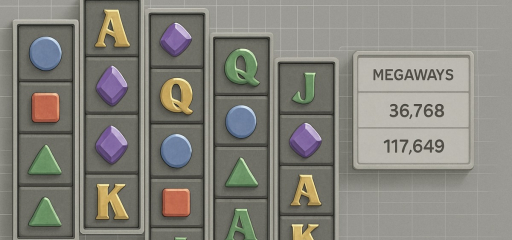
The first time I saw a Megaways slot advertise “117,649 ways to win,” I’ll admit the number did its job on me for about three seconds. It’s a weirdly specific figure, not a rounded marketing flourish like “millions of ways” but a sharp, almost mathematical-looking number. That’s part of the trick. It looks like someone did the arithmetic, so you assume the arithmetic must mean something good for the player. I went and checked the math, and the math is real. What the math means, though, is a completely different conversation.
Where the 117,649 Comes From
Megaways is a slot mechanic licensed by Big Time Gaming, and it’s now plastered across hundreds of titles from Bonanza to Gonzo’s Quest Megaways to dozens of branded clones. The structure is simple. There are six reels. Each reel, on every spin, randomly displays somewhere between 2 and 7 symbols. The number of “ways to win” on any given spin is the product of how many symbols showed up on each reel.
So if every reel happens to land on its maximum height of 7 symbols, you get:
\[7 \times 7 \times 7 \times 7 \times 7 \times 7 = 7^6 = 117{,}649\]
That’s the marketing number. It’s mathematically honest in the same way that “your car can theoretically reach 180 mph” is honest, true under one specific configuration, not true on the average Tuesday. Most spins land somewhere in the 1,000 to 15,000 ways range, because hitting all sevens on every reel is itself an uncommon outcome. The Wizard of Odds breakdown of Megaways math walks through the distribution if you want the deeper numbers.
What “Ways to Win” Actually Counts
Here’s the part the front of the slot conveniently doesn’t explain. A “way” in Megaways means a left-to-right adjacency path, not a fixed payline. To form a winning way, you need matching symbols on reels 1, 2, 3, and so on, starting from the leftmost reel and continuing without a gap. The “ways” count multiplies symbol positions, so if reel 1 shows three A symbols and reel 2 shows two A symbols, that already creates six potential A-A combinations, and we haven’t even hit reel 3 yet.
The number balloons fast, but it’s counting overlapping paths through shared symbols. If you hit a 4-of-a-kind win, all the “ways” credited to that win are using the same physical symbols, just permuted across positions. The casino pays you once for that win, at a multiplier that already factors in how the ways calculation works, not 600 separate times. The headline number and the actual paycheck live on different planets.
The Virtual Reel Strip, Where the House Lives
Slots haven’t been mechanical for decades. Every modern slot, Megaways included, runs on a virtual reel strip, a list of weighted symbol positions stored in software. When the RNG picks a stop, it picks from that weighted list. High-pay symbols are deliberately rare. Low-pay symbols and blanks dominate the strip.
This is the actual reason a “117,649 ways” spin can pay you peanuts. The structure offers many potential winning paths, but the virtual reel strip controls how often each symbol shows up. A six-of-a-kind on the top-paying symbol might be technically possible across thousands of ways combinations, while the underlying probability of getting that symbol on all six reels at once stays around the level of “once every twenty thousand spins, if you’re lucky.”
| Element | What it claims | What it actually controls |
|---|---|---|
| Ways count (e.g. 117,649) | Number of winning combinations | Geometric arrangement only, not probability |
| Virtual reel strip | Not usually disclosed to players | Real hit frequency of every symbol |
| Symbol weighting | Implied “random” | Heavily skewed toward low-pay symbols and blanks |
| RTP figure | Long-run payout percentage | The only number that actually predicts cost-per-spin |
A Worked Example That Hurts a Little
Let’s set up a stripped-down Megaways. Six reels. Each reel’s virtual strip has 50 positions: 1 top symbol, 4 mid-tier symbols, 15 low-pay symbols, and 30 blank-or-filler positions. Suppose during the spin, each reel displays 7 symbols, so we get the maximum 117,649 ways.
The chance of a single specified reel showing the top symbol anywhere in its 7-symbol window is roughly \(1 – (49/50)^7 \approx 13.2\%\). The chance of all six reels simultaneously showing the top symbol somewhere in their windows is about:
\[0.132^6 \approx 0.0000053\]
That’s roughly one spin in 188,000, and we’re already at the maxed-out reel height, which itself isn’t every spin. Meanwhile, a classic 25-payline slot with friendlier symbol weighting can hand out small wins on something like 1 in 4 spins, because the structure is built around shorter, more frequent matches.
The Megaways spin looks richer. It rumbles, the screen lights up, the “WIN!” graphic fires for a 0.80x payout on a 1.00 stake. Net result: you lost twenty cents and felt like you won.
The RTP Numbers Don’t Crown Megaways
Here’s where the marketing collapses cleanly. The UK Gambling Commission requires disclosure of return-to-player figures on licensed slots, and the published RTPs tell a flat story.
- Bonanza Megaways (the original BTG flagship): ~96.0% RTP
- Extra Chilli Megaways: ~96.8% RTP at base, lower on certain bonus-buy versions
- Sweet Bonanza (Pragmatic, not strictly Megaways but cluster-pays): ~96.5% RTP
- A generic 25-payline classic slot: ~95% to 96% RTP
- Some Megaways skins on regulated markets: as low as 94% RTP
So the supposed innovation, 117,649 ways!, doesn’t actually return more money. In many cases it returns slightly less, and it does so with much higher variance, meaning bigger droughts between meaningful wins and bigger swings when wins do hit. You’re not getting better math. You’re getting the same math served on a louder plate.
Cascading Reels and the Skill Illusion
Most Megaways titles bundle in cascading reels (sometimes called Reactions or tumbling reels). When you hit a winning way, those symbols vanish, the symbols above drop down, and new symbols fill the gaps. If the new arrangement triggers another win, it cascades again. People love this feature. It’s the closest a slot ever gets to feeling like a combo system in a video game.
But every cascade is an independent random event. The game isn’t responding to your skill or your timing. It rolled the dice, then rolled them again with a fresh set of falling symbols. A four-cascade streak that builds to a 30x win feels like a story with a beginning, middle, and end. It’s actually four uncorrelated coin flips that happened to land heads in a row. Your nervous system can’t tell the difference, which is the entire point of the feature.
I’ll be opinionated for a second: the audiovisual design on these games is genuinely brilliant, in a way I sort of resent. The sound effects escalate per cascade. The win counter ticks up with a pleasing rising tone. Background music swells. Every part of the presentation is doing free emotional work on behalf of math that, on its own, would feel pretty flat. If you stripped a Megaways spin of the sound and animation and just printed the net dollar outcome on a receipt, almost nobody would play these.
Why “More Wins” Doesn’t Mean “More Winnings”
The hit frequency on a typical Megaways slot, meaning the percentage of spins that pay anything at all, sits somewhere around 20 to 30%. That sounds great compared to a classic slot at 18 to 22%. The catch: a huge chunk of those Megaways “wins” pay less than your stake. You bet $1, you “win” $0.35, the screen celebrates, and you’ve lost 65 cents. Industry folks call these sub-stake wins, and Megaways absolutely loves them.
If you’re tracking your own session, the only honest number is net result, stake minus return, over a chunk of spins big enough to average out variance. Anecdotally, hit-frequency feel has approximately zero correlation with whether you walk away up or down. I’ve had sessions where the screen lit up on what felt like every other spin and I still bled chips for an hour. If you want a tiny refresher on how independent probabilities multiply, the same arithmetic that makes the 117,649 number work, there’s a clean primer over at Effortless Math that’s worth a peek.
One more thing worth flagging here. The big payouts on Megaways slots, the screenshots that go viral on social media, almost always come from the bonus round, not the base game. Free-spins bonuses in Megaways titles typically come with an unlimited win multiplier that grows with each cascade. That’s where the 5,000x stake stories happen. Triggering the bonus, though, usually requires landing 4 or more scatter symbols in a single spin, and the underlying probability of that event sits in the neighborhood of 1 in 250 to 1 in 400 spins. So you’re paying a stake every spin to chase a bonus that triggers a few times an hour, and even when it does trigger, the median bonus result is closer to 15x stake than 1,000x. The variance is doing all the marketing work. The expected value is doing none of it.
FAQ
Is 117,649 ways really the max for every Megaways slot?
For the standard 6-reel BTG-licensed Megaways with up to 7 symbols per reel, yes. Some variants use different reel counts or symbol caps and produce different headline numbers (e.g., 200,704 ways on certain modified versions).
Does a higher ways count mean better odds?
No. Ways count is a structural feature, not a probability feature. The virtual reel strip and symbol weighting determine your actual odds, and those are tuned to hit the game’s published RTP, which on most Megaways slots is comparable to or worse than a classic slot.
Are cascading reels worth anything mathematically?
They’re factored into the RTP. The cascade mechanic doesn’t add expected value beyond what’s already baked in. It changes how the game feels more than what it returns.
Why does it feel like I’m winning more on Megaways?
Because you are, in terms of spin events that register as “wins.” A lot of those events pay less than your stake. Hit frequency is up, average win size is down, and the long-run net position usually isn’t better.
Are some Megaways slots fairer than others?
Some operators run multiple RTP versions of the same Megaways title, 96%, 94%, sometimes 92%. Check the info panel before spinning. If you see anything below 96%, you’re playing a deliberately worsened version.
Last Thought
117,649 is a real number. It’s a real count of geometric arrangements on a six-reel grid. What it isn’t is a measurement of how often you’ll win, how much you’ll win, or whether you’ll come out ahead. The marketing wants you to read it as a fairness signal, look how many ways the machine gives you to succeed, and it’s nothing of the sort. It’s a side effect of multiplication.
The slots are designed by people who understand probability extremely well, and they’re designed to entertain you for a price. There’s nothing inherently wrong with paying that price, as long as you know what you’re paying. The mirage lives in the suggestion that the math is on your side because the number on the box is big, not in the math itself.

Related to This Article
More math articles
- How to Find Similarity and Ratios? (+FREE Worksheet!)
- Top 10 Math Books for Grade 7 Students: A Complete Review
- The Best Grade 8 ELA Practice Tests for Montana Students
- 4th Grade NYSE Math Worksheets: FREE & Printable
- The Best Grade 7 ELA Practice Tests for Wyoming Students
- Multi-Line Slots: When 25 Paylines Cost More Than They Pay
- Free Louisiana Grade 2 English Worksheets
- Fiscal policy
- The Best Grade 3 Math Book for Idaho Students
- The Best Grade 3 ELA Practice Tests for North Dakota Students






What people say about "Megaways Slots and the Mirage of 117,649 Ways to Win - Effortless Math"?
No one replied yet.