The Best Grade 8 Math Book for Texas Students
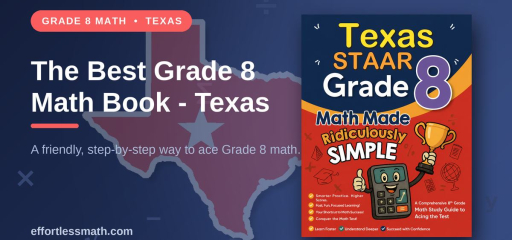
For a Texas eighth grader, math has a specific spring landmark: the STAAR Grade 8 Math test. It is the assessment that caps off middle school math, and for a lot of families it is the first time the word “STAAR” feels like it carries real weight. The next STAAR a student meets, after all, is the high-school Algebra I exam that counts toward graduation.
That makes eighth grade a genuine turning point. It is the last full year before high school math begins, and it is the dress rehearsal for the bigger STAAR exams ahead. A Texas student who finishes eighth grade math feeling solid walks into Algebra 1 with a real advantage. The way to get them there is a clear book and a steady plan.
What the STAAR Grade 8 Math test covers
Texas teaches math through its own standards, the TEKS, and the STAAR Grade 8 Math test is built directly from them. The eighth grade course covers a substantial year of material: the real number system including irrational numbers, exponents and scientific notation, proportional and linear relationships, an introduction to functions, systems of equations, geometry topics like the Pythagorean theorem and transformations, and the basics of analyzing data.
None of that is beyond a Texas eighth grader. The reason a capable student struggles is almost always pace. A class has to keep moving, a textbook explains a new idea in a hurry, and a student who needed one more clear example slips a step behind. Because so much of eighth grade math feeds directly into Algebra 1, those small gaps are worth closing now, while there is still time and breathing room.
The book we recommend for STAAR Grade 8 Math
For a Texas student preparing for eighth grade math and the STAAR test, the book we recommend is Texas STAAR Grade 8 Math Made Ridiculously Simple.
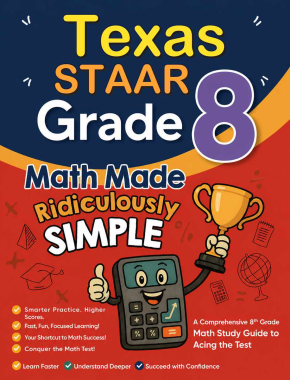
The book teaches the way a student on their own actually needs. Every topic gets a clear, plain-language explanation, then a worked example with no hidden steps, then practice with answer keys for instant feedback. It is aligned to the TEKS and to the way the STAAR test frames its questions, so the practice your child does is real preparation for the spring exam, and a real head start on Algebra 1.
It also teaches the student directly, with no tutor required. That makes it dependable for homeschooling families, for students catching up, and for parents who want to help at home without first reviewing the math themselves.
A simple plan that works
Owning a good book is step one. Using it well is step two:
- Study in short, regular sessions. Thirty focused minutes a few times a week beats a frantic cram before the test.
- Always work problems with a pencil. Watching a worked example is not the same as solving one.
- Treat wrong answers as information. Each one shows exactly what to review next.
- Master each section before moving on. STAAR rewards solid foundations, and so does Algebra 1.
When eighth grade wraps up and Algebra 1 is next, our guide to the best Algebra 1 book for Texas students carries the same approach right into high school.
How to use this book during the school year
A strong math book works best when it becomes part of the weekly routine, not something saved only for the week before a test. For a Texas Grade 8 student, the most useful rhythm is simple: preview the lesson, work through two or three examples, complete a short practice set, then review the missed problems while the mistake is still fresh.
Parents do not need to reteach the whole course. Their best role is to help the student slow down, show work clearly, and name the exact step that caused trouble. If the mistake is a computation error, assign a few fluency problems. If the mistake is a setup error, return to the explanation and copy one worked example before practicing again.
Skills to check before moving on
Before leaving a Grade 8 chapter, make sure the student can do more than recognize the topic. A student is ready to move forward when they can:
- connect tables, graphs, equations, and verbal descriptions of linear relationships
- use exponents, roots, scientific notation, and the Pythagorean theorem
- solve equations, systems, and multi-step word problems
- recognize functions, compare rates of change, and explain reasoning in writing
- check an answer and explain why it is reasonable
This quick check prevents the most common problem in math study: moving ahead while the student only half-understands the previous lesson. That half-understanding often looks fine during easy practice, but it breaks down on mixed review and state-style questions.
A simple weekly study plan
| Day | What to do |
|---|---|
| Day 1 | Read the lesson, copy one worked example, and talk through the steps. |
| Day 2 | Complete a short practice set without rushing. Mark every uncertain problem. |
| Day 3 | Review missed questions, correct the work, and write one sentence explaining each error. |
| Day 4 | Do mixed review so older skills stay active while new topics are added. |
| Day 5 | Try a short timed set to build focus and confidence. |
This schedule is intentionally simple. Consistency matters more than long sessions. Twenty to thirty focused minutes several times a week usually produces better results than one long study session that leaves the student tired and frustrated.
What to do if your child is already behind
If your child is missing earlier skills, do not rush through the current chapter just to stay on pace. Start with the first lesson that feels shaky, rebuild that foundation, and then return to the current assignment. In math, catching up usually means repairing one small skill at a time, not trying to relearn the whole year at once.
A good sign of progress is not simply getting more answers correct. It is seeing cleaner work, fewer skipped steps, and better explanations. When a student can show the process clearly, they are much more likely to handle Texas' classroom work, homework, and year-end assessment questions with confidence.
Used this way, the book becomes more than a product recommendation. It becomes a practical study system: learn the lesson, practice the skill, correct mistakes, and keep old topics alive until the student is ready for the next grade level.
Questions Texas parents ask
When do Texas students take the STAAR Grade 8 Math test?
It is given in the spring, at the end of the eighth grade course. It assesses the math standards your child has worked on all year.
Why is eighth grade math such an important year?
It is the last year before high school math, and its topics, linear equations, functions, exponents, are exactly what Algebra 1 builds on. A strong eighth grade makes the high-school STAAR Algebra I exam much more manageable.
My child freezes on STAAR tests. Can this help?
Yes. Test-day freezing usually eases once a student has practiced with questions that look and feel like the real STAAR. Familiarity is what replaces the panic.
Can this book be used without a tutor?
It can. The explanations are self-contained and the answer keys give instant feedback, so a motivated student can work through it on their own. It also pairs well with a tutor or a helping parent.
The bottom line
Eighth grade math is a turning point in Texas: the last year before high school and the dress rehearsal for the STAAR exams to come. Texas STAAR Grade 8 Math Made Ridiculously Simple gives a student clear teaching and honest practice for the spring test, and a genuine head start on Algebra 1. Start early, keep it steady, and your child crosses into high school math standing tall.

Related to This Article
More math articles
- 3rd Grade MCAS Math FREE Sample Practice Questions
- Free Grade 4 English Worksheets for Hawaii Students
- Fundamental Economic Concepts
- A Comprehensive Collection of Free CLEP College Algebra Practice Tests
- The statutory side does not control the economic burden
- The Ultimate ALEKS Math Formula Cheat Sheet
- Fifth-Grade Math in Missouri (MAP): 49 Free Printable Worksheets, One Concept Per Page
- A ceiling binds below equilibrium
- Splitting Pairs: Eight Decisions Where Math Disagrees With Intuition
- Latin Roots for Actions and Ideas















What people say about "The Best Grade 8 Math Book for Texas Students"?
No one replied yet.