Banks, Reserves, and Deposit Expansion
The Chapter 13 companion lesson study guide on Effortless Math covers Banks, Reserves, and Deposit Expansion: the key terms, the core ideas, and worked examples showing how this topic is tested on this course.
Chapter 13 companion lesson
A bank loan does not merely move existing paper currency from one person to another. It usually creates a new deposit and a matching loan asset. The balance sheet shows both sides of that event.
In plain language: Banks create deposits when they make loans, but they remain constrained by reserves, capital, regulation, and the demand for credit. Required reserves are a fraction of checkable deposits. The simple deposit multiplier gives a maximum expansion under strict assumptions; currency holding and excess reserves make actual expansion smaller.
What should you know about the bank balance sheet: assets, liabilities, and capital?
A bank balance sheet lists what the bank owns or is owed on the asset side and what it owes on the liability side. Reserve balances held at the central bank and vault cash are assets. Loans are assets because borrowers promise repayment. Securities are assets because their issuers promise payments. A checkable deposit is a liability: the customer can direct the bank to transfer or redeem the balance.
Bank capital, or owners' equity, equals assets minus liabilities. If a bank has 100 million in assets and 92 million in liabilities, its capital is 8 million. Capital absorbs losses. If 3 million of loans become worthless, assets and capital each fall by 3 million. Reserves do not automatically fall, because a loan loss and a reserve outflow are different events.
That distinction separates solvency from liquidity. A solvent bank has assets worth more than liabilities. A liquid bank can meet near-term payment and withdrawal needs. A bank can own valuable long-term loans but temporarily lack immediately usable reserves; it can also hold cash yet be insolvent if the total value of its assets is below its obligations. Introductory questions often test the concepts separately.
How does the CLEP test required reserves, excess reserves, and settlement?
Reserves consist of eligible vault cash and balances a bank holds at the central bank under the definitions used in the model. They support payment settlement and liquidity. When a customer at Bank A pays a customer at Bank B, deposits change on the banks' books and reserve balances move from A to B through settlement.
Under a simple required-reserve model, required reserves equal the required reserve ratio times reservable deposits. If deposits are 1,000 and the stated ratio is 10 percent, required reserves are 100. Excess reserves equal actual reserves minus required reserves. If actual reserves are 140, excess reserves are 40.
The word “required'' is model-dependent. Since March 2020, reserve-requirement ratios on U.S. transaction accounts have been set to zero, and the Federal Reserve implements policy in an ample-reserves framework. CLEP materials can still present a positive ratio to test the textbook multiplier. Follow the assumptions in the stem rather than mixing a historical classroom model with current operating facts.
Watch the model in motion
Jacob Clifford explains the same core relationship visually. Pause before each result and predict the next movement or calculation.
How does the CLEP test the simple deposit multiplier and the lending chain?
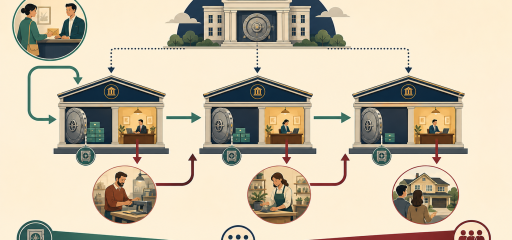
The simple deposit multiplier is the reciprocal of a positive required reserve ratio: 1/rr. With a 20 percent ratio, the maximum total deposit change supported by a new reserve injection is five times the injection. This result is a geometric sum, not an act in which one bank lends the same dollar repeatedly.
Suppose the banking system receives 1,000 in new reserves. The first bank retains 200 and lends 800. When the 800 is spent and redeposited, the second bank retains 160 and lends 640. The sequence continues: 1,000, 800, 640, and so on. Total deposits approach 5,000; total new loans approach 4,000 because the original 1,000 remains as reserves.
The formulas answer different questions. Maximum total deposit change is new reserves times 1/rr. Maximum total loan change is new reserves times (1/rr-1) when the reserve injection initially creates an equal deposit. An individual bank's first-round maximum new loan is its excess reserves. Confusing first-round lending with final systemwide deposits is one of the most common distractor paths.
Why Actual Deposit Expansion Is Smaller?
The simple multiplier gives a maximum under strong assumptions. A currency drain occurs when recipients keep some loan proceeds as currency rather than redepositing everything. Currency held by the public is money, but it is no longer available as bank reserves supporting the next round of deposit expansion. The deposit multiplier is therefore smaller.
Banks may also hold additional reserves. If a bank retains 20 percent of a new deposit as required reserves and another 10 percent as desired extra reserves, only 70 percent continues to the next round. The relevant leakage is 30 percent, so the geometric expansion is smaller than the reciprocal of the required ratio alone.
Borrowers' behavior matters too. Banks cannot make sound loans merely because reserves exist. Weak expected sales can reduce firms' desire to borrow, high policy rates can make credit expensive, and lenders can tighten standards when default risk rises. The process can stop because demand for loans or willingness to supply them is weak.
What is the CLEP likely to ask?
Expect T-account changes, required/excess-reserve calculations, maximum deposit and loan expansion, and assumptions that shrink the multiplier. A deposit is a liability to the bank; reserves are assets.
A useful check is to name the model before doing arithmetic. Then write the first change, the intermediate market response, and the final macroeconomic result. This keeps a plausible distractor from borrowing one true step and attaching it to the wrong conclusion.
Can you do these without notes?
- Classify reserves, vault cash, loans, securities, deposits, and capital. Then show the two entries when cash is deposited, a loan is created, and a loan defaults.
- Explain why a customer payment moves reserves between banks. Calculate required and excess reserves before and after a cash deposit, and distinguish the result from a central-bank reserve injection.
- State every assumption behind 1/rr. Given a reserve injection and ratio, calculate first-round lending, total deposit change, and total loan change without treating them as synonyms.
For each prompt, say why the tempting wrong answer fails. That extra sentence is often the difference between recognizing a term and being able to use it under time pressure.
Keep studying with the complete guide
This lesson accompanies CLEP Principles of Macroeconomics for Beginners. The book adds annotated graphs, worked calculations, chapter practice, two printed full-length tests, and ten online test forms.

Reza is an experienced Math instructor and a test-prep expert who has been tutoring students since 2008. He has helped many students raise their standardized test scores--and attend the colleges of their dreams. He works with students individually and in group settings, he tutors both live and online Math courses and the Math portion of standardized tests. He provides an individualized custom learning plan and the personalized attention that makes a difference in how students view math.
Related to This Article
More math articles
- FREE 3rd Grade FSA Math Practice Test
- Words for Evidence and Judgment
- 6th Grade TNReady Math Worksheets: FREE & Printable
- The Ultimate 7th Grade SC Ready Math Course (+FREE Worksheets)
- The Best Grade 8 ELA Practice Tests for Texas Students
- Advanced Vocabulary Words: Regale to Stimulate
- 10 Most Common OAR Math Questions
- The Best Grade 7 ELA Practice Tests for Arkansas Students
- Full-Length 7th Grade GMAS Math Practice Test-Answers and Explanations
- Algebra 1 Formula Flashcards (Free Visual Review)



















What people say about "Bank Reserves and Deposit Expansion | Effortless Math"?
No one replied yet.