YOUR CLEP MACROECONOMICS PREP STARTS HERE
CLEP Macroeconomics Online Center
Prepare for CLEP Principles of Macroeconomics with independent practice, flashcards, and connected lessons. Distinguish a nominal change from a real change before interpreting an economic indicator. Review one skill before your next practice session.
Free study tools · Focused review · Books to compare
CLEP Macroeconomics Practice Tests
Use the existing form and explanations to identify a skill to review. Results are study feedback, not official scores.
CLEP Macroeconomics Flashcards
Recall the concept and explain an example before revealing the answer.
CLEP Macroeconomics Study Guides
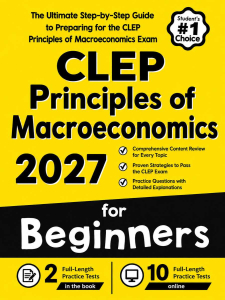
CLEP Principles of Macroeconomics for Beginners
Subject-specific independent study. Compare the preview and contents with the current assessment topics before choosing a book.
View book & purchase options →CLEP Macroeconomics Quick Review
Choose a lesson or worked explanation, then return to practice.
Open this resource →MEET THE ASSESSMENT · CHOOSE YOUR NEXT SKILL
Know CLEP Macroeconomics before you start.
CLEP Principles of Macroeconomics has approximately 80 questions in 90 minutes, including unscored pretest items. Study aggregate output, prices, employment, financial markets, policy, and international economics. Your college sets its own credit policy; independent practice results are not official CLEP scores.
Official assessment information ↗Output, prices, and employment
Distinguish a nominal change from a real change before interpreting an economic indicator.
Explore this study route →Aggregate demand and supply
Identify the curve that changes and separate short-run effects from long-run adjustment.
Explore this study route →Policy and international connections
Trace how a policy or exchange-rate change affects the economy rather than memorizing its label.
Explore this study route →Official assessment guidance
Check the current format, eligibility, and preparation information before test day.
Explore this study route →CLEP Macroeconomics Practice Center
Take a full practice test, review the explanations, then use the flashcards to repair the terms and ideas that slowed you down.
CLEP Macroeconomics Study Blueprint
Open each area to see what to master. The bars show how this Online Center distributes its lessons, so you can plan study time without mistaking the map for an official exam weighting.
01 Basic economic conceptsReview scarcity, production possibilities, trade, and market coordination. 3lessons
- Opportunity cost and comparative advantage
- Supply, demand, and equilibrium reasoning
02 Measuring economic performanceInterpret the indicators used to describe output, prices, and employment. 3lessons
- GDP and real versus nominal values
- Inflation, unemployment, and business cycles
03 National income and price determinationUse aggregate models to explain changes in output and the price level. 3lessons
- Aggregate demand and aggregate supply
- Multipliers and equilibrium output
04 Financial sectorConnect banking, money, interest rates, and investment. 4lessons
- Money creation and central-bank tools
- Money market and loanable-funds reasoning
05 Policy, growth, and international economicsTrace stabilization choices and long-run or international effects. 7lessons
- Fiscal and monetary policy
- Growth, trade, exchange rates, and capital flows
Study-map shares describe the learning resources on this page. They are not presented as official test percentages.
Macroeconomics stops feeling like a wall of vocabulary when you learn to trace one change through the right model. Use this page to choose a lesson, repair a weak causal chain, review the official content weights, or run a focused four-week study plan.
Learn the model, then make it work
Each companion lesson follows the same sequence: plain-language teaching, a worked line of reasoning, a verified teaching video, retrieval prompts, and targeted practice. The result is an Online Center you can use to diagnose a mistake instead of simply rereading a chapter.
Start With a Diagnostic Study Cycle
Do not begin by rereading everything. Find the model that breaks down, repair it, and then test the same idea in a new form.
Attempt before reviewing
Use a chapter set or printed practice test without notes. Mark any item you guessed on, even if the guess was correct.
Tag the exact failure
Was the problem a definition, graph shift, denominator, sign, missing assumption, or broken causal chain?
Open the matching lesson
Rebuild the graph or calculation from a blank page. Say what is held constant and why every step follows.
Retest after a delay
Wait at least a day, then solve a different question on the same model. Recognition is not yet mastery.
CLEP Macroeconomics Snapshot
The exam emphasizes aggregate demand and supply, the financial sector, and stabilization policy, but every section can appear in graph, data, or model-application form.
Approximate content weights
CLEP Macroeconomics Topics
Choose the content area that needs work, then open its lesson in a new tab. Chapters 1 and 2, the exam guide and graph-and-math toolkit, come first because their methods support every content area.
Begin Here
Understand the exam, read economic graphs, and avoid the level-versus-change mistakes that spread across topics.
- 01Understanding the CLEP Macroeconomics ExamCLEP Principles of Macroeconomics tests whether you can recognize an economic model, apply a stated change, and follow the result through graphs, data, and short calculations.
- 02Math, Graphs, and Economic ReasoningMacroeconomic reasoning turns percentages, indexes, equations, and graphs into a sequence of decisions.
Basic Economic Concepts
Build the foundation: scarcity, trade, markets, and government intervention.
- 03Scarcity, Opportunity Cost, and the Production Possibilities FrontierScarcity means that limited resources cannot satisfy every possible use.
- 04Comparative Advantage, Specialization, and TradeComparative advantage belongs to the producer with the lower opportunity cost, even when another producer has an absolute advantage in both goods.
- 05Supply, Demand, and Government InterventionSupply and demand determine a competitive market's equilibrium price and quantity.
Measurement of Economic Performance
Separate output from prices and classify labor-market data before calculating.
- 06The Circular Flow and Gross Domestic ProductGross domestic product is the market value of final goods and services produced within a country during a period.
- 07Nominal GDP, Real GDP, Price Indexes, and InflationNominal GDP values current output at current prices, while real GDP values output at base-period prices.
- 08Employment, Unemployment, and the Labor ForceThe labor force includes employed people and unemployed people who are available for work and actively seeking it.
National Income and Price Determination
Trace demand and supply shocks through real GDP, the price level, and output gaps.
- 09Aggregate Demand and the Spending MultiplierAggregate demand is planned spending on domestic output at different overall price levels.
- 10Short-Run and Long-Run Aggregate SupplyShort-run aggregate supply relates the price level to real output while some input prices are sticky.
- 11Macroeconomic Equilibrium, Gaps, and Self-CorrectionMacroeconomic equilibrium occurs where aggregate demand and aggregate supply intersect.
Financial Sector
Connect money, banks, bond prices, interest rates, and Federal Reserve actions.
- 12Money, Financial Assets, Bonds, and the Time Value of MoneyMoney is the most liquid commonly accepted means of payment, while financial assets are claims on future payments.
- 13Banks, Reserves, and Deposit ExpansionBanks create deposits when they make loans, but they remain constrained by reserves, capital, regulation, and the demand for credit.
- 14Money Market, Loanable Funds, and Interest RatesThe money market determines a nominal interest rate from money demand and a policy-controlled money supply, while the loanable-funds market determines a real interest rate from saving and investment.
- 15The Federal Reserve and Monetary PolicyMonetary policy changes financial conditions to influence spending, output, employment, and inflation.
Inflation, Unemployment, and Stabilization
Compare fiscal and monetary choices, policy lags, and expectations.
- 16Fiscal Policy, Deficits, and Public DebtFiscal policy changes government purchases, taxes, or transfers to affect aggregate demand.
- 17Policy Mix, Transmission, Rules, and LagsA policy mix combines fiscal and monetary actions whose effects may reinforce or offset one another.
- 18Inflation, Unemployment, and ExpectationsThe short-run Phillips curve describes an inverse relationship between inflation and unemployment for a given expected inflation rate and supply environment.
Economic Growth and Productivity
Explain why productivity, not simply more money, raises living standards.
Open Economy: International Finance
Link exchange rates, trade, the current account, and financial flows.
Six Macroeconomics Chains Students Often Miss
These are not trivia errors. Each one begins with a plausible first step and then goes wrong because two models, curves, or time horizons get mixed together.
Nominal growth is not automatically real growth
Remove the price-level change before concluding that the economy produced more.
Nominal value → deflate → real value
A movement along SRAS is not an SRAS shift
A changed price level moves the economy along SRAS. Input costs, productivity, and expected inflation shift the curve.
Cause → curve → direction
Reserves, deposits, and money are not synonyms
Read the bank balance sheet first. Then decide whether the question asks for one bank’s loan, a deposit change, or a system-wide maximum.
Balance sheet → constraint → expansion
The first market response comes before the final goal
An open-market purchase changes reserves and short-term rates before investment, aggregate demand, output, and prices respond.
Tool → rate → spending → AD
Short-run Phillips results do not last forever
Once expected inflation adjusts, the short-run curve shifts and unemployment returns toward its natural rate.
Unexpected inflation → adjustment → LRPC
Currency appreciation changes relative prices
A stronger domestic currency makes imports cheaper to domestic buyers and exports more expensive to foreign buyers, other things equal.
Exchange rate → relative prices → net exports
Macroeconomics Flashcards
Twenty carefully chosen terms cover the definitions that unlock graphs, calculations, and causal chains. Say the definition before turning each card. Then give one example or draw the related model.
Four-Week CLEP Macroeconomics Roadmap
Plan for five study sessions each week. A useful session has three parts: learn or review, retrieve without notes, and correct one specific error.
Build the language and calculations that later models assume.
- Chapters 1 to 8
- PPF and trade tables
- GDP, indexes, inflation
- Labor-force classification
Draw every model from memory and label both axes.
- Chapters 9 to 14
- Multiplier assumptions
- Output gaps and self-correction
- Banks, money, and rates
Practice long causal chains and distinguish short-run from long-run results.
- Chapters 15 to 20
- Fiscal and monetary transmission
- Phillips curves and expectations
- Growth and foreign exchange
Use unseen tests deliberately; do not burn through them in one sitting.
- Take printed Test 1 under time
- Repair the two weakest areas
- Take printed Test 2
- Begin spaced online testing
CLEP Macroeconomics FAQ
How many questions are on the CLEP Principles of Macroeconomics exam?
The College Board describes the exam as approximately 80 questions in 90 minutes. Some questions are pretest items that are not scored, but you will not know which ones they are.
What kinds of skills does the exam test?
Expect important terms and concepts, economic graphs, economic data, and simple model application. The harder questions often combine two of those skills, for example, interpreting a policy change on a graph and then predicting a numerical direction.
What should a complete beginner study first?
Start with Chapters 1 and 2, then move through scarcity, trade, supply and demand, GDP, inflation, and unemployment. Those topics supply the language, graph habits, and measurement rules used in AD, AS, banking, and policy.
Do I need to memorize every graph?
You need to reconstruct the main graphs accurately: axes, curve slopes, equilibrium, and shift determinants. Memorizing a picture without knowing why a curve shifts is not enough for a new scenario.
How should I use the flashcards?
Recall the definition aloud before revealing it, then connect the term to a graph, formula, or example. A card is not mastered if you can recognize the words but cannot apply the idea.
When should I take the two printed practice tests?
Take the first after your initial content review. Use its misses to choose your repair work. Take the second only after those repairs, so it measures improvement rather than short-term memory.
Why are the ten online tests not linked publicly here?
They are reserved for book readers and timed practice. Keeping those forms out of the public Online Center preserves their value as unseen assessments and protects the access path printed in the book.
What score earns college credit?
The ACE recommendation is a credit-granting score of 50 for three semester hours, but every institution sets its own policy. Confirm the accepted score and credit hours with your college before registering.
Official and Companion Resources
Use official sources for current exam policy and use the companion lessons here for teaching and practice.
Independent-study notice: This is original preparation material. CLEP is a registered trademark of the College Board, which does not endorse or produce this resource.
Study one model. Trace one change. Explain every result.
That routine turns a large macroeconomics syllabus into a series of manageable decisions. Begin with the exam guide if you are new, or go directly to the content area that your last practice set exposed.
CLEP Macroeconomics Flashcards
Recall the definition, reveal it, then name the graph or calculation where the term matters.
Every lesson in one place
Open a lesson in a new tab, then check your understanding with its short book-based quiz.
Browse the complete lesson directory
A USEFUL NEXT STEP
CLEP Macroeconomics: study questions
What should I know about CLEP Principles of Macroeconomics?
CLEP Principles of Macroeconomics has approximately 80 questions in 90 minutes, including unscored pretest items. Study aggregate output, prices, employment, financial markets, policy, and international economics. Your college sets its own credit policy; independent practice results are not official CLEP scores.
Official source ↗How should I use these independent CLEP Macroeconomics study tools?
Start with a practice activity, review explanations for missed questions, and use quick review or flashcards for one weak topic. The practice results are study feedback, not official exam scores. Compare a book’s contents with your course or test requirements before buying.
Resources from Effortless Math · Editorial standards