YOUR CLEP MICROECONOMICS PREP STARTS HERE
CLEP Microeconomics Online Center
Prepare for CLEP Principles of Microeconomics with independent practice, flashcards, and connected lessons. Separate a movement along a curve from a shift caused by a different determinant. Review one skill before your next practice session.
Free study tools · Focused review · Books to compare
CLEP Microeconomics Practice Tests
Use the existing form and explanations to identify a skill to review. Results are study feedback, not official scores.
CLEP Microeconomics Flashcards
Recall the concept and explain an example before revealing the answer.
CLEP Microeconomics Study Guides
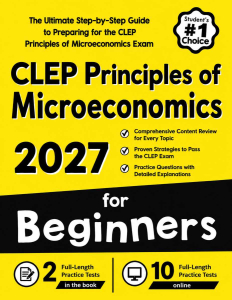
CLEP Principles of Microeconomics for Beginners
Subject-specific independent study. Compare the preview and contents with the current assessment topics before choosing a book.
View book & purchase options →CLEP Microeconomics Quick Review
Choose a lesson or worked explanation, then return to practice.
Open this resource →MEET THE ASSESSMENT · CHOOSE YOUR NEXT SKILL
Know CLEP Microeconomics before you start.
CLEP Principles of Microeconomics has approximately 80 questions in 90 minutes, including unscored pretest items. Study consumer and firm decisions, markets, production, factor markets, and market failure. Your college sets its own credit policy; independent practice results are not official CLEP scores.
Official assessment information ↗Supply, demand, and elasticity
Separate a movement along a curve from a shift caused by a different determinant.
Explore this study route →Costs and market structures
Compare marginal revenue with marginal cost and check the market structure before choosing output.
Explore this study route →Factor markets and efficiency
Distinguish a private incentive from its effect on society when evaluating market failure.
Explore this study route →Official assessment guidance
Check the current format, eligibility, and preparation information before test day.
Explore this study route →CLEP Microeconomics Practice Center
Take a full practice test, review the explanations, then use the flashcards to repair the terms and ideas that slowed you down.
CLEP Microeconomics Study Blueprint
Open each area to see what to master. The bars show how this Online Center distributes its lessons, so you can plan study time without mistaking the map for an official exam weighting.
01 Foundations and economic reasoningEstablish the language, math, and graph skills needed for the exam. 5lessons
- Scarcity, choice, trade, and marginal analysis
- Percentages, slopes, areas, and graph interpretation
02 Markets and elasticityExplain prices and quantities using supply, demand, and responsiveness. 9lessons
- Shifts, equilibrium, controls, taxes, and welfare
- Elasticity calculations and revenue effects
03 Consumer and producer decisionsUse marginal analysis to understand choice, production, and cost. 11lessons
- Utility, production, and cost relationships
- Profit, shutdown, and long-run adjustment
04 Market structures and factor marketsCompare firm behavior and resource-market outcomes. 6lessons
- Competition, monopoly, and strategic behavior
- Labor, capital, and derived demand
05 Efficiency and market failureJudge when markets allocate resources efficiently and when policy may help. 4lessons
- Externalities, public goods, and information
- Equity, efficiency, and government responses
Study-map shares describe the learning resources on this page. They are not presented as official test percentages.
CLEP Microeconomics Study Online Center: a single starting point that brings together the lessons, worksheets, practice tests, and review material for this subject, arranged in a sensible order so you can work through it from start to finish.
Free companion to the book
Learn the model, work the graph, and then test the decision. This Online Center organizes the full course into a clear 35-chapter path, two timed practice tests, and fast retrieval tools for formulas and key terms.
Choose the right starting point
Do not study everything in the same way. Begin with the route that matches what you can do today.
Start with Chapters 1 to 5. Learn the language of choice, opportunity cost, graphs, and marginal analysis before moving into markets.
Take Practice Test 1 under a 90-minute timer. Use every wrong, guessed, or slow answer to choose your repair chapters.
Use the formula, graph, and trap chapters, then complete Practice Test 2 as a fresh final rehearsal.
Study in proportion to the real blueprint
Product markets dominate the official exam. Your study time should reflect that weighting.
The complete 35-chapter learning map
Open any chapter card to see the performance goal. The sequence moves from decisions to markets, firms, policy, and final retrieval.
Foundations and exam method
5 chapters
01
How the CLEP Microeconomics Exam Thinks
Find the decision maker, time horizon, relevant constraint, and marginal comparison.
What to be able to do: Find the decision maker, time horizon, relevant constraint, and marginal comparison.
Use the chapter lesson, worked examples, graph practice, and end-of-chapter questions together. Do not stop at recognizing the vocabulary; explain why each plausible wrong answer fails.
02
Math and Graph Skills You Actually Need
Read axes, calculate changes and areas, and translate a graph into a verbal conclusion.
What to be able to do: Read axes, calculate changes and areas, and translate a graph into a verbal conclusion.
Use the chapter lesson, worked examples, graph practice, and end-of-chapter questions together. Do not stop at recognizing the vocabulary; explain why each plausible wrong answer fails.
03
Scarcity, Opportunity Cost, and Marginal Choice
Separate sunk costs from relevant costs and choose where marginal benefit meets marginal cost.
What to be able to do: Separate sunk costs from relevant costs and choose where marginal benefit meets marginal cost.
Use the chapter lesson, worked examples, graph practice, and end-of-chapter questions together. Do not stop at recognizing the vocabulary; explain why each plausible wrong answer fails.
04
PPFs, Comparative Advantage, and Trade
Read efficiency from a frontier, calculate opportunity cost, and test terms of trade.
What to be able to do: Read efficiency from a frontier, calculate opportunity cost, and test terms of trade.
Use the chapter lesson, worked examples, graph practice, and end-of-chapter questions together. Do not stop at recognizing the vocabulary; explain why each plausible wrong answer fails.
05
Economic Systems, Property Rights, and Incentives
Connect institutions and property rights to incentives, exchange, and allocation.
What to be able to do: Connect institutions and property rights to incentives, exchange, and allocation.
Use the chapter lesson, worked examples, graph practice, and end-of-chapter questions together. Do not stop at recognizing the vocabulary; explain why each plausible wrong answer fails.
Markets and consumers
9 chapters
06
Demand
Distinguish a movement along demand from a shift caused by income, tastes, expectations, or related goods.
What to be able to do: Distinguish a movement along demand from a shift caused by income, tastes, expectations, or related goods.
Use the chapter lesson, worked examples, graph practice, and end-of-chapter questions together. Do not stop at recognizing the vocabulary; explain why each plausible wrong answer fails.
07
Supply
Trace input prices, technology, expectations, and seller entry through marginal cost to supply.
What to be able to do: Trace input prices, technology, expectations, and seller entry through marginal cost to supply.
Use the chapter lesson, worked examples, graph practice, and end-of-chapter questions together. Do not stop at recognizing the vocabulary; explain why each plausible wrong answer fails.
08
Market Equilibrium and Market Changes
Locate equilibrium and handle single or simultaneous curve shifts without inventing certainty.
What to be able to do: Locate equilibrium and handle single or simultaneous curve shifts without inventing certainty.
Use the chapter lesson, worked examples, graph practice, and end-of-chapter questions together. Do not stop at recognizing the vocabulary; explain why each plausible wrong answer fails.
09
Price Ceilings, Price Floors, and Rationing
Decide whether a control binds and calculate the resulting shortage, surplus, or traded quantity.
What to be able to do: Decide whether a control binds and calculate the resulting shortage, surplus, or traded quantity.
Use the chapter lesson, worked examples, graph practice, and end-of-chapter questions together. Do not stop at recognizing the vocabulary; explain why each plausible wrong answer fails.
10
Elasticity
Use midpoint elasticity, classify responsiveness, and apply the total-revenue test.
What to be able to do: Use midpoint elasticity, classify responsiveness, and apply the total-revenue test.
Use the chapter lesson, worked examples, graph practice, and end-of-chapter questions together. Do not stop at recognizing the vocabulary; explain why each plausible wrong answer fails.
11
Consumer Surplus, Producer Surplus, and Efficiency
Measure gains from trade as areas and identify the efficient competitive quantity.
What to be able to do: Measure gains from trade as areas and identify the efficient competitive quantity.
Use the chapter lesson, worked examples, graph practice, and end-of-chapter questions together. Do not stop at recognizing the vocabulary; explain why each plausible wrong answer fails.
12
Taxes, Tax Incidence, and Deadweight Loss
Follow a tax wedge, divide the burden by relative elasticity, and measure lost trades.
What to be able to do: Follow a tax wedge, divide the burden by relative elasticity, and measure lost trades.
Use the chapter lesson, worked examples, graph practice, and end-of-chapter questions together. Do not stop at recognizing the vocabulary; explain why each plausible wrong answer fails.
13
Utility and Consumer Choice
Allocate a budget by comparing marginal utility per dollar and recognize consumer equilibrium.
What to be able to do: Allocate a budget by comparing marginal utility per dollar and recognize consumer equilibrium.
Use the chapter lesson, worked examples, graph practice, and end-of-chapter questions together. Do not stop at recognizing the vocabulary; explain why each plausible wrong answer fails.
14
Income and Substitution Effects
Separate the relative-price effect from the purchasing-power effect for normal and inferior goods.
What to be able to do: Separate the relative-price effect from the purchasing-power effect for normal and inferior goods.
Use the chapter lesson, worked examples, graph practice, and end-of-chapter questions together. Do not stop at recognizing the vocabulary; explain why each plausible wrong answer fails.
Firms and market structures
11 chapters
15
Production and Marginal Product
Move between total, average, and marginal product and identify diminishing marginal returns.
What to be able to do: Move between total, average, and marginal product and identify diminishing marginal returns.
Use the chapter lesson, worked examples, graph practice, and end-of-chapter questions together. Do not stop at recognizing the vocabulary; explain why each plausible wrong answer fails.
16
Short-Run Costs
Build cost measures from schedules and explain why marginal cost intersects average curves at their minimums.
What to be able to do: Build cost measures from schedules and explain why marginal cost intersects average curves at their minimums.
Use the chapter lesson, worked examples, graph practice, and end-of-chapter questions together. Do not stop at recognizing the vocabulary; explain why each plausible wrong answer fails.
17
Long-Run Costs and Input Choice
Distinguish economies of scale from short-run diminishing returns and choose the least-cost input mix.
What to be able to do: Distinguish economies of scale from short-run diminishing returns and choose the least-cost input mix.
Use the chapter lesson, worked examples, graph practice, and end-of-chapter questions together. Do not stop at recognizing the vocabulary; explain why each plausible wrong answer fails.
18
Profit and the MR = MC Rule
Choose output using marginal revenue and marginal cost, then calculate economic profit or loss.
What to be able to do: Choose output using marginal revenue and marginal cost, then calculate economic profit or loss.
Use the chapter lesson, worked examples, graph practice, and end-of-chapter questions together. Do not stop at recognizing the vocabulary; explain why each plausible wrong answer fails.
19
Comparing Market Structures
Identify a market from entry barriers, product differentiation, price control, and strategic dependence.
What to be able to do: Identify a market from entry barriers, product differentiation, price control, and strategic dependence.
Use the chapter lesson, worked examples, graph practice, and end-of-chapter questions together. Do not stop at recognizing the vocabulary; explain why each plausible wrong answer fails.
20
Perfect Competition: The Firm's Decision
Use P = MR = AR, choose output, and apply the shutdown rule.
What to be able to do: Use P = MR = AR, choose output, and apply the shutdown rule.
Use the chapter lesson, worked examples, graph practice, and end-of-chapter questions together. Do not stop at recognizing the vocabulary; explain why each plausible wrong answer fails.
21
Competitive Markets in the Short Run and Long Run
Follow entry and exit to zero economic profit and the efficient long-run outcome.
What to be able to do: Follow entry and exit to zero economic profit and the efficient long-run outcome.
Use the chapter lesson, worked examples, graph practice, and end-of-chapter questions together. Do not stop at recognizing the vocabulary; explain why each plausible wrong answer fails.
22
Monopoly Output and Price
Choose quantity where MR = MC, read price from demand, and calculate profit.
What to be able to do: Choose quantity where MR = MC, read price from demand, and calculate profit.
Use the chapter lesson, worked examples, graph practice, and end-of-chapter questions together. Do not stop at recognizing the vocabulary; explain why each plausible wrong answer fails.
23
Monopoly Efficiency, Price Discrimination, and Natural Monopoly
Compare monopoly with the efficient benchmark and evaluate alternative pricing rules.
What to be able to do: Compare monopoly with the efficient benchmark and evaluate alternative pricing rules.
Use the chapter lesson, worked examples, graph practice, and end-of-chapter questions together. Do not stop at recognizing the vocabulary; explain why each plausible wrong answer fails.
24
Oligopoly and Game Theory
Find dominant strategies and Nash equilibrium and explain the incentive to cheat on collusion.
What to be able to do: Find dominant strategies and Nash equilibrium and explain the incentive to cheat on collusion.
Use the chapter lesson, worked examples, graph practice, and end-of-chapter questions together. Do not stop at recognizing the vocabulary; explain why each plausible wrong answer fails.
25
Monopolistic Competition
Combine differentiated demand with free entry, zero long-run profit, and excess capacity.
What to be able to do: Combine differentiated demand with free entry, zero long-run profit, and excess capacity.
Use the chapter lesson, worked examples, graph practice, and end-of-chapter questions together. Do not stop at recognizing the vocabulary; explain why each plausible wrong answer fails.
Factor markets and government
6 chapters
26
Derived Demand and Marginal Revenue Product
Value an input by the additional revenue created by its marginal product.
What to be able to do: Value an input by the additional revenue created by its marginal product.
Use the chapter lesson, worked examples, graph practice, and end-of-chapter questions together. Do not stop at recognizing the vocabulary; explain why each plausible wrong answer fails.
27
Labor Markets and Hiring Decisions
Compare competitive hiring with monopsony and distinguish the wage from marginal resource cost.
What to be able to do: Compare competitive hiring with monopsony and distinguish the wage from marginal resource cost.
Use the chapter lesson, worked examples, graph practice, and end-of-chapter questions together. Do not stop at recognizing the vocabulary; explain why each plausible wrong answer fails.
28
Externalities
Separate private and social marginal values and select a policy that internalizes the spillover.
What to be able to do: Separate private and social marginal values and select a policy that internalizes the spillover.
Use the chapter lesson, worked examples, graph practice, and end-of-chapter questions together. Do not stop at recognizing the vocabulary; explain why each plausible wrong answer fails.
29
Public Goods and Common Resources
Classify goods by rivalry and excludability and diagnose free riding or overuse.
What to be able to do: Classify goods by rivalry and excludability and diagnose free riding or overuse.
Use the chapter lesson, worked examples, graph practice, and end-of-chapter questions together. Do not stop at recognizing the vocabulary; explain why each plausible wrong answer fails.
30
Antitrust and Economic Regulation
Match antitrust or price regulation to the source of market power and cost conditions.
What to be able to do: Match antitrust or price regulation to the source of market power and cost conditions.
Use the chapter lesson, worked examples, graph practice, and end-of-chapter questions together. Do not stop at recognizing the vocabulary; explain why each plausible wrong answer fails.
31
Income Distribution, Lorenz Curves, and the Gini Coefficient
Read a Lorenz curve, interpret Gini changes, and separate positive measurement from value judgment.
What to be able to do: Read a Lorenz curve, interpret Gini changes, and separate positive measurement from value judgment.
Use the chapter lesson, worked examples, graph practice, and end-of-chapter questions together. Do not stop at recognizing the vocabulary; explain why each plausible wrong answer fails.
Final mastery
4 chapters
32
Formula Mastery
Choose a formula from the requested variable, preserve units, and reject familiar but irrelevant calculations.
What to be able to do: Choose a formula from the requested variable, preserve units, and reject familiar but irrelevant calculations.
Use the chapter lesson, worked examples, graph practice, and end-of-chapter questions together. Do not stop at recognizing the vocabulary; explain why each plausible wrong answer fails.
33
Graph Mastery
Rebuild the core diagrams from economic logic and predict curve, price, quantity, surplus, and efficiency changes.
What to be able to do: Rebuild the core diagrams from economic logic and predict curve, price, quantity, surplus, and efficiency changes.
Use the chapter lesson, worked examples, graph practice, and end-of-chapter questions together. Do not stop at recognizing the vocabulary; explain why each plausible wrong answer fails.
34
Common CLEP Traps
Diagnose wrong-horizon, wrong-level, total-versus-marginal, and incomplete-chain distractors.
What to be able to do: Diagnose wrong-horizon, wrong-level, total-versus-marginal, and incomplete-chain distractors.
Use the chapter lesson, worked examples, graph practice, and end-of-chapter questions together. Do not stop at recognizing the vocabulary; explain why each plausible wrong answer fails.
35
Rapid Review: The Whole Course in One Pass
Retrieve the entire course as connected decisions before the final timed forms.
What to be able to do: Retrieve the entire course as connected decisions before the final timed forms.
Use the chapter lesson, worked examples, graph practice, and end-of-chapter questions together. Do not stop at recognizing the vocabulary; explain why each plausible wrong answer fails.
Full-length CLEP-style practice
Each form has 80 five-choice questions and a 90-minute timer. Answers and teaching explanations remain hidden until you submit.
Practice Test 1
Use this form early enough that the score can change what you study next.
- 80 original questions
- Balanced official-domain blueprint
- Post-submit answer explanations
Practice Test 2
Keep this form fresh until you have repaired the patterns found in Test 1.
- 80 different questions
- Graph, table, and scenario items
- Timed question navigator
Online tests for 10-test book readers
Each printed practice test has its own matching 80-question online form. Scan the QR code on that test’s banner page to open it. The timer starts when you select Begin Test; answers and explanations appear after submission.
Use the QR in your book
Open Practice Test 1–10 in your printed book. Scan the code on its banner page to go directly to the same numbered online test.
- 80 questions in the same order as the book
- 90-minute timer and question navigator
- Score and explanations after submission
Take it in the book
Work through the printed questions, then use the answer key and explanations to review. The online option is there when you want a timed digital run.
The test links are supplied only by the individual QR codes in 10 Full-Length CLEP Principles of Microeconomics Practice Tests (2026 edition).
Essential microeconomics flashcards
Say the definition before revealing it. If you only recognize the answer after seeing it, the term is not yet ready for test day.
135 terms mapped to the CLEP exam outlineThe deck opens over the Online Center, so you can study without losing your place in the chapter map.
Open flashcards
A four-pass study cycle
Repeat this cycle until the reason behind the answer feels more familiar than the wording of the question.
Read a chapter and solve each worked example before reading its explanation.
Close the book, state the rule aloud, and redraw the graph from memory.
Complete the chapter practice without notes, then take timed mixed sets.
Classify every miss: concept, graph, arithmetic, wording, or pacing.
Ready to turn the course into decisions?
Start with the chapter map if the subject is new. Start with Practice Test 1 if you need a diagnostic. Either way, use explanations to repair a reason, not merely to memorize a letter.
Exam length, skill categories, and content ranges are based on the current College Board CLEP Principles of Microeconomics exam page. This independent study Online Center is not sponsored or endorsed by the College Board. A credit-granting score of 50 is an ACE recommendation; each institution sets its own policy.
A USEFUL NEXT STEP
CLEP Microeconomics: study questions
What should I know about CLEP Principles of Microeconomics?
CLEP Principles of Microeconomics has approximately 80 questions in 90 minutes, including unscored pretest items. Study consumer and firm decisions, markets, production, factor markets, and market failure. Your college sets its own credit policy; independent practice results are not official CLEP scores.
Official source ↗How should I use these independent CLEP Microeconomics study tools?
Start with a practice activity, review explanations for missed questions, and use quick review or flashcards for one weak topic. The practice results are study feedback, not official exam scores. Compare a book’s contents with your course or test requirements before buying.
Resources from Effortless Math · Editorial standards