YOUR CLEP NATURAL SCIENCES PREP STARTS HERE
CLEP Natural Sciences Online Center
Review Clep Natural Sciences with the independent study resources available on this page. Explore the official assessment, choose a focused topic, and use review or flashcards to strengthen your understanding.
Free study tools · Focused review · Books to compare
CLEP Natural Sciences Practice Tests
Open the existing practice form and review its explanations. Its results are study feedback, not official scores.
CLEP Natural Sciences Flashcards
Recall a term, then connect it with an example.
CLEP Natural Sciences Study Guides
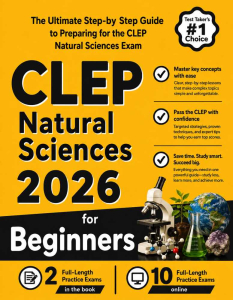
CLEP Natural Sciences for Beginners
A CLEP Natural Sciences guide covering introductory science study. Compare the contents with the current official outline before buying.
View book & purchase options →CLEP Natural Sciences Quick Review
Choose a concept or lesson to refresh before another practice activity.
Open this resource →MEET THE ASSESSMENT · CHOOSE YOUR NEXT SKILL
Know CLEP Natural Sciences before you start.
College Board lists approximately 120 questions in 90 minutes, including some unscored pretest questions. The exam surveys biological and physical sciences at an introductory level for nonscience majors. The independent chapter review and flashcards here are study tools, not official scores. Check your college’s required score and credit policy.
Official assessment information ↗Biological sciences
Connect structures and processes rather than memorizing isolated terms.
Explore this study route →Physical sciences
Identify quantities and units before explaining a physical relationship.
Explore this study route →Evidence and experiments
Distinguish a measured result from an explanation of that result.
Explore this study route →Balance science coverage
Use the official outline to plan biological and physical science preparation.
Explore this study route →CLEP Natural Sciences Practice Center
Take a full practice test, review the explanations, then use the flashcards to repair the terms and ideas that slowed you down.
CLEP Natural Sciences Study Blueprint
Open each area to see what to master. The bars show how this Online Center distributes its lessons, so you can plan study time without mistaking the map for an official exam weighting.
01 Cells, genetics, and evolutionConnect the molecular and cellular basis of life to heredity and change over time. 24lessons
- Cell structure, energy, division, and gene expression
- Genetics, evolution, and biological diversity
02 Organisms and ecologyStudy plant and animal systems within populations and ecosystems. 16lessons
- Structure, function, reproduction, and development
- Ecology, populations, and environmental science
03 Chemistry and matterUse particles, bonding, reactions, and solutions to explain material behavior. 17lessons
- Atomic structure, formulas, and bonding
- Reactions, stoichiometry, solutions, acids, and gases
04 Physics, Earth, and spaceApply physical relationships to motion, energy, waves, Earth systems, and astronomy. 14lessons
- Mechanics, energy, waves, sound, and light
- Earth structure, weather, oceans, and the universe
05 Scientific reasoning and dataInterpret measurements, experiments, graphs, tables, and evidence. 8lessons
- Variables, controls, uncertainty, and design
- Quantitative reasoning and evidence-based conclusions
Study-map shares describe the learning resources on this page. They are not presented as official test percentages.
CLEP Natural Sciences Study Online Center: a single starting point that brings together the lessons, worksheets, practice tests, and review material for this subject, arranged in a sensible order so you can work through it from start to finish.
Independent college-credit exam preparation
Study biological and physical science in plain language, open the exact lesson you need, and use the chapter flashcards to check what you can explain without notes.
34 chapters · 208 lessons · 260 flashcards
Choose your next move
If you are starting from the beginning, work through Biological Science first and then Physical Science. If you have already taken a diagnostic test, let your missed questions choose the chapter.
Every CLEP Natural Sciences lesson
Each link opens the closest published teaching page in a new tab. Existing Biology, Chemistry, Physics, TEAS, ASVAB, and GED lessons are reused wherever they already cover the book topic.
208 lessons
Biological Science
Chapter 1: Nature of Life and Scientific Investigation
Chapter 2: Origin of Life, Evolution, and Natural Selection
Chapter 3: Classification and Diversity of Life
Chapter 4: Chemistry of Life
Chapter 5: Cell Structure and Function
Chapter 6: Cellular Energy: Photosynthesis and Respiration
Chapter 7: Cell Division
Chapter 8: DNA, RNA, and Gene Expression
Chapter 9: Genetics and Heredity
Chapter 10: Plant Structure, Function, and Reproduction
Chapter 11: Animal Biology and Human Body Systems
Chapter 12: Reproduction and Development
Chapter 13: Ecology and Ecosystems
Chapter 14: Population Biology and Environmental Science
- Thinking in Environmental Systems
- Matter Moves Through Cycles
- Air Pollution: Primary and Secondary Pollutants
- Ozone: Same Molecule, Different Environmental Role
- Particulate Matter
- Acid Deposition
- The Greenhouse Effect and Climate Chemistry
- Water Quality and Treatment
- Dissolved Oxygen and Eutrophication
- Chemical Fate: Solubility, Sorption, and Persistence
- Bioaccumulation and Biomagnification
- Toxicology: Dose, Route, and Response
- Units and Environmental Data
- Environmental Sampling and Evidence
- Environmental Justice and Unequal Exposure
- Green Chemistry and Safer Design
- A Unified Environmental-Chemistry Decision Process
Physical Science
Chapter 15: Measurement, Mathematics, and Scientific Problem Solving
Chapter 16: Matter and Atomic Structure
Chapter 17: Nuclear Science and Radioactivity
Chapter 18: Chemical Bonding
Chapter 19: Chemical Reactions
- Reactants, Products, and Signs a Reaction Happened
- Conservation of Mass
- Reading an Equation: Coefficients and Subscripts
- Balancing Equations Step by Step
- Recognizing Common Reaction Patterns
- Endothermic and Exothermic Reactions
- What a Reaction Rate Is
- Collision Theory: Why Reactions Happen
- Temperature and Concentration
- Surface Area and Catalysts
Chapter 20: Solutions, Acids, Bases, and Gases
Chapter 21: States of Matter and Thermodynamics
Chapter 22: Motion
Chapter 23: Forces and Newton's Laws
Chapter 24: Work, Energy, Momentum, and Machines
- Energy: A New Way to Predict Change
- Work: Energy Transferred by a Force
- Energy Stored in Motion and Interactions
- The Work-Energy Theorem: Focus on One Object
- System Energy Accounts and Conservation
- Power: How Fast Energy Is Transferred
- Efficiency: Useful Output Compared with Input
- Momentum, Impulse, and Machines
Chapter 25: Electricity and Magnetism
Chapter 26: Waves, Sound, and Light
Chapter 27: Astronomy: The Solar System
Chapter 28: Stars, Galaxies, and the Universe
Chapter 29: Earth's Structure and Plate Tectonics
Chapter 30: Rocks, Minerals, and Geologic Time
Chapter 31: Atmosphere, Weather, and Climate
Chapter 32: Oceans and the Water Cycle
Cross-Disciplinary CLEP Skills
Chapter 33: Graphs, Tables, and Scientific Data
Chapter 34: Experimental Design and Evidence
- The Three Kinds of Variables
- Control Groups and Experimental Groups
- What Makes a Fair Test
- Identifying Variables and Judging a Design
- Internal and External Validity
- From Observation to Hypothesis
- The Scientific Method Is a Cycle
- Hypothesis, Theory, and Law
- What Makes an Explanation Scientific
- Variation, Uncertainty, and Null Results
- Drawing a Conclusion the Data Supports
- Making Predictions from a Pattern
- Correlation Is Not Causation
- Does the Evidence Support the Claim?
- The CHECK Checklist
- Spotting Weaknesses and Suggesting Fixes
- Bias and Conflicts of Interest
- Is the Conclusion Supported? Strong and Weak Evidence
Use the Online Center like a tutor
After reading, name the main relationship in one sentence. Give one example and one tempting nonexample. If you cannot explain why the nonexample fails, return to that one section instead of rereading the whole chapter.
Ready for a focused review?
Open the flashcards, choose a chapter, and mark the terms you cannot explain in your own words. Those terms become today’s short study list.
These independent study materials are not official CLEP examinations or scaled-score reports. CLEP and College Board are registered marks of their respective owners, who do not endorse this site or its materials.
Every lesson in one place
Open a lesson in a new tab and keep this Online Center nearby as your study home.
Browse the complete lesson directory
A USEFUL NEXT STEP
CLEP Natural Sciences: study questions
What is the official CLEP Natural Sciences exam format?
College Board lists approximately 120 questions in 90 minutes, including some unscored pretest questions. The exam surveys biological and physical sciences at an introductory level for nonscience majors. The independent chapter review and flashcards here are study tools, not official scores. Check your college’s required score and credit policy.
Official source ↗How should I use these independent CLEP Natural Sciences study tools?
Start with a practice activity, review explanations for missed questions, and use quick review or flashcards for one weak topic. The practice results are study feedback, not official exam scores. Compare a book’s contents with your course or test requirements before buying.
Resources from Effortless Math · Editorial standards