Environmental Science: Pollution, Exposure, and Safer Design
Environmental Science: Pollution, Exposure, and Safer Design: this Effortless Math guide explains the topic in plain language, shows how it works through solved examples, and gives you free practice to try immediately, so the idea sticks instead of staying abstract.
CLEP Natural Sciences · Beginner lesson
Environmental Science: Pollution, Exposure, and Safer Design
Environmental questions become manageable when you follow matter. Track where a substance starts, how it moves and changes, who is exposed, and which intervention can interrupt the pathway. That same routine works for air pollution, water quality, toxicology, and safer design.
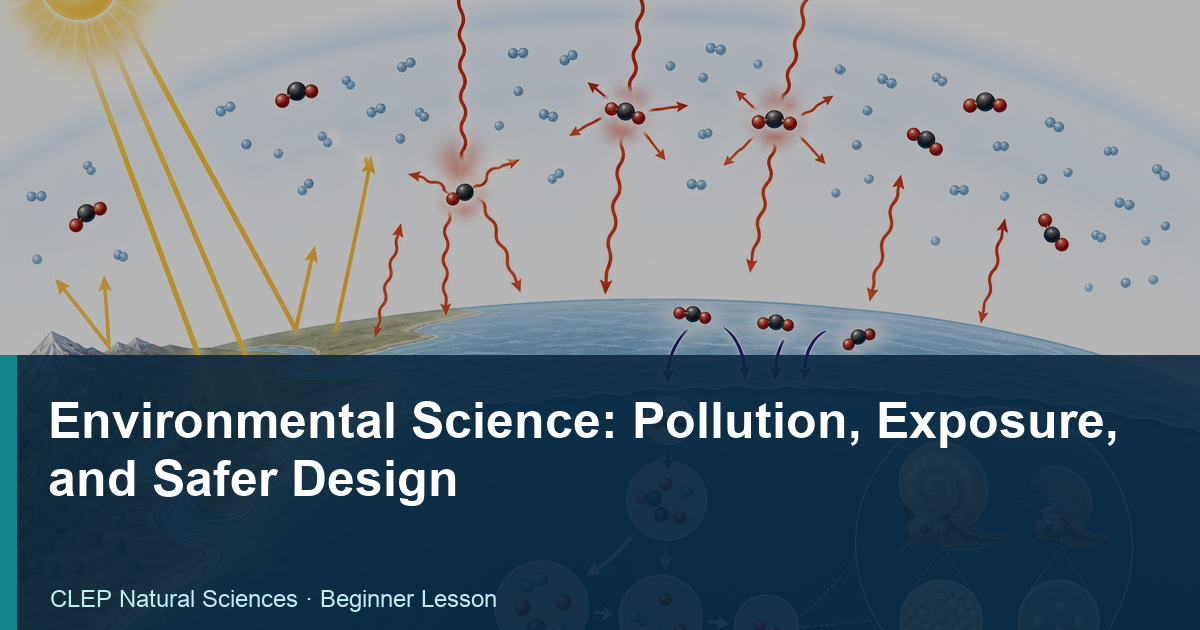
Environmental science studies connected natural and human systems by tracing matter, energy, chemical change, exposure, biological effects, and the evidence used to judge risk.
How do environmental scientists track a problem?
Begin with seven questions: What is the source? Which substance or chemical form is present? How much is there? How does it move? What does it become? How long does it remain? Who or what is exposed? This sequence prevents a common mistake: treating detection alone as proof of danger.
Risk depends on identity, concentration, route, duration, toxicity, and uncertainty. A tiny amount detected by a sensitive instrument and a large dose inhaled over years are different exposure stories.
How does matter move through environmental cycles?
Atoms are conserved while their chemical form and location change. Carbon moves among air, oceans, organisms, soils, rocks, and fuels. Nitrogen fixation makes atmospheric nitrogen available to living systems. Nitrification and denitrification move it among other forms. Sulfur moves through rock, water, organisms, fuels, and the atmosphere.
What is the difference between primary and secondary pollutants?
A primary pollutant enters the environment directly from a source. Carbon monoxide from incomplete combustion is one example. A secondary pollutant forms after emitted substances react. Ground-level ozone and much fine sulfate or nitrate material are secondary.
Why can the same ozone molecule help in one place and harm in another?
Stratospheric ozone absorbs damaging ultraviolet radiation. Ground-level ozone forms through sunlight-driven chemistry involving nitrogen oxides and volatile organic compounds. At ground level, it can irritate respiratory tissue and damage plants. Location changes the role, even though the molecule is still ozone.
What do particulate matter and acid deposition tell us?
Particulate matter is a size class, not one chemical. Fine particles can stay suspended longer and travel deeper into the lungs. Composition still matters. Soot, sulfate, nitrate, mineral dust, and metals do not have identical sources or effects.
Acid deposition forms when sulfur and nitrogen compounds undergo atmospheric reactions and return in rain, snow, fog, gases, or particles. Its effect depends partly on the buffering capacity of soil and water. Carbonate-rich systems can neutralize more added acid than poorly buffered systems.
How do greenhouse gases change Earth’s energy balance?
Greenhouse gases absorb and re-emit infrared radiation. Increasing their concentration changes the balance between incoming and outgoing energy. Weather varies from day to day. Climate describes long-term patterns, so one unusual day does not establish or disprove a climate trend.
What happens during water treatment and eutrophication?
Drinking-water treatment may combine settling, filtration, and disinfection. Each stage addresses a different problem. Wastewater treatment reduces solids, organic matter, nutrients, and pathogens before discharge.
Excess nitrogen or phosphorus can stimulate algal growth. When the added biomass dies, decomposers consume oxygen. Dissolved oxygen may fall far enough to stress or kill aquatic organisms. The important chain is nutrient input, algal growth, decomposition, oxygen decline, biological effect.
What determines a chemical’s fate?
Solubility affects movement with water. Sorption to soil or sediment can slow transport while storing a chemical for later release. Volatility favors movement into air. Persistence describes how slowly a substance is removed or transformed. Chemical form matters because different forms can have different mobility and toxicity.
How are bioaccumulation and biomagnification different?
| Process | What increases | Where it happens |
|---|---|---|
| Bioaccumulation | Concentration inside one organism over time | Within an organism |
| Biomagnification | Concentration at higher feeding levels | Across a food web |
A persistent, fat-soluble substance that leaves the body slowly is more likely to accumulate. Predators can then receive the substance from many contaminated prey.
How should you read a dose-response claim?
Hazard describes a substance’s ability to cause harm. Risk combines hazard with exposure. Dose, route, timing, and duration all matter. A study of ingestion cannot automatically answer a question about inhalation, and a short high dose may not behave like a low dose spread over years.
How do sampling and environmental justice affect the evidence?
A sample must represent the place, time, and population named in the claim. One convenient sampling site can miss neighborhoods, seasons, or exposure pathways. Environmental justice asks whether environmental burdens and decision-making power are distributed fairly. Strong analysis uses measured patterns and clearly defined groups instead of assumptions.
What does green chemistry change?
Green chemistry tries to prevent hazards at the design stage. Useful questions include: Can the product use a less hazardous substance? Can the process use less energy? Can it produce less waste? Can materials be recovered? Can the product break down into safer substances after use? Prevention usually offers more control than cleanup after release.
Watch the idea take shape
Pollution: Crash Course Ecology #11 gives you a second route through the same science. Pause once or twice and explain the central relationship aloud before continuing.
Check your understanding
- Why is detection alone not enough to establish risk?
- How does a secondary pollutant differ from a primary pollutant?
- Why is ozone protective in the stratosphere but harmful near the ground?
- What sequence connects nutrient pollution to low dissolved oxygen?
- How does biomagnification differ from bioaccumulation?
- What is the main goal of green chemistry?
Answers
- Risk also depends on concentration, chemical form, route, duration, toxicity, and who or what is exposed.
- A primary pollutant is emitted directly. A secondary pollutant forms through later reactions.
- Stratospheric ozone absorbs ultraviolet radiation, while ground-level ozone acts as an air pollutant.
- Nutrient input leads to algal growth, decomposition, increased oxygen use, and then lower dissolved oxygen.
- Bioaccumulation occurs within one organism. Biomagnification is the increase across higher trophic levels.
- To prevent waste and hazard through safer product and process design.

Related to This Article
More math articles
- Ethnicity and Minority-Group Status
- The Best Grade 6 ELA Practice Tests for Rhode Island Students
- The Best Grade 3 Math Book for Tennessee Students
- Chapter 11: The Presidency
- Free Grade 8 English Worksheets for West Virginia Students
- Top 10 TSI Math Test-taking Tips
- Tax revenue is a rectangle
- Number Properties Puzzle – Challenge 19
- The Pacific War and the Atomic Bomb
- How to Understand Congruence through Rigid Motion Transformations



















What people say about "Pollution, Exposure, and Safer Design"?
No one replied yet.