How to Evaluate Experiments and Evidence
Students who choose a study app score higher than students who do not use it. That result raises a useful question about the app, but motivation, previous preparation, and study time could also differ between the groups. Evaluating evidence begins by checking what was actually compared.
Before accepting the claim printed beneath a graph, examine group assignment, the treatment, and the outcome to see whether the conclusion stays within the limits of the design and measurements.
Separate the treatment from competing explanations
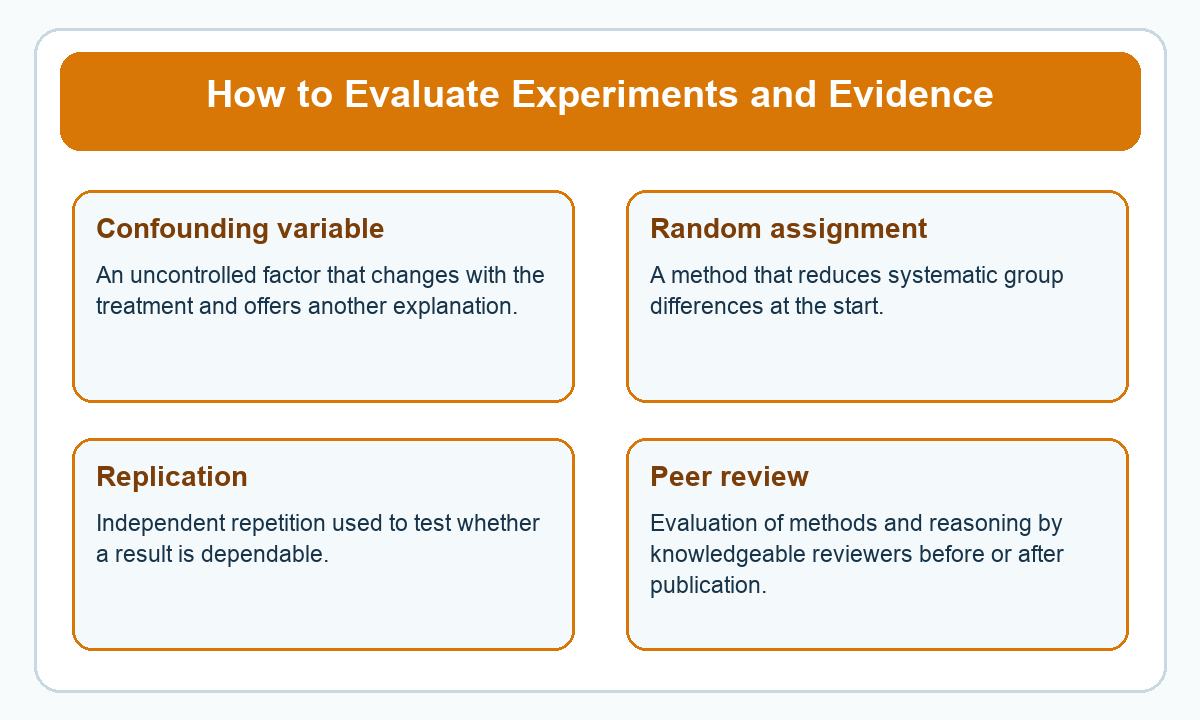
If fertilized seedlings also receive extra water, a growth difference cannot be assigned confidently to fertilizer alone because water is a confounding variable that changed with the treatment. Both conditions changed.
A stronger design gives comparable seedlings the same water, light, soil, and observation period while varying fertilizer. Random assignment distributes seedlings among the treatment groups without letting the investigator choose the most promising plants for one group. It reduces systematic starting differences, although a small random sample can still be uneven by chance.
Random sampling answers a different question. Selecting individuals from a population affects how well the sample represents that population, whereas random assignment affects the fairness of the comparison between groups. A study can use one without the other.
Check what the measurement means
A report says a plant is healthier. How was health measured? Leaf number, dry mass, survival, and height describe different outcomes. A tall seedling may be responding to low light rather than growing more total tissue. A useful measurement must match the claim.
Repeated measurements also need the same procedure. Measure stem height from the same reference point, use consistent units, and define the observation time before comparing groups. A ruler that consistently adds two centimeters produces a systematic error. Repeating that measurement does not remove the bias.
Look beyond the group averages
Two groups may differ by one millimeter on average while individual plants vary by several centimeters. Report the spread and sample size along with the mean. A large sample can reveal a small effect, yet the effect may still have little practical importance.
Repeating observations on one plant does not create ten independent plants. Repeated measurements can improve the description of that individual, but estimating variation among plants requires separate biological replicates, so keep the unit being studied clear.
Test whether the explanation travels
An independent group may repeat a study using comparable methods. Agreement strengthens confidence in a result. Disagreement deserves examination of the organisms, conditions, measurements, and analysis before either result is dismissed.
Peer review adds another check. Knowledgeable reviewers can identify missing controls, unsupported interpretations, or unclear methods. They do not usually repeat every experiment, and publication cannot guarantee that a conclusion is correct. Later observations remain relevant.
Return to the study app. Randomly assigning comparable students to use the app or a comparison resource would address some selection differences, while measuring both groups before and after a defined study period would show how scores changed. The conclusion would still concern the students, resources, and time period actually studied. Applying it to every learner would require further evidence.
If one group gains four points and the comparison group gains three, the observed difference in improvement is one point. Whether that difference is dependable requires information about variation and the number of independent participants.
Watch a short lesson
The investigations video shows how controls and variable management determine whether evidence can support a causal claim.
Can you check your understanding?
Answer before opening each explanation.
-
What is confounded when fertilized plants also receive extra water?
Check the answer
Fertilizer and water change together. Either could explain a growth difference, so their effects cannot be separated by that comparison.
-
What does random assignment help accomplish?
Check the answer
It reduces systematic starting differences between treatment groups. It does not guarantee perfectly identical groups.
-
How does random sampling differ from random assignment?
Check the answer
Sampling concerns who enters the study. Assignment concerns which condition each participant or organism receives.
-
Are ten measurements of one plant ten independent plant replicates?
Check the answer
No. They are repeated observations of one biological individual.
-
Does a small statistically detectable effect have to be useful?
Check the answer
No. Practical importance depends on effect size, costs, consequences, and the measurement context.
-
What does successful peer review establish?
Check the answer
That reviewers evaluated the work through the journal’s process. It can improve a study, but it does not guarantee correctness or replace replication.
Where does this fit in your science review?
The ATI TEAS Science Study Hub places this lesson inside the larger scientific reasoning review. Continue with these connected lessons:

Related to This Article
More math articles
- Restrictions on demonstrations
- Algebra Puzzle – Challenge 52
- How Smart Bettors Use Math to Beat the Books
- Sterilization Safety and Exposure Control
- The Constitution, Federalism, and Amendments
- How to Find the Central Angle of a Circle?
- Free Grade 8 English Worksheets for Oklahoma Students
- How to Solve Theoretical Probability?
- Full-Length PSAT 10 Math Practice Test
- Free Grade 8 English Worksheets for Illinois Students


















What people say about "How to Evaluate Experiments and Evidence"?
No one replied yet.