Cells, Tissues, Organs, and Homeostasis
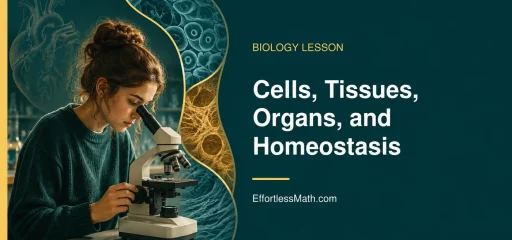
Look at the tissues in a heart. Muscle cells contract, connective tissue supports the organ, and electrical signals coordinate the beats. Its inner lining is another tissue. You need several tissue types working together to explain how this one organ pumps blood through the body.
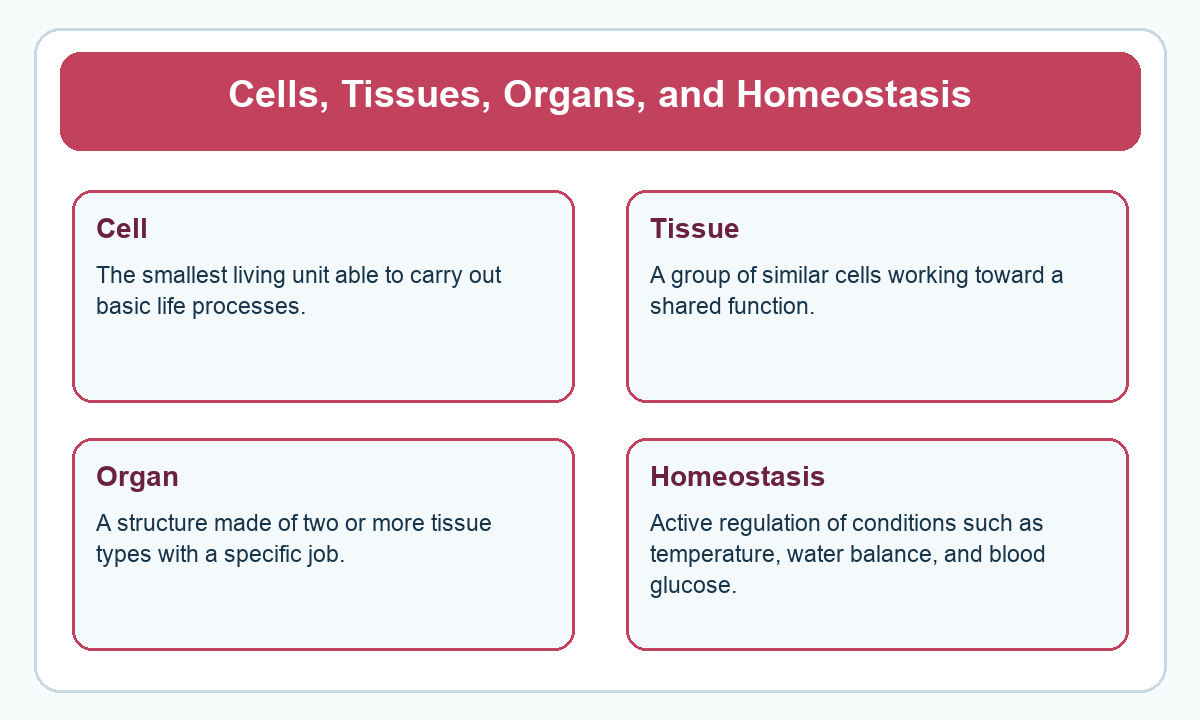
Multicellular body organization links cells, tissues, organs, and organ systems. Homeostasis describes the regulation of internal conditions within workable ranges. These are related ideas, but they answer different questions: organization identifies the parts, while regulation explains how their coordinated activity responds to change.
How do cells combine into an organ?
A tissue consists of cells and, where present, extracellular material organized for related functions. Its cells do not have to be identical. An organ contains multiple tissue types working together. The stomach, for example, combines a lining, smooth muscle, connective tissues, nerves, and blood vessels. An organ system connects multiple organs through a broader function such as digestion or circulation.
| Level or process | Example | Evidence that identifies it |
|---|---|---|
| Cell | One smooth-muscle cell | An individual cellular unit |
| Tissue | Smooth-muscle tissue | Organized cells contributing to contraction |
| Organ | Stomach | Several tissue types working within one structure |
| Organ system | Digestive system | Multiple organs processing and absorbing food |
| Homeostasis | Regulation of blood glucose | Coordinated responses limiting a variable’s deviation |
Why does homeostasis allow variation?
Body temperature, blood glucose, and many other regulated variables change during ordinary life. Eating, exercise, sleep, and environmental conditions can alter them. Homeostasis does not require a single unchanging reading. It involves responses that keep conditions compatible with cell function.
In a feedback model, a sensor detects information about a variable, an integrating process coordinates a response, and effectors carry it out. These roles may be distributed across several structures. A diagram is a useful simplification, not a claim that every pathway contains exactly three separate organs.
How can you recognize negative feedback?
Identify the variable and ask whether the response opposes its deviation. When body temperature rises, sweating can increase evaporative heat loss, and increased skin blood flow can support heat exchange under suitable conditions. The response tends to reduce the rise. Sweat cools effectively when it evaporates. High humidity can limit that effect.
Positive feedback amplifies a change for a particular process. During childbirth, cervical stretch can promote hormonal signals that strengthen contractions, producing further stretch. Delivery removes the stimulus. “Positive” and “negative” describe response direction, not whether a process is good or bad.
What would you conclude from a rising pulse?
Suppose a student’s pulse rises during a short walk and falls during recovery. The changing value alone is not evidence that homeostasis failed. During activity, tissues need greater delivery of oxygen and nutrients and removal of metabolic products. The cardiovascular system adjusts to those demands. To assess a problem, you would need the context, appropriate measurements, and a comparison with expected physiological responses.
For a diagram question, first identify the scale being shown. A single muscle cell, a layer of muscle tissue, and the whole heart cannot be labeled interchangeably. For a feedback question, trace the regulated variable through the response instead of selecting an answer simply because it names a familiar hormone or organ.
Watch levels of biological organization
Use the video to connect cells with tissues, organs, and systems. Then apply the feedback examples above to explain how those structures coordinate their activity.
Watch feedback change a response
Track the regulated variable in each example. Explain how thermoregulation opposes a change and how fruit ripening amplifies one.
Try six application checks
Why is the stomach an organ rather than one tissue?
It contains several tissue types that cooperate in digestion and movement.
Must all cells in a tissue be identical?
No. Related cell types and extracellular material can contribute to a shared tissue function.
Does a change in a regulated variable prove homeostasis has failed?
No. Normal regulation allows variation and adjusts to changing demands.
What makes sweating part of negative feedback when temperature rises?
Evaporation can remove heat, opposing the initial rise in temperature.
Does “positive feedback” mean a beneficial response?
No. It means the response amplifies the initial change. An endpoint is often needed.
Is homeostasis another structural level after the organ system?
No. It describes regulation performed through interacting cells, tissues, organs, and systems.
Explore transport and exchange and nervous and endocrine control, or return to the Biology learning hub.
For the AP course sequence and practice tests, use the AP Biology study hub.

Related to This Article
More math articles
- Chapter 6: Federalism
- CLEP U.S. History I 062: Expanded White Male Suffrage and Mass Parties
- The Best Grade 3 Math Book for Indiana Students
- Sterile Processing: The Dirty-to-Clean Flow
- The Best Grade 4 Math Book for New Mexico Students
- The Best Grade 6 ELA Practice Tests for Montana Students
- The Ultimate 7th Grade NDSA Math Course (+FREE Worksheets)
- Descending into Numbers: A Deep Dive into the Floor Value
- Understanding the Prompt and Rubric
- Build a Word, Then Check It Against the Whole Word

















What people say about "Cells, Tissues, Organs, and Homeostasis"?
No one replied yet.