NREMT AEMT Exam Changes: Check Your Level Before Choosing a Course (2027 Prep)
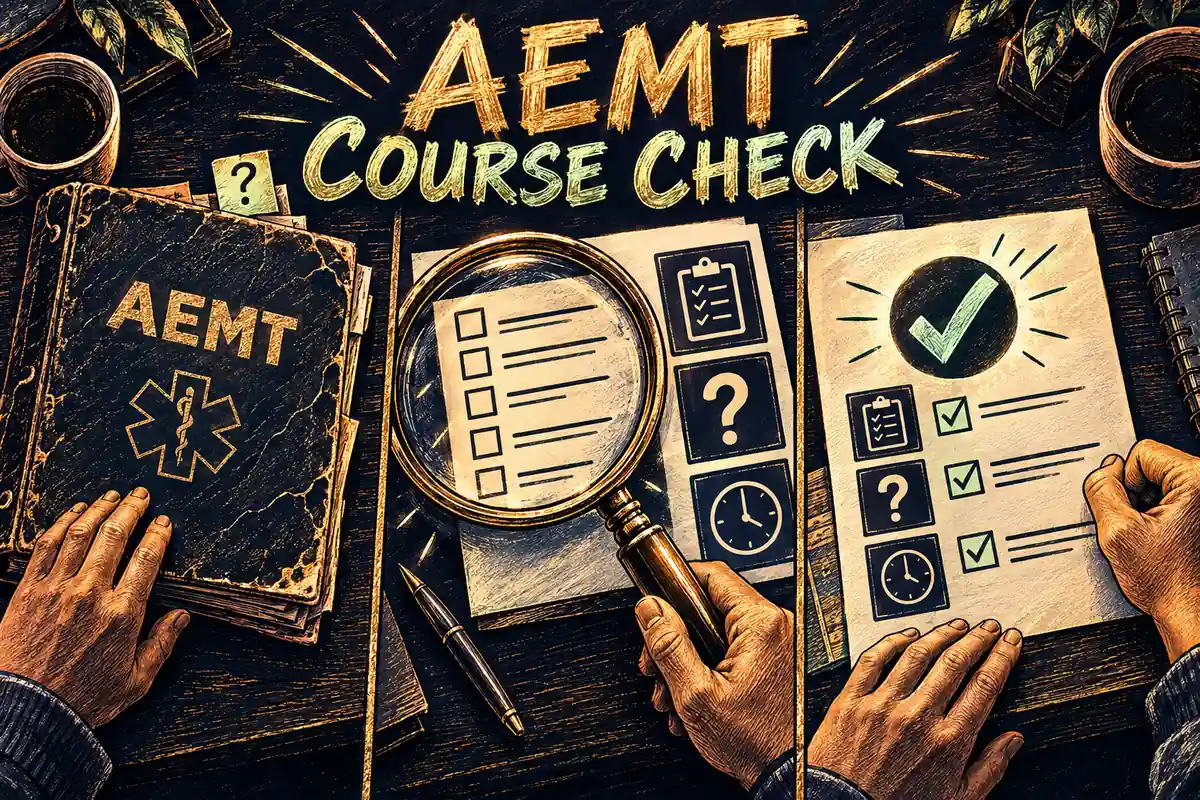
If you are preparing for the NREMT Advanced Emergency Medical Technician (AEMT) exam in 2027, check whether your materials match the current exam. The Registry launched it on July 1, 2024. The 2027 label marks this preparation edition. Your course should match the current test plan and item formats.
If you want the exam details in one place, start with the NREMT AEMT exam prep hub, which summarizes the current format, all six domains, and official resources.
That date matters if your course, class notes, or question bank has been sitting on a shelf for a while. A label that says ‘updated’ sounds reassuring, but it gives no date or source. Here is a quick way to check the actual material.
Start with the current AEMT exam facts
The current NREMT AEMT exam is a fixed-length, linear computer-based test. Candidates answer 135 items, including 100 scored items and 35 unscored pilot items, in three hours after a ten-minute tutorial, according to the current Registry handbook. The Registry does not identify the pilot items, so answer each question carefully.
There is one navigation detail worth practicing. You can change an answer before you advance to the next item. After you submit and move on, you cannot return; the test plan also says you must answer every item, and unanswered items count as incorrect. If time is getting short, choose your best answer before submitting rather than leaving a blank. The Registry’s current exam-format overview lists EMR, EMT, and Paramedic as computer-adaptive and AEMT as fixed-length linear CBT in its official comparison. If an AEMT course calls the exam adaptive, compare that claim with the current AEMT plan.
What changed on July 1, 2024?
The change is bigger than a new date on a prep book. Use these three checks to separate the old pathway, today’s Registry exam, and your own next step.
Before the transition
The prior ALS pathway included separate cognitive and psychomotor examinations.
Audit your course: flag any instruction that still tells you to schedule both National Registry exams.
Current NREMT process
One new AEMT Certification Examination began July 1, 2024. A separate psychomotor exam is not required in the new Registry testing process. Clinical Judgment is now 31–35% of the exam.
What changed in the blueprint: communication, leadership, and a repeated patient-information cycle are sampled alongside the four clinical domains and EMS Operations.
What you should do
Choose prep that asks you to interpret a changing scenario: notice the cues, decide what they mean, choose an action, and reassess the response.
Keep practicing hands-on care in your course. Registry certification testing, education-program skills checks, and state licensure are separate requirements.
There is a second change to keep straight. Since July 1, 2024, AEMT candidates must meet the Recommended AEMT Student Minimum Competency (SMC) Matrix as part of the certification requirements. The SMC is not another National Registry exam: the matrix guides state EMS offices and AEMT programs as they set and verify student competency. The current NREMT candidate requirements also require current National Registry certification or a state license at EMT level or higher. Candidates need a state-approved AEMT course that meets or exceeds the National EMS Education Standards for AEMT, completed within the past two years, with Program Director verification, the SMC requirement, and a passing certification exam. Ask your program director which state SMC requirements apply to you. AEMT education and SMC competency checks still matter even though the separate Registry psychomotor exam is gone. State licensure rules remain a separate question.
Use the six-domain card set as a course audit
Open the current NREMT AEMT examination page beside your course outline. Compare the domain names and ranges below. The Registry publishes a range and broad knowledge areas for each domain. Use the short anchors below to audit coverage, not to predict exact exam questions; individual practice sets can vary.
Current AEMT domains and official percentage ranges
Airway, Respiration and Ventilation
Published range: 9–13%
Plan anchor: Assessment, pathophysiology, and management.
Cardiology and Resuscitation
Published range: 11–15%
Plan anchor: Assessment, pathophysiology, and management; the official sample set includes rhythm-strip graphics.
Trauma
Published range: 7–11%
Plan anchor: Assessment, pathophysiology, and management.
Medical/Obstetrics/Gynecology
Published range: 25–29%
Plan anchor: Assessment, pathophysiology, and management across medical, obstetric, and gynecologic presentations.
EMS Operations
Published range: 6–10%
Plan anchor: Vehicle and equipment operation, professionalism, communication and documentation, legal standards, and the care environment.
Clinical Judgment
Published range: 31–35%
Plan anchor: Communication and leadership; recognize and analyze cues, define a hypothesis, generate solutions, act, and evaluate the response.
Pediatric patient care is integrated across all six exam domains. Clinical Judgment has the largest published range. The domain ranges overlap when added together. Read them as broad bands and check the test plan for exact specifications.
Check the exam format and item types
The official test plan describes a fixed-length linear exam. An AEMT course that calls the exam computer-adaptive has a format mismatch. The plan lists several item formats. A course can teach well without reproducing every exam screen. Check whether it teaches you to read instructions and respond to several kinds of prompt.
- Multiple choice: select one response from four options.
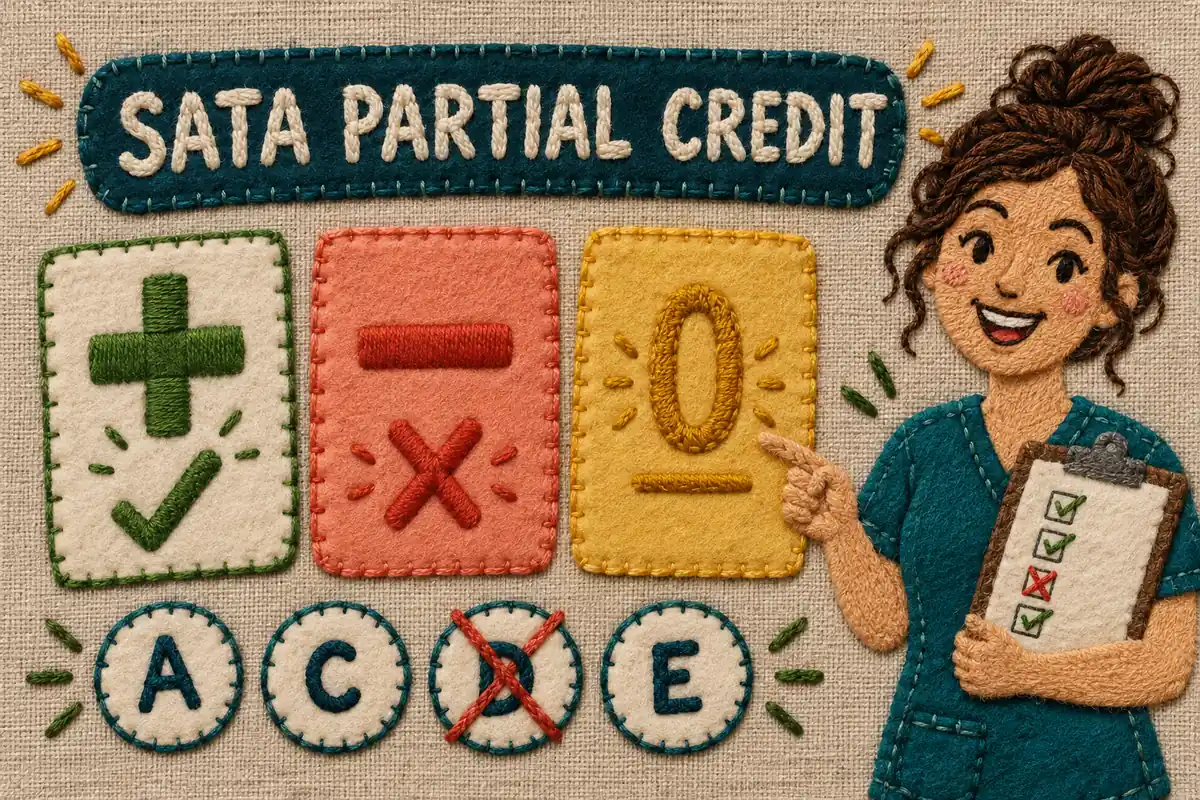
- Multiple response: choose two or three correct answers from five or six options. All items are scored dichotomously; a partly correct response receives no credit.
- Build list: put the options in the order named in the instructions.
- Drag and drop: place options into the requested categories or positions.
- Options box: classify or identify options in a table using the criteria provided.
- Graphical: use a chart, capnography rhythm strip, image, or picture to answer.
- Scenario-based: answer multiple questions from a scenario or passage. A scenario can use any of the item types above.
Use the Registry’s AEMT Candidate Handbook and its official sample items to see the instructions and current examples. A practice resource built around four-option recall questions can help with some content. For multiple-response practice, do not assume partial credit. Then try the Registry sample items so the instructions and interactive formats feel familiar.
A five-minute check for an older study course
- Confirm the level. Look for AEMT specifically. EMT and Paramedic materials can support selected topics. Each certification level has its own exam plan.
- Find its update date and source. Look for a link to the current AEMT test plan or handbook. A recent page date tells you little about which specifications were checked.
- Check the exam facts. Compare the course’s claims about linear versus adaptive delivery, 135 items, three hours, pilot questions, and navigation with the official plan.
- Scan its question formats. Look for multiple response, build list, drag-and-drop, options box, graphical, and scenario-based practice or clear instruction for those formats.
- Read one explanation after you miss a question. It should explain the reasoning and cite or identify the learning source, rather than stopping at the answer letter.
Some current prep pages contain conflicting exam details. On October 14, 2026, the Pocket Prep AEMT page mentioned the July 2024 update, then described a 135-item adaptive exam with a two-hour-fifteen-minute limit. The OpenExamPrep AEMT blueprint chapter also described adaptive delivery and said candidates could not skip and return. Those statements conflict with the current NREMT test plan. Verify each product claim against the official plan before deciding which material to keep.
Keep the older material that still earns its place
An older book or course can still help you review foundational material. Keep its sections that match the current AEMT domains, even if it predates July 2024. Add practice for any domain or item format it misses. Replace the source of exam-structure facts with the current Registry handbook and test plan.
If you are unsure whether a course meets your training program’s requirements, ask your program director. For state licensure questions, use your state EMS office. The Registry sets its certification examination. States handle licensure.
Official sources to keep beside your course
- NREMT AEMT examination information and domain ranges
- NREMT AEMT Candidate Handbook: exam format and test-day information
- NREMT AEMT Candidate Responsibilities: course and Student Minimum Competency requirements
- NREMT exam-format overview by certification level
- NREMT AEMT Certification Examination Test Plan and domain knowledge areas (PDF)
- NREMT announcement of the July 1, 2024 AEMT and Paramedic examination launch
Use the official plan to check facts, your course to learn the material, and your own missed-question notes to decide what to review next. Revisit the plan if the Registry posts a newer version.

Related to This Article
More math articles
- 5th Grade ISASP Math Worksheets: FREE & Printable
- How to Use the Quadratic Formula: Every Case for 2026
- The Best Calculator for FE Exam
- Top 10 Tips to Overcome ISEE Math Anxiety
- Democracy
- Marriage rights
- What Kind of Math Is Taught in 8th Grade?
- How Verification Became the Most Controversial Topic in Online Entertainment
- How to Write a Math-Based Analytical Paper Step by Step
- Black Codes and the Civil Rights Act of 1866





















What people say about "NREMT AEMT Exam Changes: Check Your Level Before Choosing a Course (2027 Prep) - Effortless Math"?
No one replied yet.