Transport and Exchange in the Human Body
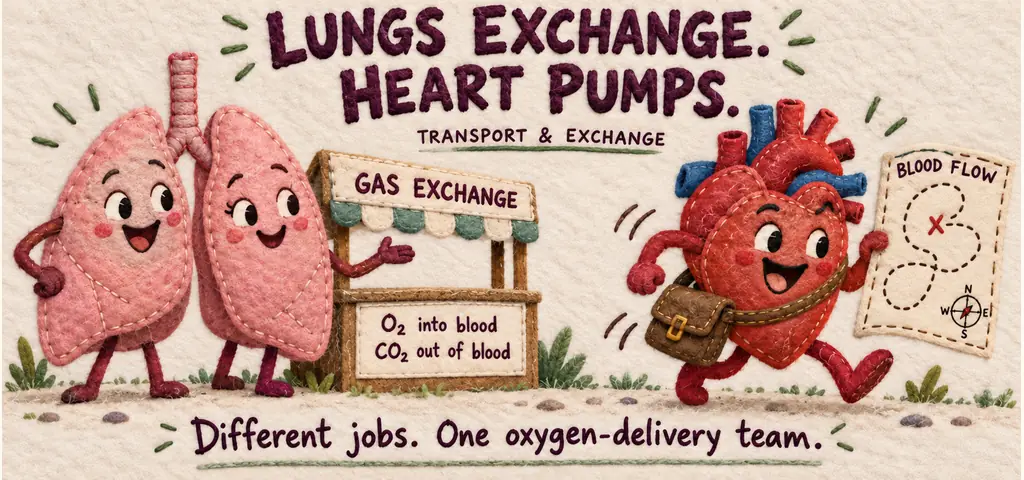
Transport and Exchange in the Human Body: this Effortless Math guide explains the topic in plain language, shows how it works through solved examples, and gives you free practice to try immediately, so the idea sticks instead of staying abstract.
Breathing brings air to the lungs, but it does not carry that air directly to a toe.
Oxygen must cross an exchange surface, travel in blood, and reach cells. Following the material helps separate several processes that are easy to confuse.
Transport moves materials through the body, while exchange transfers them across surfaces between compartments. Blood flow provides bulk transport. Diffusion moves gases across thin barriers down partial-pressure gradients. Digestive absorption and kidney transport use additional mechanisms, linking the circulatory, respiratory, digestive, and urinary systems in maintaining internal conditions.
How does oxygen reach a body cell?
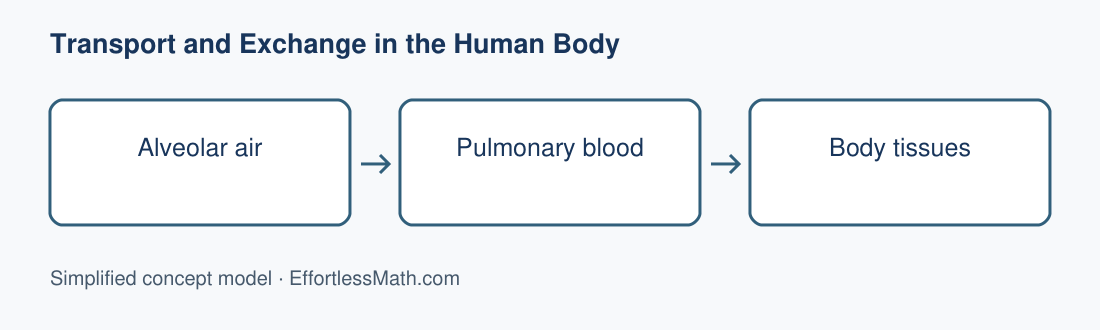
Ventilation brings air to alveoli. Oxygen diffuses across the alveolar, capillary barrier into blood when its partial pressure is higher in alveolar air. Most blood oxygen is carried bound to hemoglobin. The heart and vessels deliver blood to tissue capillaries, where oxygen can leave for tissues. Ventilation, diffusion, and circulation therefore describe different parts of the route.
Where do absorbed nutrients go?
The small intestine supplies a large absorptive surface. Many water-soluble products of digestion enter blood capillaries and travel toward the liver through the hepatic portal circulation. Most long-chain dietary lipids are packaged in chylomicrons, enter intestinal lymphatic vessels, and later reach the blood. It is inaccurate to give every nutrient exactly the same first route.
What does a kidney do besides filter blood?
Filtration moves water and small solutes into the nephron while normally retaining blood cells and most large proteins. Tubular reabsorption returns selected materials to blood, and secretion transfers selected substances from blood into tubules. These processes occur along the nephron rather than as three isolated whole-organ steps. The remaining fluid becomes urine.
Which process does each term describe?
| Term | Meaning in this lesson |
|---|---|
| Ventilation | Moves air into and out of lungs |
| Diffusion | Transfers molecules across a local gradient |
| Circulation | Moves blood through a pressure-driven circuit |
| Reabsorption | Returns substances from kidney tubules to blood |
How can you reason through an example?
Imagine a healthy runner begins climbing stairs. Muscles use more oxygen and produce more carbon dioxide. Increased ventilation helps exchange gases, while increased cardiac output helps deliver and remove them. Saying “the lungs pump oxygen through the arteries” combines two separate jobs: lungs exchange gases; the heart drives blood flow.
- Choose one material, such as oxygen or glucose.
- Trace the compartments it crosses in order.
- Name the mechanism at each crossing or transport step.
Can you apply the ideas?
Answer these six questions before opening the explanations.
- Is breathing identical to cellular respiration?
- What carries most oxygen in blood?
- Do arteries always contain oxygen-rich blood?
- Where does most nutrient absorption occur?
- Does everything filtered by the kidney leave in urine?
- What drives oxygen diffusion from alveoli into blood?
Check the six answers and explanations
- No. Breathing ventilates lungs; cellular respiration includes cellular pathways that transfer energy from fuels.
- Hemoglobin in red blood cells.
- No. Arteries carry blood away from the heart; pulmonary arteries normally carry oxygen-poor blood.
- In the small intestine, through a specialized absorptive surface.
- No. Much filtered water and many useful solutes are reabsorbed.
- A suitable oxygen partial-pressure gradient across the thin exchange barrier.
What does the video explain?
Watch Respiratory System by Amoeba Sisters. It develops one part of this lesson; return to the reading for the other connections.
Where does this lesson fit?
Use the Biology Learning Hub to choose your next topic. Related lessons explain cells, tissues, and homeostasis, how body systems cooperate, DNA, RNA, and protein synthesis.
Further reading: OpenStax Biology 2e topic reference. Lesson text and diagrams are original educational material; examples marked hypothetical are teaching scenarios.
Recommended study resources
The algebra bundle below supports quantitative skills used in science, including reading relationships, working with units, and solving for unknown quantities.


Related to This Article
More math articles
- Types of Democracy: Participatory, Pluralist, and Elite
- Congressional oversight
- How to Solve Exponential Growth and Decay Functions?
- SAT Math Subject Level 1 Calculator Tips and Hints
- ASTB Math Formulas
- Rocks and the Rock Cycle
- Ratification of the U.S. Constitution
- CLEP U.S. History I 001: Diverse Indigenous Societies before 1500
- Competing Visions of Modernity: The New Woman, Mass Entertainment, and the Lost Generation
- Comparing demographic groups





















What people say about "Transport and Exchange in the Human Body"?
No one replied yet.