Immunity, Reproduction, and Development
Immunity, Reproduction, and Development: this Effortless Math guide explains the topic in plain language, shows how it works through solved examples, and gives you free practice to try immediately, so the idea sticks instead of staying abstract.
A body must recognize threats while also controlling growth and maintaining its own tissues.
Defense and development both depend on communication among cells, although they solve different biological problems.
Immunity protects the body through barriers, innate responses, and adaptive responses with antigen-specific recognition and memory. Sexual reproduction brings genetic material from gametes together at fertilization. Development then involves cell division, movement, signaling, differentiation, and changes in gene expression that organize cells into tissues and a functioning organism.
How do innate and adaptive defenses differ?
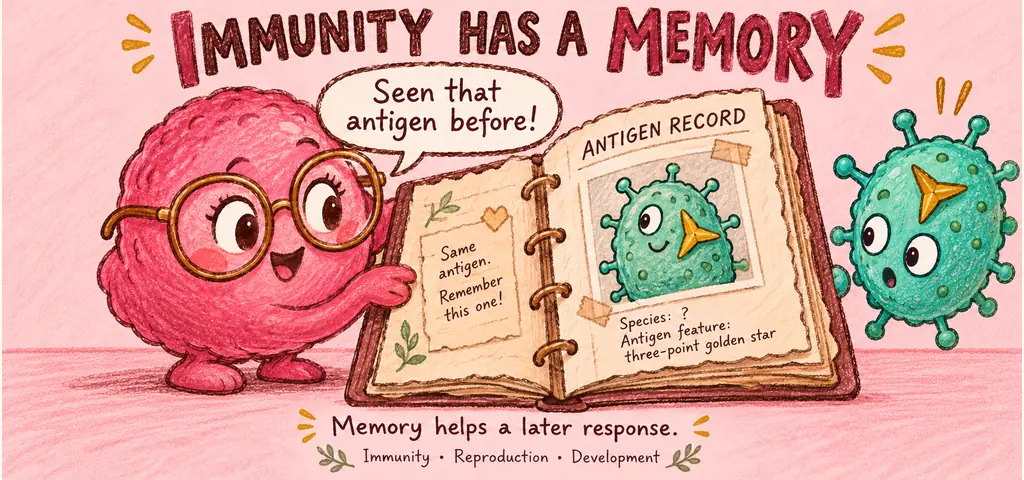
Skin and mucous membranes help prevent entry. Innate responses include inflammation and cells that recognize broad features associated with damage or microbes. Adaptive responses involve antigen-specific B and T lymphocytes. Some activated B cells become antibody-secreting plasma cells; other lymphocytes form memory populations. Cytotoxic T cells can attack infected cells. Antibodies do not perform every immune function.
How does immune memory help?
After an initial encounter, memory cells can support a faster or stronger response to a later encounter with the relevant antigen. Vaccination can establish protective responses without requiring the person to undergo the full natural disease. Protection varies with the pathogen, vaccine, individual, and time; immune memory is not a promise that infection is impossible.
How do fertilization and differentiation differ?
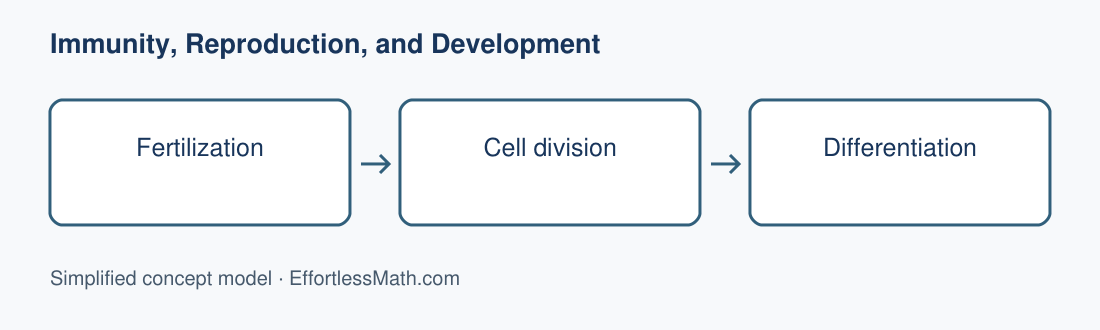
Fertilization brings gamete genetic material together to establish a zygote. In humans, haploid egg and sperm normally contribute one chromosome set each. Subsequent mitotic divisions produce more cells, while signaling and gene regulation guide differentiation. Specialized cells generally retain the genome rather than discard every gene they are not currently using. Development is not simply a larger version of the first cell.
Which process does each term describe?
| Term | Meaning in this lesson |
|---|---|
| Fertilization | Combines gamete genetic material |
| Cell division | Increases cell number |
| Differentiation | Develops specialized cellular functions |
| Immune memory | Changes the response to a later relevant antigen encounter |
How can you reason through an example?
Suppose two cell samples have similar DNA sequences, but only one produces large amounts of a muscle protein. The difference is consistent with specialized gene expression. Finding that difference does not mean the other sample has “lost the muscle gene.” Measuring its RNA, regulatory signals, and protein production would help explain the specialization.
- Identify whether the question concerns defense, reproduction, or development.
- Name the relevant cell type and its actual function.
- Distinguish a change in gene expression from a change in DNA sequence.
Can you apply the ideas?
Answer these six questions before opening the explanations.
- Which cells secrete antibodies after B-cell activation?
- Are all antigens parts of pathogens?
- What makes adaptive memory specific?
- What normally restores the diploid chromosome complement in human sexual reproduction?
- Does differentiation usually require removing unused genes?
- Does immune memory guarantee that later infection cannot happen?
Check the six answers and explanations
- Plasma cells, which develop from activated B cells.
- No. Antigens are recognized molecular features and can come from pathogens or other sources.
- The receptors and cell populations involved recognize particular antigen features.
- Fertilization, when haploid gamete contributions come together.
- No. Regulation changes which genes are expressed and how strongly.
- No. It can improve the response, but protection is not absolute and can change over time.
What does the video explain?
Watch Immune System, Part 2: Crash Course Anatomy & Physiology #46 by CrashCourse. It develops one part of this lesson; return to the reading for the other connections.
Where does this lesson fit?
Use the Biology Learning Hub to choose your next topic. Related lessons explain cells, tissues, and homeostasis, how body systems cooperate, DNA, RNA, and protein synthesis.
Further reading: OpenStax Biology 2e topic reference. Lesson text and diagrams are original educational material; examples marked hypothetical are teaching scenarios.
Recommended study resources
The algebra bundle below supports quantitative skills used in science, including reading relationships, working with units, and solving for unknown quantities.


Related to This Article
More math articles
- Choice architecture should be judged by evidence and agency
- PSAT Math Worksheets: Free Topic Practice
- Dividing by 1-Digit Numbers (No Remainders) for 4th Grade
- Regulations, Standards, Guidelines, and IFUs
- Top 10 Tips to Create a PERT Math Study Plan
- CPA REG Blueprint and Tax-Law Timing: Check Before You Study (2027 Prep)
- How to Ace the GRE Quantitative Section (2026 Guide)
- Free Grade 8 English Worksheets for South Carolina Students
- Deviance, Crime, and Social Control
- Substitution Rule of Integrals: Integral Problems Made Simple
















What people say about "Immunity, Reproduction, and Development"?
No one replied yet.