Human Impact, Climate, and Biodiversity
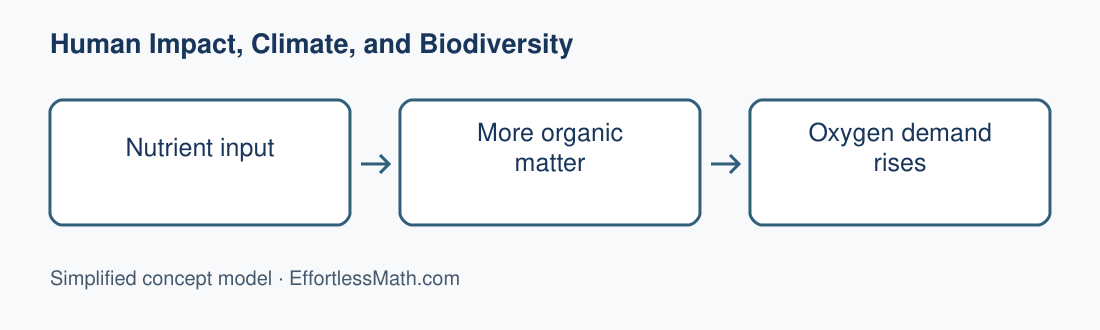
After fertilizer washes into a lake, an algal bloom appears and dissolved oxygen falls. How are those events connected? A biological explanation follows the nutrients into growth and decomposition, then asks which measurements could distinguish that mechanism from other causes of low oxygen.
Good environmental explanations identify the mechanism and the evidence rather than attaching every change to the same cause.
Human impacts on biodiversity include habitat loss and fragmentation, exploitation, pollution, introduced species, and climate change. These pressures can interact and affect genes, populations, communities, and ecosystems. Explaining an observed change requires connecting a specific activity to environmental conditions and then to biological responses, while considering alternative causes and uncertainty.
How does added carbon dioxide affect climate?
Greenhouse gases absorb and emit infrared radiation, influencing Earth’s energy balance. Human activities, especially fossil-fuel use, have increased atmospheric carbon dioxide. Climate describes long-term patterns and variability. A single cold day does not overturn a long-term warming trend. The IPCC’s 2023 synthesis estimated global surface temperature in 2011 to 2020 at about 1.1 degrees Celsius above 1850 to 1900. Those dates are part of the claim.

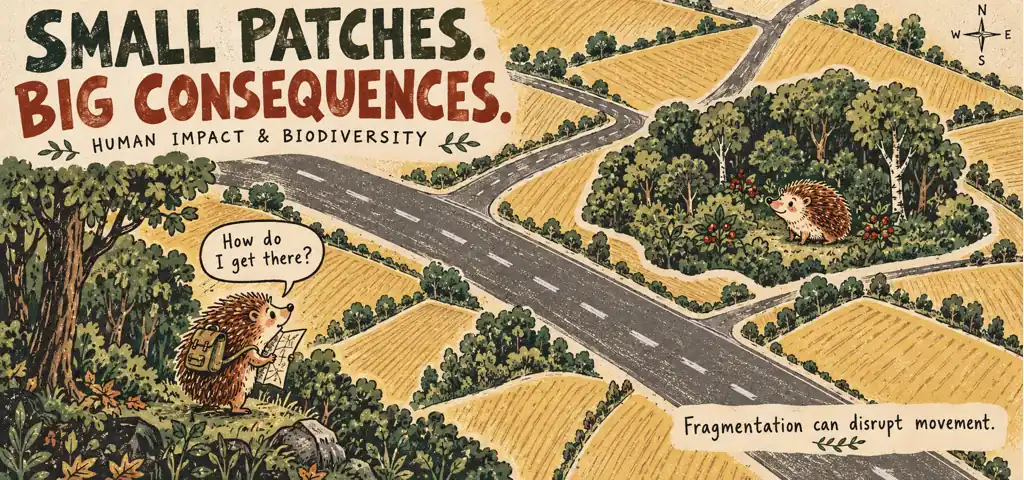
Why can habitat fragmentation matter?
Dividing a habitat into smaller patches can change movement, breeding connections, edge conditions, and access to resources. A corridor can help some organisms move between suitable patches, but its value depends on the species and landscape. Corridor design needs evidence. Simply drawing a green strip on a map does not guarantee a successful connection.
How can fertilizer reduce oxygen in water?
Excess nutrients can support algal growth. When organic material is broken down, microbial respiration can consume dissolved oxygen and harm aquatic organisms. Algae also respire, and conditions vary with light, temperature, mixing, and flow. The oxygen loss follows biological activity, including respiration during decomposition.
Which process does each term describe?
| Term | Meaning in this lesson |
|---|---|
| Mitigation | Reduces a pressure, such as greenhouse-gas emissions |
| Adaptation | Adjusts to impacts, such as planning for changed flood risks |
| Restoration | Repairs ecosystem structure or function where feasible |
How can you reason through an example?
A hypothetical lake record shows higher nutrient concentrations followed by an algal bloom and then low oxygen. The sequence is consistent with nutrient enrichment and increased oxygen demand. To test that explanation, compare inflows, mixing, temperature, and oxygen at multiple depths over time. The pattern supports a mechanism. Three observations alone do not exclude every alternative.
- Name the human activity and the environmental change.
- Trace the biological mechanism connecting them.
- Identify the comparison or measurement that would strengthen the explanation.
Can you apply the ideas?
Answer these six questions before opening the explanations.
- Does one snowy winter disprove global warming?
- Why include dates with a warming estimate?
- What process can consume oxygen after a bloom?
- Are all introduced species invasive?
- Is reducing emissions mitigation or adaptation?
- Why might a habitat corridor fail?
Check the six answers and explanations
- No. Weather at one place and time is not the same as a global climate trend.
- The estimate refers to a specified observation interval and baseline.
- Respiration by decomposers and other organisms can increase oxygen demand.
- No. Invasive species are introduced organisms that spread and cause harm in the relevant context.
- Mitigation, because it reduces a driver of climate change.
- Its location or habitat conditions may not support the target species’ movement or survival.
What does the video explain?
Watch The Effects of Climate Change: Crash Course Biology #9 by CrashCourse. Track how a climate change affects organisms in the video. Choose one example and identify the environmental measurement needed to test the proposed connection.
Where does this lesson fit?
Use the Biology Learning Hub to choose your next topic. Related lessons explain testing a biological explanation, how DNA instructions become proteins, organisms in ecosystems.
Further reading: IPCC, Climate Change 2023 Synthesis Report. Lesson text and diagrams are original educational material. Examples marked hypothetical are teaching scenarios.
Recommended study resources
The algebra bundle below supports quantitative skills used in science, including reading relationships, working with units, and solving for unknown quantities.

For the AP course sequence and practice tests, use the AP Biology study hub.

Related to This Article
More math articles
- The Ultimate PERT Math Formula Cheat Sheet
- Intelligent Math Puzzle – Challenge 84
- Washington SBAC Fifth-Grade Math: 49 Free Printable Worksheets, Chapter by Chapter
- 7th Grade Math: The Complete Parent’s Guide for 2026
- HiSET Math – Test Day Tips
- Complete Sentences and Clauses
- Top 10 4th Grade FSA Math Practice Questions
- Top 10 8th Grade MCAS Math Practice Questions
- Mastering the Basics: The Significance of “Algebra I for Beginners” in Your Back-to-School List
- ACT Aspire Algebra 1 Free Worksheets: Free Printable ACT Aspire Algebra 1 Practice with Worked Keys



















What people say about "Human Impact, Climate, and Biodiversity"?
No one replied yet.