Distance Measurement for 4th Grade
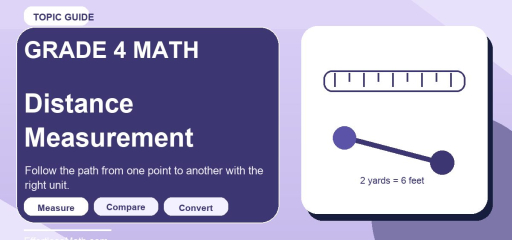
Distance Measurement for 4th Grade: this Effortless Math guide explains the topic in plain language, shows how it works through solved examples, and gives you free practice to try immediately, so the idea sticks instead of staying abstract.
Distance measurement tells how far apart two points are or how long something is from one end to the other.
In Grade 4, students measure distance with customary and metric units and decide which unit makes the most sense for the situation.
Key Ideas to Remember
- Choose the correct unit before you start solving so the answer fits the situation.
- Convert measurements before comparing or combining them when the units do not match.
- Keep the unit label with the final answer to avoid confusion.
Detailed Explanation
Short distances might be measured in inches, feet, centimeters, or meters. Longer distances might be measured in yards, miles, or kilometers.
Students often solve distance problems by comparing measurements, converting units, or adding and subtracting lengths in word problems.
Worked Example
Problem: How many feet are in 2 yards?
- Use the fact that 1 yard = 3 feet.
- Multiply 2 by 3.
- 2 yards equals 6 feet.
Answer: 2 yards = 6 feet.
Practice Tip
Have students choose the most reasonable unit before solving so they connect the numbers to a real measurement situation.
Common Mistakes
Students usually improve faster in distance measurement when they slow down and watch for a few repeated mistakes. These are the ones worth checking first:
- Comparing measurements that are still written in different units.
- Choosing a unit that is too large or too small for the object being measured.
- Leaving the unit off the final answer.
Practice Strategy
A short but consistent review routine helps students build confidence with distance measurement without getting overwhelmed.
- Estimate the answer first, then measure or convert to check the estimate.
- Practice one comparison problem and one unit-conversion problem.
- Keep a short list of benchmark measurements to build intuition.
Frequently Asked Questions
What is length measurement in grade 4?
In grade 4, length measurement means describing how long or how far something is with customary units (inches, feet, yards, miles) or metric units (centimeters, meters, kilometers), and converting within one system. Key facts include 1 foot = 12 inches, 1 yard = 3 feet, 1 meter = 100 centimeters and 1 kilometer = 1,000 meters. For example, 4 feet = 4 × 12 = 48 inches.
How do you measure distance in grade 4?
Start by picking a sensible unit and tool: a ruler for inches or centimeters, a yardstick or meter stick for a room, and miles or kilometers for trips. Line the tool up with the starting point and read the mark at the end. In word problems, students add or subtract distances, such as 350 m + 475 m = 825 m for a walk to school and then on to the park.
What is the distance measurement formula?
The usual distance formula is distance = speed × time. If a cyclist rides 8 miles per hour for 3 hours, the distance is 8 × 3 = 24 miles. Most 4th grade distance problems, though, focus on measuring lengths, converting units like 2 yards = 6 feet, and adding or subtracting distances. The speed formula becomes more common in later grades.
How is distance measured for walking?
Walking distances are usually measured in miles or kilometers, and shorter walks in feet, yards or meters. One mile equals 5,280 feet, and 1 kilometer equals 1,000 meters. A fun benchmark activity is to measure the school hallway and figure out how many trips would make a kilometer. For example, a 100-meter hallway walked 10 times equals 1 kilometer.
Are there grade 4 measurement worksheets in PDF with answers?
Yes, many grade 4 measurement worksheets come as PDFs with answer keys, covering length, distance, weight, capacity and time. For distance practice, look for sheets that mix conversions, such as 3 kilometers = 3,000 meters, with word problems that add and subtract lengths. Checking each answer right away, including the unit label, helps students catch mistakes before they become habits.
Keep Practicing
After finishing this lesson on distance measurement, spend a few minutes on mixed review so the skill stays connected to the rest of Grade 4 math.
Need more Grade 4 review? Explore the Grade 4 Mathematics Worksheets hub for extra guided practice, review sets, and printable support.

Related to This Article
More math articles
- Twenty-Fourth Amendment
- How to Add and subtract Fractions with Like Denominators in Recipes
- Area Models Unveiled: How to Divide Unit Fractions by Whole Numbers
- Brown v. Board, the Clark Studies and the Legal Campaign
- Efficiency and equity ask different questions
- 10 Most Common 5th Grade PSSA Math Questions
- The Ultimate MTTC Mathematics (Elementary) (089) Course (+FREE Worksheets & Tests)
- The Best Grade 8 Math Book for Maine Students
- CPA BAR Variance Analysis: Trace Price and Efficiency (2027 Prep)
- Eliminate, Flag, and Review



What people say about "Distance Measurement for 4th Grade"?
No one replied yet.