The Best Book to Relearn Algebra as an Adult

There is a quiet club of adults who all share the same secret: somewhere along the way, algebra slipped away from them. Maybe it never made sense in the first place. Maybe it did, decades ago, and the details have simply faded. And now there is a reason to get it back — a college program, a career change, a placement test, a child who needs help with homework, or just the long-held wish to finally understand the thing that once made them feel stupid.
If that is you, here is what you most need to hear first: relearning algebra as an adult is possible — in many ways adults are better at it than teenagers. You are more patient, more motivated, and you actually want to understand. What you need is a book built for you, not a hand-me-down high school textbook.
Quick answer: A good algebra workbook for adults starts with a short arithmetic refresher, explains each idea in plain language, and gives worked examples plus practice with answers. Adult Algebra for Beginners is built that way, moving from integers and fractions to equations, graphing, systems and quadratics. Three or four 30-minute sessions a week is enough to make steady progress.
Our pick: Adult Algebra for Beginners
Adult Algebra for Beginners is written specifically for the grown learner coming back to math — and that focus changes everything about how it teaches. It does not talk down to you, and it does not assume you remember a single thing. It treats you as a capable adult who simply needs the material presented clearly, patiently, and without judgment.
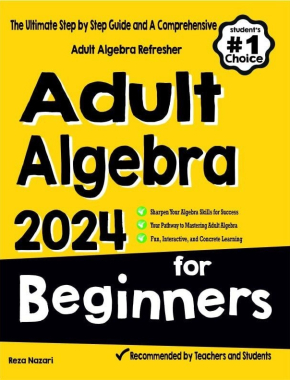
It is also a refresher and a from-scratch course at the same time. If a topic comes back to you quickly, you move through it fast. If a topic never made sense, the book teaches it properly — as if for the first time, because for many readers it is. Every concept gets a plain-language explanation, worked examples, and practice with answers, so you always know whether it has truly landed.
Why relearning algebra as an adult is different
Adult learners are not big teenagers. You learn differently, and a good book respects that:
- You want the “why.” Teenagers will often accept “just do it this way.” Adults want to understand the reasoning — and understanding is what makes the math finally stick.
- You have real constraints. A job, a family, a schedule. You need short, self-contained sections you can study in the time you actually have.
- You may carry some math baggage. Years of “I am bad at math” can become a story you believe. A patient book quietly dismantles that story, one small success at a time.
- You are genuinely motivated. You chose this. That motivation is a real advantage — the right book turns it into progress.
What the book covers
Adult Algebra for Beginners walks through the algebra that matters, in a sensible order:
- A refresher on the essentials — integers, fractions, decimals, percents, and order of operations
- Algebraic expressions — variables, like terms, and the distributive property
- Equations and inequalities — from one-step to multi-step, including word problems
- Linear equations and graphing — slope, intercepts, and the coordinate plane
- Systems of equations
- Exponents and polynomials
- Factoring and quadratic equations
That sequence is deliberate. It opens with a refresher of the number skills algebra depends on — the exact skills adults tend to be rustiest on — so the algebra that follows has a solid floor to stand on.
What to look for in an algebra workbook for adults
Whichever book you choose, these features make the biggest difference for a returning learner.
- A refresher at the start. Fractions, negative numbers and percents come up in almost every algebra problem. A book that reviews them first saves you from getting stuck later.
- Worked examples before practice. You should see a full solution, step by step, before you try one yourself.
- Answers for every problem. Checking right away is how you know an idea has landed. Step-by-step solutions are even better than final answers alone.
- Short sections. Topics you can finish in one 30-minute sitting fit an adult schedule.
- A clear order. Each chapter should build on the last, from expressions to equations to graphing.
It also helps to match the book to your goal.
| Your goal | Where to put extra time |
|---|---|
| Helping a child with homework | Expressions, one- and two-step equations, graphing lines |
| A college placement test | Equations, inequalities, exponents, polynomials and factoring |
| A job or training program | Formulas, percents, rates and word problems |
| Personal confidence | Go in order and do not skip the refresher chapters |
How to study with it
The most important rule for adult learners: consistency beats intensity. You do not need long study marathons. You need small, regular sessions.
- Aim for three or four sessions a week, 30 minutes each. That is enough.
- Study at the same times each week — attach it to an existing habit, like after dinner or before work.
- Always do the practice problems with a pencil. Reading math is not learning math.
- Check answers immediately, while the problem is still fresh.
- When something is hard, slow down rather than skip. You are not on anyone’s schedule but your own.
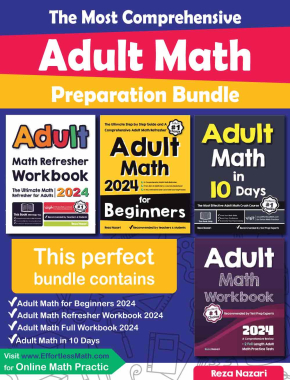
At a calm, steady pace, most adult learners rebuild a genuine working command of algebra in three to four months. If your arithmetic foundation also feels shaky — fractions, decimals, percents — it is worth starting with Adult Math for Beginners first and then moving into algebra. There is no rush, and a solid foundation makes everything afterward easier.

A sample 12-week plan
This plan follows the order of Adult Algebra for Beginners and assumes three or four sessions a week of about 30 minutes each. Move faster through topics you remember and stay longer on the ones that never made sense.
| Weeks | Focus |
|---|---|
| 1 to 2 | Integers, fractions, decimals, percents and order of operations |
| 3 to 4 | Variables, like terms and the distributive property |
| 5 to 6 | One-step to multi-step equations, inequalities and word problems |
| 7 to 8 | Slope, intercepts and graphing lines on the coordinate plane |
| 9 | Systems of equations |
| 10 | Exponents and polynomials |
| 11 to 12 | Factoring and quadratic equations |
At the end of each week, spend one session on review only. Redo five problems you missed earlier, without looking at the solutions. If you can now solve them, move on. If not, give that topic one more week. Falling behind the plan is fine. Skipping a topic that has not landed is what causes trouble later, because each chapter leans on the ones before it.
Who this book is for
- Adults returning to college who need algebra for a program or placement test
- Career changers entering a field that requires math confidence
- Parents who want to help their children — and finally understand it themselves
- Anyone preparing for the GED, ACCUPLACER, ALEKS, or a similar test who needs the algebra underneath it
- Anyone who has carried “I am bad at math” for years and is ready to put it down
Common mistakes adult learners make
- Believing the “too old to learn math” myth. It is simply not true. Adults relearn algebra successfully all the time.
- Skipping the refresher chapters. The early number-skills review is where adults are rustiest. Do not skip it.
- Studying in rare long bursts. Short and frequent wins. A tired three-hour session teaches less than three calm half-hours.
- Giving up after one hard topic. One difficult section is not a verdict on your ability. Slow down, and it will yield.
Find your starting point: a 5-question self-check
Before you open chapter one, try these five problems with pencil and paper. No calculator.
- −7 + 12
- 3/4 − 1/3
- 20% of 45
- Solve 2x + 6 = 18
- Simplify 3(x + 4) − 2x
Answers: 1) 5. 2) 5/12, because 9/12 − 4/12 = 5/12. 3) 9, because 0.20 × 45 = 9. 4) x = 6, because 2x = 12. 5) x + 12, because 3x + 12 − 2x = x + 12.
What your results mean:
- Missed any of questions 1 to 3: start with the number-skills refresher. If several felt hard, Adult Math for Beginners is a gentler first step.
- Got 1 to 3 right but missed 4 or 5: skim the refresher, then begin carefully at expressions and equations.
- All five right: do a quick pass through the early chapters and slow down when you reach linear equations and graphing.
Take the same check again after a month. Seeing your own progress is one of the best ways to stay motivated.
Frequently asked questions
Am I too old to relearn algebra?
No. There is no age at which the brain stops being able to learn algebra. Adults often have advantages teenagers lack: patience, motivation, and a real desire to understand. Age is not the obstacle — the wrong book is.
How long does it take an adult to relearn algebra?
With steady, part-time study, most adults rebuild a solid working command of algebra in three to four months. Pace it to your own life — consistency matters far more than speed.
I was always bad at math. Can I still do this?
Almost certainly yes. “Bad at math” is usually the result of being taught too fast, with gaps left unfilled. A book that rebuilds the basics patiently, with no judgment, is designed for exactly your situation.
Do I need to relearn arithmetic before algebra?
If fractions, decimals, percents, and negative numbers feel shaky, yes — start there. Adult Math for Beginners covers those foundations, and a strong foundation makes algebra dramatically easier.
Can this book help me prepare for a placement test?
Yes. Tests like the GED, ACCUPLACER, and ALEKS lean heavily on algebra. Rebuilding algebra properly is one of the best things you can do to prepare for any of them.
What is the best way to relearn algebra on your own?
Work through one well-organized book in order, starting with a short review of arithmetic. Read each worked example, then do the practice problems with pencil and paper and check your answers right away. Short sessions three or four times a week work better than occasional long ones, and a weekly review session helps the ideas stick.
Are workbooks or videos better for adults learning algebra?
Both help, but a workbook gives you something videos alone cannot: lots of practice with answers to check. Watching someone solve a problem feels like learning, but doing problems yourself is what builds skill. Many adults use a workbook as the main path and look up a short video only when one explanation does not click.
How many practice problems should I do in each session?
Quality matters more than quantity. In a 30-minute session, 10 to 15 problems is a good target for most adults. Start with a few easy ones to warm up, spend most of the time on the new topic, and finish with two or three problems from earlier chapters so older skills stay fresh.
What should I do when I get stuck on an algebra problem?
First, reread the worked example that matches the problem and compare it step by step with your own work. If you are still stuck after a few minutes, check the solution and find the exact step you missed. Mark the problem, and try it again two or three days later without help.
The bottom line
Relearning algebra as an adult is not about recapturing something lost — for many people it is about finally learning, properly and patiently, something they were rushed through years ago. With the right book, it is genuinely within reach.
Adult Algebra for Beginners was written for you: clear, patient, judgment-free, and paced for a real adult life. Start small, study steadily, and be kind to yourself along the way. The algebra that once felt out of reach has been waiting for you to come back — on your terms this time.

Related to This Article
More math articles
- 4th Grade OAA Math Worksheets: FREE & Printable
- What Kind of Math Is Taught in 8th Grade?
- Why Do Most Students Struggle with Math?
- The Best Grade 4 Math Book for California Students
- Geometry Puzzle – Challenge 71
- Free Grade 3 English Worksheets for Maine Students
- Top 10 Tips to Create a TSI Math Study Plan
- ASVAB Arithmetic and Mathematics Preview
- Narrator and Point of View
- Eisenhower’s New Look, Suez and the Space Race


















What people say about "Algebra Workbook for Adults: Relearn Algebra Step by Step"?
No one replied yet.