How to Find Slope From a Graph?
Slope measures vertical change divided by horizontal change between two points. A vertical line has undefined slope because its horizontal change is zero.
Quick method: Choose two clear points on the straight line. Read the units on each axis, find the vertical change (rise) and horizontal change (run), then divide rise by run. For (1, 2) and (4, 8), the slope is 6 ÷ 3 = 2.
Key takeaways:
- Slope = \(\frac{\text{rise}}{\text{run}} = \frac{y_2 - y_1}{x_2 - x_1}\).
- Pick lattice points (whole-number coordinates) to keep the arithmetic clean.
- Positive slope rises left to right; negative slope falls.
- Horizontal lines have slope 0; vertical lines have undefined slope.
- The slope is the same between any two points on the same straight line.
The slope of a line is defined as the change in the \(y\) coordinate relative to the change in the \(x\) coordinate of that line. In the following guide, you will learn about ways of calculating slope from a graph.

The slope of the line is the ratio of the rise to the run, or rise divided by the run. It describes the steepness of a line in the coordinate plane. In general, to find the slope of a line, we must have values of both different coordinates on the line.
Related Topics
A step-by-step guide to finding slope from a graph
The process of finding the slope from a graph uses the slope formula \(\frac{rise}{run}\). When the graph of a line is given and we are asked to find its equation, the first thing that we need to do is to find its slope.
Finding slope from a graph
Start with two distinct points that you can read accurately on the straight line. Grid intersections are helpful, but always check the axis labels before counting.
- Read the scale: Find how many units one interval represents on each axis.
- Choose two points: Label the left point A = (x₁, y₁) and the right point B = (x₂, y₂).
- Find the rise: Subtract y₂ − y₁. Up is positive; down is negative.
- Find the run: Subtract x₂ − x₁. Moving from left to right gives a positive run.
- Divide: Use \(m = \frac{y_2-y_1}{x_2-x_1}\) and simplify. For a vertical line the run is zero, so its slope is undefined.
You can use either point first in the formula, provided you subtract in the same order in the numerator and denominator. The rise and run describe two parts of the same move from A to B.
Positive-Slope Graph Example
The line below passes through A = (1, 2) and B = (4, 8). The horizontal ticks are 1 unit apart, while the vertical ticks are 2 units apart.
Rise: 8 − 2 = 6. Run: 4 − 1 = 3. Therefore \(m = \frac{6}{3} = 2\). The line rises 2 units for every 1 unit to the right.
Check it: what if you start at B instead?
Both changes become negative: rise = 2 − 8 = −6 and run = 1 − 4 = −3. Their ratio is still (−6) ÷ (−3) = 2. Reversing only one subtraction would give the wrong sign.
Check the Axis Scales Before Counting
In this example, the rise covers three grid intervals, but each vertical interval is 2 units, so the rise is 6. The run covers three intervals of 1 unit, so the run is 3. Dividing spaces alone would incorrectly give 1.
If the graph has no labels, use a stated scale or clearly labeled coordinates. Without that information, you may be able to tell whether slope is positive, negative or zero, but you cannot always find its exact value. A curve does not have one constant slope; this lesson’s method is for straight lines.
Exercises for Finding Slope From a Graph
Find the slope of the line from the following graphs using the \(\frac{rise}{run}\) formula.
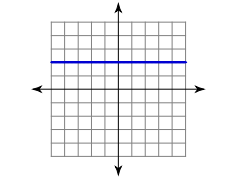
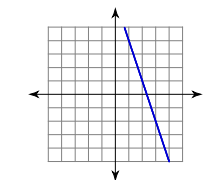

- \(\color{blue}{0}\): The first line is horizontal, so its rise is zero for any nonzero run.
- \(\color{blue}{-3}\): On the second graph, the line falls 3 grid intervals for every 1 interval to the right. With the same unit scale on both axes, the slope is −3.
Recommended EffortlessMath Books
For a longer review, the optional paid Pre-Algebra for Beginners is shown below. Open its product page to check the preview, PDF format and current purchase options before choosing a book. You can continue using this lesson and the free resources without buying it.

Pre-Algebra for Beginners 2026 The Ultimate Step by Step Guide to Preparing for the Pre-Algebra Test
Frequently Asked Questions
What’s the slope of a line?
Slope measures how steep a line is and which direction it leans. Formally, slope is the ratio of vertical change to horizontal change between any two points on the line: \(m = \frac{y_2 – y_1}{x_2 – x_1}\) or rise over run.
How do I find slope from a graph?
Pick two clear points on the line, count the rise (vertical change) and run (horizontal change) between them, then divide rise by run. Use lattice points (whole-number coordinates) when possible to keep counting easy.
What does a positive slope mean?
The line goes up from left to right. As \(x\) increases, \(y\) increases too. Slope of 1 means the line rises 1 unit for every 1 unit right. Slope of 5 means it rises much faster, 5 units up per 1 right.
What does a negative slope mean?
The line goes down from left to right. As \(x\) increases, \(y\) decreases. Slope of \(-2\) means the line drops 2 units for every 1 unit right.
What’s the slope of a horizontal line?
Zero. A horizontal line has no vertical change between any two points, so rise = 0 and slope = \(\frac{0}{\text{run}} = 0\). Horizontal lines look like \(y = 5\) or \(y = -2\).
What’s the slope of a vertical line?
Undefined. A vertical line has no horizontal change, so run = 0. You can’t divide by zero, so the slope is undefined. Vertical lines look like \(x = 3\). They’re not functions because each \(x\) maps to many \(y\) values.
Does it matter which point I call first?
No, as long as you stay consistent. \(m = \frac{y_2 – y_1}{x_2 – x_1} = \frac{y_1 – y_2}{x_1 – x_2}\), the signs flip in both numerator and denominator, so the result is the same. Pick one ordering and stick with it.
What if I can’t find clear lattice points?
Use two clearly labeled points or extend the straight line to readable grid intersections. If the coordinates can only be estimated, your slope is approximate. If no scale or coordinates are given, an exact numerical slope may not be determined.
What’s a common mistake when reading slope from a graph?
Counting rise and run in opposite directions. If you go right for the run, also count up (positive) or down (negative), don’t switch the direction of counting between the two values. Another mistake: confusing rise/run with run/rise. Vertical change goes on top.
Where can I get more slope practice?
Use the free Pre-Algebra worksheet library for related skill review. Once you can read slope, try the point-slope form worksheet with answers to write a line equation from a slope and a point.
Related EffortlessMath Lessons
If a topic on this page feels rusty, these short lessons go deeper:
- How to find the slope of a line
- How to graph linear equations
- How to write linear equations (resource currently unavailable)
- How to graph proportional relationships and find the slope
- Slope-intercept form

Related to This Article
More math articles
- Unlock the Answers: “GED Math for Beginners” Solution Manual
- Values, Beliefs, Norms, and Sanctions
- Free Grade 3 English Worksheets for Arkansas Students
- How to Prepare for FTCE General Knowledge Math Test?
- Rounding Decimals for 5th Grade: Nearest Tenth and Hundredth
- Plant Transport and Responses
- How to Integrate By Parts: Step-by-Step Guide
- Alabama ACAP Grade 5 Math Worksheets — 49 Free Printable Single-Skill PDFs
- Free Grade 4 English Worksheets for Wyoming Students
- Stoichiometry and Limiting Reactants: Calculate Yield











What people say about "How to Find Slope From a Graph"?
No one replied yet.