How to Solve Linear Equations: Step-by-Step with Examples

Linear equations are the foundation of algebra. Every other algebra topic, systems, inequalities, functions, even quadratics, rests on the ability to solve a linear equation cleanly. The good news: the process is mechanical. If you know the steps, you can solve any linear equation in under a minute.
This guide takes you from “\(x + 3 = 7\)” all the way through “\(3(x – 4) = 5x + 2 – x\),” with every worked step.
What a Linear Equation Is
A linear equation is an equation where the variable appears to the first power, no exponents, no roots, no \(x^2\). Examples:
- \(x + 3 = 7\)
- \(3x – 5 = 16\)
- \(2(x + 1) = x – 3\)
- \(\dfrac{x}{4} + 2 = 9\)
The goal is always the same: isolate the variable on one side of the equal sign.
The One Big Rule
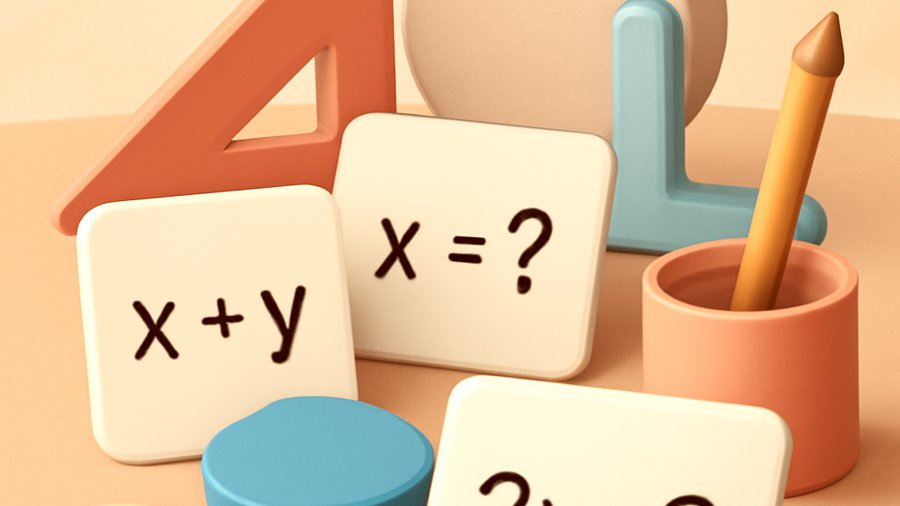
Whatever you do to one side, do to the other. The equal sign is a balance scale. Add 3 to the left, you add 3 to the right.
The operations you can use:
1. Add the same number to both sides.
2. Subtract the same number from both sides.
3. Multiply both sides by the same nonzero number.
4. Divide both sides by the same nonzero number.
That’s it. Every linear equation reduces to those four operations.
One-Step Equations
Pattern: One operation between the variable and a number.
Example 1
\(x + 7 = 12\)
Subtract 7 from both sides:
\(x = 5\).
Example 2
\(x – 3 = 10\)
Add 3 to both sides:
\(x = 13\).
Example 3
\(5x = 30\)
Divide both sides by 5:
\(x = 6\).
Example 4
\(\dfrac{x}{4} = 8\)
Multiply both sides by 4:
\(x = 32\).
Recommended Practice Resources

Two-Step Equations
Pattern: Two operations between the variable and the answer.
The key: undo addition or subtraction first, then undo multiplication or division. (This is the reverse order of operations.)
Example 5
\(3x + 5 = 14\)
Step 1: subtract 5: \(3x = 9\).
Step 2: divide by 3: \(x = 3\).
Example 6
\(\dfrac{x}{2} – 4 = 7\)
Step 1: add 4: \(\dfrac{x}{2} = 11\).
Step 2: multiply by 2: \(x = 22\).
Example 7
\(-2x + 5 = 13\)
Step 1: subtract 5: \(-2x = 8\).
Step 2: divide by $-2$: \(x = -4\).
Always check by plugging back: \(-2(-4) + 5 = 8 + 5 = 13\). ✓
Multi-Step Equations
Pattern: More than two operations, often with parentheses or like terms.
Steps for any multi-step equation
- Distribute any multiplication into parentheses.
- Combine like terms on each side.
- Move variable terms to one side.
- Move constant terms to the other side.
- Divide to isolate the variable.
Example 8
\(2(x + 3) = 10\)
Distribute: \(2x + 6 = 10\).
Subtract 6: \(2x = 4\).
Divide by 2: \(x = 2\).
Example 9
\(3(x – 2) + 4 = 19\)
Distribute: \(3x – 6 + 4 = 19\).
Combine: \(3x – 2 = 19\).
Add 2: \(3x = 21\).
Divide: \(x = 7\).
Example 10
\(5x + 3 = 2x + 18\)
Subtract $2x$: \(3x + 3 = 18\).
Subtract 3: \(3x = 15\).
Divide: \(x = 5\).
Example 11 (with parentheses on both sides)
\(2(x + 3) = 4(x – 1)\)
Distribute: \(2x + 6 = 4x – 4\).
Subtract $2x$: \(6 = 2x – 4\).
Add 4: \(10 = 2x\).
Divide: \(x = 5\).
Equations with Fractions
The trick: multiply both sides by the LCD (least common denominator) to clear fractions first.
Example 12
\(\dfrac{x}{3} + \dfrac{1}{2} = 2\)
LCD is 6. Multiply both sides by 6:
\(2x + 3 = 12\).
Subtract 3: \(2x = 9\).
Divide: \(x = 4.5\).
Example 13
\(\dfrac{x + 2}{4} = \dfrac{x – 1}{3}\)
Cross-multiply: \(3(x + 2) = 4(x – 1)\).
Distribute: \(3x + 6 = 4x – 4\).
Subtract $3x$: \(6 = x – 4\).
Add 4: \(x = 10\).
Special Cases
No solution
\(2x + 3 = 2x + 5\) → subtract $2x$: \(3 = 5\). False statement → no solution.

Infinite solutions
\(3(x + 2) = 3x + 6\) → distribute: \(3x + 6 = 3x + 6\). Always true → all real numbers.
Both cases mean the original equation is not really a linear equation in one variable. It’s an identity (always true) or a contradiction (never true).
Common Mistakes
Forgetting the negative sign
\(-3(x – 4) = -3x + 12\), not $-3x – 12$. Distribute carefully.
Combining unlike terms
$3x + 5$ is not $8x$. You can only combine $3x$ with another \(x\) term.
Dropping the equal sign
Every step should re-write the full equation. Don’t lose track of what equals what.
Forgetting to divide both sides
\(2x = 14\) → \(x = 7\), not \(x = 14\).
Not checking the answer
Plug your answer back in. If both sides are equal, you’re done. If not, find the mistake.
Mishandling decimals
\(0.5x = 3\) → \(x = 6\), not \(x = 1.5\). Divide both sides by 0.5.
How to Practice
- Start with one-step equations. Build automatic fluency.
- Move to two-step. Drill until each takes under 30 seconds.
- Mix in distribution and fractions. Slow down, write every step.
- Always check your answer. Always.
- Do 5 problems a day for 2 weeks. That’s 70 problems total, enough to lock in mastery.
Free Resources
Effortless Math has a complete free linear-equation library:
- Algebra 1 Worksheets, equation problems by difficulty with answer keys.
- Math Topics Library, every linear-equation topic explained.
- Algebra 1 eBooks, full Algebra 1 workbooks.
Frequently Asked Questions
What’s the difference between an equation and an expression?
An equation has an equal sign and can be solved. An expression has no equal sign and can be simplified or evaluated.
Can a linear equation have no solution?
Yes, when the variables cancel and the constants don’t match (like \(2x = 2x + 5\)).
Can a linear equation have more than one solution?
A linear equation in one variable has at most one solution. A linear equation in two variables (like \(y = 2x + 3\)) has infinite solutions, one for each \(x\).
Why do I have to “undo” in reverse order?
Because the original equation built the expression in order of operations. To get back to \(x\), you reverse those steps, addition/subtraction first, then multiplication/division.
Do I have to show every step?
For learning and grading, yes. With practice, you can combine steps mentally.
What’s the best way to learn linear equations?
Daily practice. 10 problems a day for 2 weeks. The mechanics become second nature.
You’ve Got the Method
Linear equations are not memorization. They are a system. Learn the four operations, follow the order, check your answer. Every algebra and pre-calc course rests on this skill. Master it now and the rest of math gets easier.
Keep Practicing With the Right Resources

Related to This Article
More math articles
- 5th Grade DCAS Math Worksheets: FREE & Printable
- How Math Can Help You Win At Poker?
- Wyoming WY-TOPP Grade 7 Math Worksheets: 95 Free Printable PDFs with Step-by-Step Keys
- ISEE Middle Level Math Formulas
- Top 10 Tips to Create an AFOQT Math Study Plan
- Overview of the ISEE Upper-Level Mathematics Test
- Mitosis and Cell-Cycle Data: Chromosome Counts and Examples
- How to Write the Equation of a Sine Graph
- How to Decipher Limits and Function Values
- How to Mastering Rational Expressions: A Comprehensive Guide to Multiplication and Division Techniques









What people say about "How to Solve Linear Equations Step by Step"?
No one replied yet.