How to Use Properties of Integer Exponents? (+FREE Worksheet!)
Exponent rules let you simplify expressions that involve repeated multiplication, quickly and accurately. Whether you are multiplying powers, dividing them, raising a power to another power, or dealing with zero and negative exponents, a small set of rules covers every situation. These properties of integer exponents are among the most-tested topics in 8th-grade math and form the foundation for scientific notation, polynomials, and beyond.
Use Properties of Integer Exponents: what to notice and how to work it
What to notice first
Common student mistake
Key formulas and cues
A reliable path
- Decide directionPositive numbers move right; negative numbers move left.
- Combine distancesAdd distances when the signs match and subtract distances when the signs differ.
- Give the signUse the direction with the larger distance to decide the final sign.
Worked examples
Different signs
- Start at -9.
- Adding 14 moves right 14 spaces.
- You pass zero and land at 5.
Subtract a negative
- Subtracting a negative means add the opposite.
- Rewrite as 6 + 8.
- Add the distances.
Try one before moving on
Use Properties of Integer Exponents: pop-up practice
In this complete guide you will learn every rule, see step-by-step examples, and get practice problems with fully worked solutions.
The Exponent Rules at a Glance
| Rule Name | Algebraic Form | Example |
|---|---|---|
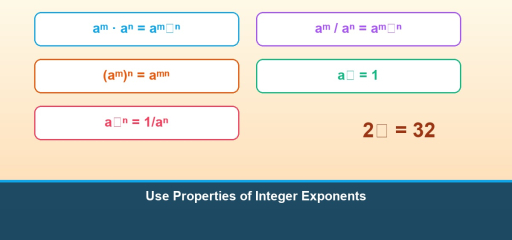
| Product Rule | \(a^{m} \cdot a^{n} = a^{m+n}\) | \(2^{3} \cdot 2^{4} = 2^{7}\) |
| Quotient Rule | \(\dfrac{a^{m}}{a^{n}} = a^{m-n}\) | \(\dfrac{5^{6}}{5^{2}} = 5^{4}\) |
| Power of a Power | \((a^{m})^{n} = a^{mn}\) | \((3^{2})^{4} = 3^{8}\) |
| Power of a Product | \((ab)^{n} = a^{n}b^{n}\) | \((2x)^{3} = 8x^{3}\) |
| Power of a Quotient | \(\left(\dfrac{a}{b}\right)^{n} = \dfrac{a^{n}}{b^{n}}\) | \(\left(\dfrac{3}{4}\right)^{2} = \dfrac{9}{16}\) |
| Zero Exponent | \(a^{0} = 1 \; (a \neq 0)\) | \(7^{0} = 1\) |
| Negative Exponent | \(a^{-n} = \dfrac{1}{a^{n}}\) | \(2^{-3} = \dfrac{1}{8}\) |
Understanding Each Rule

Pre-Algebra for Beginners 2026 The Ultimate Step by Step Guide to Preparing for the Pre-Algebra Test
Product Rule: \(a^{m} \cdot a^{n} = a^{m+n}\)
When you multiply two powers with the same base, keep the base and add the exponents.
Why it works: \(a^{3} \cdot a^{2} = (a \cdot a \cdot a)(a \cdot a) = a^{5}\). You have \(3 + 2 = 5\) factors of \(a\).
Quotient Rule: \(\dfrac{a^{m}}{a^{n}} = a^{m-n}\)
When you divide two powers with the same base, subtract the exponents.
Why it works: \(\dfrac{a^{5}}{a^{2}} = \dfrac{a \cdot a \cdot a \cdot a \cdot a}{a \cdot a} = a^{3}\). Cancel 2 factors, leaving \(5 – 2 = 3\).
Power of a Power: \((a^{m})^{n} = a^{mn}\)
When raising a power to another power, multiply the exponents.
Why it works: \((a^{2})^{3} = a^{2} \cdot a^{2} \cdot a^{2} = a^{6}\). Three groups of 2 = \(2 \times 3 = 6\).
Zero Exponent: \(a^{0} = 1\)
Any nonzero number raised to the power of 0 equals 1. This follows from the quotient rule: \(\frac{a^{n}}{a^{n}} = a^{n-n} = a^{0} = 1\).
Negative Exponent: \(a^{-n} = \dfrac{1}{a^{n}}\)
A negative exponent means “take the reciprocal.” Moving a factor from numerator to denominator (or vice versa) changes the sign of its exponent.
Worked Examples
Example 1, Product Rule
Simplify \(x^{4} \cdot x^{7}\).
\(x^{4+7} = x^{11}\)
Example 2, Quotient Rule
Simplify \(\dfrac{3^{8}}{3^{5}}\).
\(3^{8-5} = 3^{3} = 27\)
Example 3, Power of a Power
Simplify \((2^{3})^{4}\).
\(2^{3 \times 4} = 2^{12} = 4096\)
Example 4, Negative Exponent
Write \(5^{-2}\) as a fraction.
\(5^{-2} = \dfrac{1}{5^{2}} = \dfrac{1}{25}\)
Example 5, Mixed Rules
Simplify \(\dfrac{(x^{3})^{2} \cdot x^{4}}{x^{5}}\).
Numerator: \(x^{6} \cdot x^{4} = x^{10}\).
\(\dfrac{x^{10}}{x^{5}} = x^{5}\)

Video Lesson
Watch this video for additional examples and a step-by-step walkthrough:
Practice Problems
- Simplify: \(4^{3} \cdot 4^{2}\)
- Simplify: \(\dfrac{7^{9}}{7^{6}}\)
- Simplify: \((5^{2})^{3}\)
- Evaluate: \((-3)^{0}\)
- Write with a positive exponent: \(x^{-4}\)
- Simplify: \((2x^{3})^{4}\)
- Simplify: \(\dfrac{a^{8} \cdot a^{3}}{a^{6}}\)
- Simplify: \(\left(\dfrac{3}{y}\right)^{2}\)
- Evaluate: \(2^{-3} \cdot 2^{5}\)
- Simplify: \(\dfrac{(m^{4})^{2}}{m^{5} \cdot m^{2}}\)
- Write without negative exponents: \(\dfrac{x^{-2}}{y^{-3}}\)
- Simplify: \((3a^{2}b^{-1})^{3}\)
Solutions
- \(4^{5} = 1024\)
- \(7^{3} = 343\)
- \(5^{6} = 15{,}625\)
- \(1\)
- \(\dfrac{1}{x^{4}}\)
- \(2^{4} \cdot x^{12} = 16x^{12}\)
- \(a^{8+3-6} = a^{5}\)
- \(\dfrac{9}{y^{2}}\)
- \(2^{-3+5} = 2^{2} = 4\)
- \(\dfrac{m^{8}}{m^{7}} = m\)
- \(\dfrac{y^{3}}{x^{2}}\)
- \(3^{3} a^{6} b^{-3} = \dfrac{27a^{6}}{b^{3}}\)
Real-World Connections
- Scientific notation: Exponent rules are essential for multiplying and dividing numbers in scientific notation, e.g., \((3 \times 10^{4})(2 \times 10^{5}) = 6 \times 10^{9}\).
- Computer science: Memory sizes are powers of 2. Knowing that \(2^{10} = 1024 \approx 1000\) helps you quickly estimate storage.
- Finance: Compound interest uses exponents: \(A = P(1 + r)^{t}\).
Common Mistakes to Avoid
- Adding exponents when you should multiply (or vice versa). Product rule → add; power of a power → multiply. Don’t mix them up.
- Applying the product rule to different bases. \(2^{3} \cdot 3^{3}\) is not \(6^{3}\) by the product rule. (It equals \((2 \cdot 3)^{3} = 6^{3}\) by the power of a product rule, which is a different rule.)
- Thinking \(a^{0} = 0\). It equals 1, not 0.
- Forgetting to apply the exponent to the coefficient. In \((2x)^{3}\), both 2 and \(x\) are cubed: \(8x^{3}\), not \(2x^{3}\).
Frequently Asked Questions
Why is anything to the zero power equal to 1?
By the quotient rule: \(\frac{a^{n}}{a^{n}} = a^{0}\). But any number divided by itself is 1, so \(a^{0} = 1\).
What is \(0^{0}\)?
In most 8th-grade contexts, \(0^{0}\) is considered undefined (though in combinatorics it is often defined as 1 by convention).

Related to This Article
More math articles
- Natural Resources
- ISEE Middle-Level Math Practice Test Questions
- Best Tips for Math Success
- 7th Grade OAA Math Worksheets: FREE & Printable
- Controls redistribute and destroy surplus
- Leadership, Exchange, Cooperation, and Groupthink
- What is the Best Scientific Calculator for College Students?
- The Ultimate 7th Grade RISE Math Course (+FREE Worksheets)
- 7th Grade Math Worksheets for Massachusetts (MCAS): 95 Free Printable PDFs
- How to Find Modulus (Absolute Value) and Argument (Angle) of Complex Numbers?
What people say about "Properties of Integer Exponents: Worksheet"?
No one replied yet.