Free Grade 7 English Worksheets for Mississippi Students
The Friday vocabulary quiz at a middle school in Tupelo arrives every week the same way. Twenty words go home on Monday. Tuesday, a sentence-writing drill. Wednesday, a roots-and-affixes warm-up. Thursday, a partner quiz in homeroom. Friday, twenty items on a half-sheet of paper, pencil only, no phones, no notes. The seventh grader at the back of the second row has done the routine for fourteen weeks. She has stopped dreading Fridays the way she did in September. She has started looking forward to Friday, because the words from the week are starting to feel like words she knows the way she knows her own grandmother’s stories.
What the Friday vocabulary quiz teaches a Mississippi seventh grader is not just the twenty words. It teaches the muscle the MAAP ELA Grade 7 test asks for again and again, naming a word’s denotation, sensing its connotation, recognizing it as the same root she saw in a different word last week, and using it on purpose in her own sentence. Twenty words a week, twenty Fridays a year, four hundred words by spring. The MAAP item writers know that arithmetic. So do the teachers in the state who designed the routine.
MAAP ELA at Grade 7 also asks for one larger thing, a multi-source prose constructed-response. The student reads two (sometimes three) passages on a related topic and produces a written response that draws evidence from more than one source. That is a Grade 7-specific lift, and it rehearses the W.7.7 and W.7.8 research-strand skills inside a single timed task.
This page gathers forty-three free printable Grade 7 ELA worksheets, every one mapped to a Grade 7 standard in the Mississippi College- and Career-Readiness Standards for ELA, every one printable at home, no signup.
What’s on this page
Each PDF opens with a Quick Review written for a seventh grader to read alone. Practice items follow, shaped like the kinds of selected-response and constructed-response items MAAP delivers. The answer key at the end explains, in the second person, why the right answer is right and how each distractor was designed.
Pull whichever PDF lines up with what your child’s ELA teacher emphasized this week. Save the rest for the long evenings between practices.
Reading: Literature
- Citing Several Pieces of Textual Evidence, [RL.7.1] gather two or three quotes that converge on one inference
- Theme and Its Development Over the Text, [RL.7.2] say the theme as a complete sentence and trace how it grows
- How Setting, Character, and Plot Interact, [RL.7.3] how setting bends a character and how character drives plot
- Word Choice, Figurative Language, and Tone, [RL.7.4] denotation, connotation, and the mood one word can set
- How Form Shapes Meaning in Drama and Poetry, [RL.7.5] sonnet, soliloquy, stanza, line break, stage direction as meaning
- Developing and Contrasting Points of View, [RL.7.6] analyze two perspectives put deliberately in tension
- Comparing a Story to Its Audio, Film, or Stage Version, [RL.7.7] what each medium can do that the others cannot
- Comparing Fictional and Historical Portrayals, [RL.7.9] sort real history from the novelist’s invention
Reading: Informational Text
- Citing Several Pieces of Evidence in Nonfiction, [RI.7.1] pull two or three article details that point to one conclusion
- Two or More Central Ideas and Their Development, [RI.7.2] track an article teaching more than one thing at once
- How Individuals, Events, and Ideas Interact, [RI.7.3] how a person shapes an idea and how an idea reshapes a person
- Word Meaning in Nonfiction: Figurative, Connotative, Technical, [RI.7.4] three different jobs one nonfiction word can do
- How Text Structure Develops the Author’s Ideas, [RI.7.5] problem-solution, compare-contrast, chronological, and why the choice matters
- Author’s Point of View and How They Distinguish It, [RI.7.6] find the position and the moves that mark it as the author’s
- Comparing a Text to Its Audio or Video Version, [RI.7.7] what the print emphasizes vs. What the broadcast emphasizes
- Evaluating an Argument: Reasoning and Evidence, [RI.7.8] sort strong evidence from filler and weigh the logic in between
- How Two Authors Shape Their Presentation of the Same Topic, [RI.7.9] same subject, different facts emphasized, different angles taken
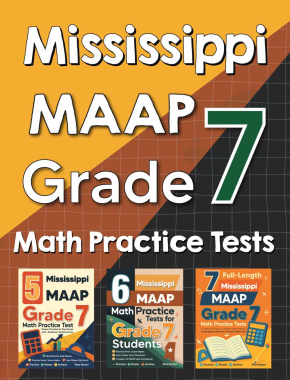
Working on Math Too? Try the Mississippi MAAP Grade 7 Math Bundle
Many third graders are getting ready for the MAAP in both subjects. If your child also needs math practice that matches the same standards, this companion bundle is the shortest path, workbook, study guide, and full practice tests in one download.
Writing
- Argument Writing: Claims, Reasons, Evidence, and Counterclaims, [W.7.1] Grade 7 makes the counterclaim non-negotiable
- Informative and Explanatory Writing, [W.7.2] teach a reader with a thesis, ordered sections, and clean transitions
- Narrative Writing, [W.7.3] pacing, dialogue, sensory description, and an ending that lands
- Coherent Writing for Task, Purpose, and Audience, [W.7.4] same idea written three ways for three readers
- Planning, Revising, and Editing, [W.7.5] sometimes the right revision is starting a paragraph over
- Short Research Projects: Question and Refocus, [W.7.7] let early findings rewrite the question
- Gathering, Evaluating, and Citing Sources, [W.7.8] author, date, publisher, and the basic citation a Mississippi teacher actually expects
Speaking & Listening
- Collaborative Discussions, [SL.7.1] come prepared, listen first, and disagree without dismissing
- Analyzing Information in Diverse Media, [SL.7.2] read a chart, a clip, and a photograph as one combined argument
- Evaluating a Speaker’s Argument, [SL.7.3] find the claim, the reasons, the evidence, and the gaps
- Presenting Claims with Focus and Coherence, [SL.7.4] open with the point, preview the order, hold to it
- Adapting Speech to Context, [SL.7.6] friend-talk and presentation-talk are different registers
Grammar
- Phrases and Clauses: Placement and Function, [L.7.1a] what each piece of a sentence is doing and where it belongs
- Sentence Structures: Simple, Compound, Complex, Compound-Complex, [L.7.1b] count clauses, then name the structure (compound-complex is new this year)
- Avoiding Dangling and Misplaced Modifiers, [L.7.1c] the small error that quietly makes a paragraph absurd
Conventions: Punctuation, Spelling
- Commas with Coordinate Adjectives, [L.7.2a] when two adjectives need a comma and when they do not
- Spelling Grade-Appropriate Words, [L.7.2b] homophones, doubled letters, and the words seventh graders miss most
Knowledge of Language and Style
- Precise and Concise Language, [L.7.3a] cut wordiness, replace vague verbs, pick the exact noun
Vocabulary and Word Study
- Using Context Clues, [L.7.4a] name the kind of clue and use it on purpose
- Greek and Latin Roots and Affixes, [L.7.4b] one root unlocks ten unrelated words
- Using Reference Materials Effectively, [L.7.4c] dictionary, thesaurus, glossary, match the tool to the question
- Verifying Word Meaning, [L.7.4d] confirm the guess before committing to it
- Allusions and Figures of Speech, [L.7.5a] myth, Bible, and literary references the Grade 7 reader is now expected to catch
- Word Relationships: Synonyms, Antonyms, Analogies, [L.7.5b] name the relationship before picking the answer
- Connotation and Denotation, [L.7.5c] same fact, different feeling, different word
- Academic and Domain-Specific Vocabulary, [L.7.6] words that travel across subjects and words tied to one field
How to use these worksheets at home
Mississippi family evenings have their own rhythm. A family in Jackson might be running between a parent’s shift at UMMC and a younger sibling’s church choir practice. A family in Hattiesburg might be timing dinner around a Wednesday-night service. A family on the Gulf Coast in Pascagoula might be planning around a parent’s drive across the bridge from work. The homework hour rarely arrives on the same clock twice.
Pull one PDF per sitting. Twelve focused minutes is the right unit. When your seventh grader misses an item, ask them to read the answer-key explanation aloud, saying the reasoning out loud lodges the move faster than rereading. Then stop. Wednesday is another day.
For the multi-source prose constructed-response, build a Sunday-afternoon habit once a month. Print two short articles on the same topic, a local news piece and a feature from the same paper, for example, and ask your seventh grader to write a two-paragraph response that draws one piece of evidence from each source and weaves them into a single claim. The exercise sounds small. It is the entire MAAP multi-source task in miniature, and a Mississippi seventh grader who does it once a month from October through April will arrive at the spring test with the multi-source move already inside their hands.
A note about MAAP ELA at Grade 7
The Mississippi Academic Assessment Program (MAAP) ELA is administered each spring at Grade 7, typically in a window that runs from late April into May depending on the district calendar. MAAP ELA is built around the Mississippi College- and Career-Readiness Standards for ELA, which the Mississippi Department of Education has adapted and refined for Mississippi students.
The multi-source prose constructed-response is the writing centerpiece of MAAP at Grade 7. Students read two or three related passages, sometimes a story paired with an informational article, sometimes two informational pieces in conversation, and produce a multi-paragraph written response that develops a claim with evidence drawn from more than one source. The response is scored on idea development, organization, evidence integration, language, and conventions. The argument-writing, informative-writing, planning-and-revising, gathering-and-citing-sources, and precise-and-concise-language worksheets on this page are direct rehearsals. The Grade 7 counterclaim move (W.7.1), the modifier work (L.7.1c), and the precise-language move (L.7.3a) all show up in those scores.
Selected-response items sample across Reading: Literature and Reading: Informational Text. Items lean on Citing Several Pieces of Textual Evidence (RL.7.1 / RI.7.1), Theme and Central Ideas (RL.7.2 / RI.7.2), Word Choice and Word Meaning (RL.7.4 / RI.7.4), Author’s Point of View and Argument (RI.7.6 / RI.7.8), and How Two Authors Shape the Same Topic (RI.7.9, directly relevant to the multi-source task). The vocabulary worksheets, context clues, roots and affixes, allusions, connotation, and academic vocabulary, show up across both strands because nearly every MAAP item ultimately turns on the reader’s command of a specific word.
Want everything in one bundle?
Some Mississippi families prefer to work from one book instead of a long page of standalone PDFs. The Grade 7 ELA Preparation Bundle organizes the rehearsal in one place, multi-source passage sets, prose constructed-response prompts with scoring guides, full-length tests built like MAAP, and answer keys with complete explanations.
Mississippi Grade 7 ELA Preparation Bundle, four practice-test books, 26 unique full-length tests, complete answer keys with explanations.
A short closing
The Friday vocabulary quiz at the middle school in Tupelo, or in Greenwood, or in Vicksburg, or in Ocean Springs, works because it never tries to teach forty words on one Thursday night. Bookmark this page, print one PDF tonight, and let your seventh grader work in the same Mississippi rhythm, small, weekly, steady, four hundred words deep by the time the spring test arrives.
Best Bundle to Ace the Mississippi MAAP Grade 7 ELA
Looking for the best resource to help your kid ace the Mississippi MAAP? Try this bundle, four full practice-test books (5 + 6 + 7 + 8 tests) covering the same Grade 7 reading, writing, and language skills your child is already learning. Instant PDF download, answer keys included.


Related to This Article
More math articles
- 5th Grade Math Worksheets for New Jersey (NJSLA): 49 Free Printable PDFs
- Family
- Algebra Puzzle – Challenge 36
- How to Help Your 5th Grade Student Prepare for the Michigan M-STEP Math Test
- Roosevelt’s Square Deal, Consumer Protection, and Conservation
- Free Grade 5 Math Worksheets for Arkansas Fifth Graders: 49 ATLAS-Aligned PDFs with Solutions
- Labeling, Stigma, and Secondary Deviance
- South Carolina EOC Algebra 1 Free Worksheets: 64 Free Printable EOC-Ready Algebra 1 Worksheets with Keys
- Word Replacement and Tone
- Sentence Variety: Fixing Choppy and Overloaded Writing










What people say about "Free Grade 7 English Worksheets for Mississippi"?
No one replied yet.